Your Weakness Is Your Greatness: Tzidkat HaTzaddik 70–71
My father and I learned Paragraphs 70–71. of Tzidkat HaTzaddik (“The Righteousness of the Righteous”): Rav Tzadok’s book of short numbered teachings on spiritual life.. The first begins with a claim that sounds familiar if you have been learning Rabbi Tzadok HaKohen of Lublin (1823–1900), Hasidic thinker and author of Tzidkat HaTzadik. for a while, though familiarity does not make it easy to understand:
באותו דבר שבו החסרון של אדם באותו דבר ועל ידיה עצמו הוא מעלתו.
In the very thing in which a person is deficient, through that very thing, lies his greatness.1
Whatever your weakness is, it is secretly your greatness. That is a fairly strong statement. He does not just say that something good might eventually come out of it.
The fig repairs what the fig damaged
He begins with Adam and Eve, the first woman (Genesis 2–3). sewing fig leaves together after eating from the Tree of Knowledge. According to the opinion that the tree was a fig tree, the repair comes from the same thing through which they went wrong:
בדבר שקלקלו בו נתקנו.
Through the thing with which they caused the damage, they were repaired.
My father compared this to Making a utensil fit for kosher use by purging what it absorbed, usually with heat.: the way something absorbed what made it forbidden determines how you remove it. “As it absorbs, so it expels”: a utensil is kashered by the same method through which it absorbed the forbidden food.. If heat got it in, heat gets it out. The comparison is not exact, but I thought it was a good one. Here too, the means of repair has a particular relationship to the damage.
Rav Tzadok then brings the teaching that The Messiah: the anointed king from the house of David who will bring the redemption. was born on the day the Temple was destroyed. The destruction and the beginning of redemption occur together.
He also brings the The rabbis’ extended discussion of the Mishnah; together the two make up the Talmud.’s question, מנין לתחיית המתים מן התורה: where in the Torah do we find that the dead come back to life? In a brief aside, he explains what it means for something to have a root in Torah. It means attachment to the source of life, which is the truth of Literally “the Name”: a reverent way of referring to God.’s will.
I tried to unpack that: even what we experience as death and destruction has its root in the source of life. We do not believe in two independent powers running the world, one producing the good things and another producing the bad ones. That is how I understood the connection to his opening claim. The weakness has not somehow escaped from God.
The downfall was bovine
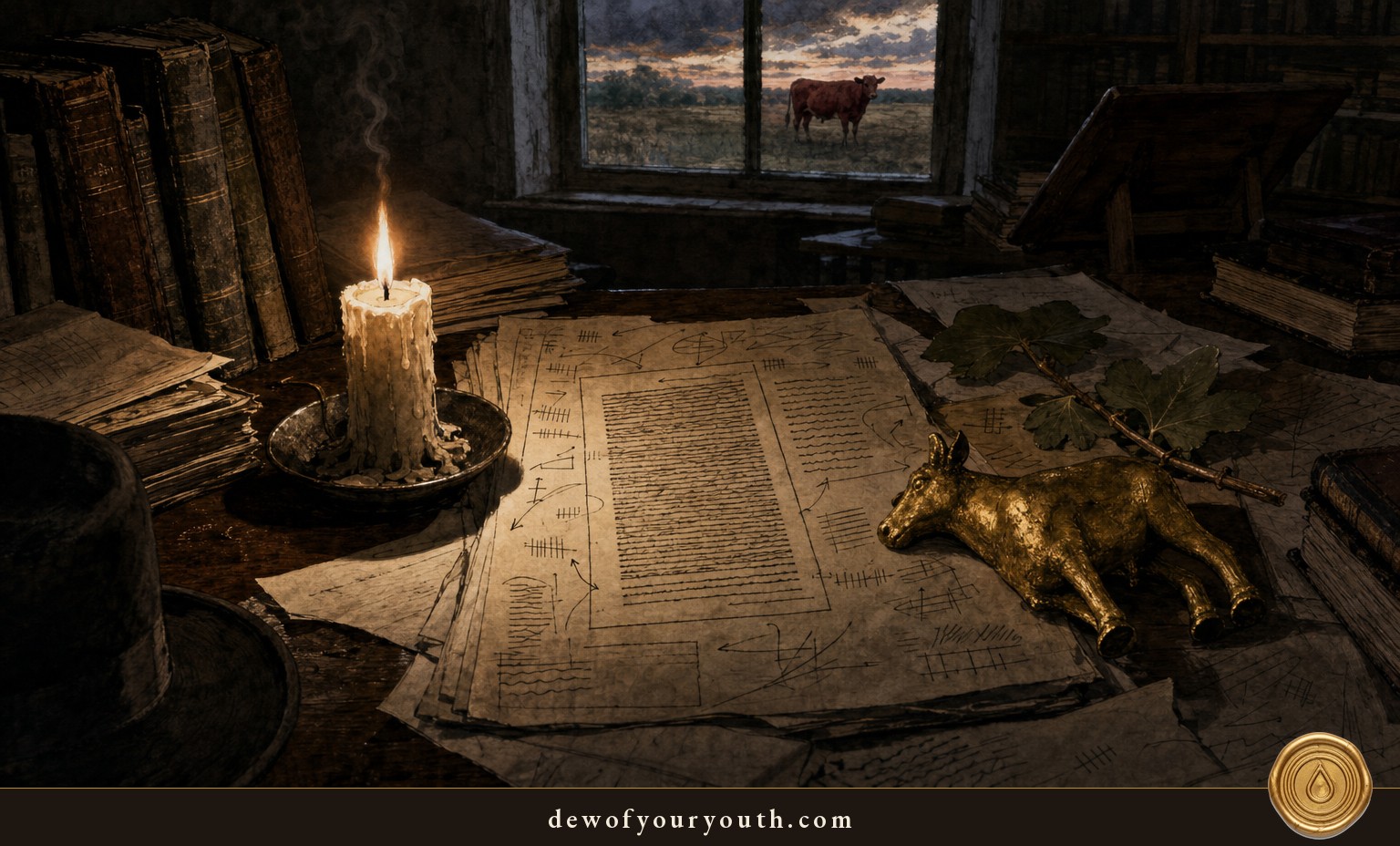
The parah adumah, the red cow, purifies someone from the impurity of death. Rav Tzadok brings the Rabbinic interpretation of Scripture through exposition, narrative and parable; also the books that collect it.’s explanation of its relationship to the Golden Calf:
תבא אם ותקנח צואת בנה.
Let the mother come and clean up her child’s filth.
The calf brought the damage; the cow comes to clean it up. The downfall was bovine, and the fix is also bovine.
He also mentions Jeroboam, first king of the northern kingdom of Israel, who set up golden calves at Bethel and Dan (1 Kings 12). in passing. He made calves too, after the kingdom split. Having established a rival kingdom, he did not want his people’s religious life continually drawing them back to the Temple in Jerusalem and the house of David. So he established his own places of worship, complete with calves, just in case anyone had doubts about how badly this could go.
Rav Tzadok connects Yeravam with the root of Messiah son of Joseph: in rabbinic tradition, a messianic figure from the tribe of Joseph who is killed before the final redemption., who is destined to be killed, and contrasts this with the life requested and received by Messiah son of David: the messianic king of the final redemption.. It is a lot to fit into an aside. The calves, death, and the eventual redemption are being drawn into the same account.
Then he returns to the mother, identifying her with בינה שבלב, understanding in the heart. The understanding is that everything comes from Hashem:
שהכל מן הש״י ממנו יצא הכל.
Everything is from Hashem; everything came from Him.
Recognizing that is itself part of the cleaning up. Even the terrible things are within His will. God has not let history run away with Him, though it sometimes feels that way.
Then how can anything be evil?
My father raised the difficulty: if everything comes from Hashem, how do you judge anything as evil?
I made the distinction we have encountered with Rav Tzadok before. Before you act, you have a choice. Do good. Do not do evil. The fact that everything is included in God’s will does not give you instructions to do whatever occurs to you.
Afterward, you are looking at something that has happened. You cannot turn back the hands of time. Even where you failed and did something wrong, you have to come to terms with the fact that this too happened within God’s world. I understood Rav Tzadok’s account of redemption through weakness in that light.2
My father asked whether that was what he meant by deficiencies. I thought it included that, but also more persistent deficiencies. It does not have to mean one particular sin you once did. It can mean the sort of person you find yourself being.
Take someone with a temper. He can spend his life telling himself what a nothing he is because he gets angry. There may be a place for rebuke. But Rav Tzadok asks him to recognize that Hashem made him with this struggle. Perhaps he has to overcome it. Perhaps he will spend his whole life struggling with it. Either way, he serves Hashem as this person.
I pushed the example to an extreme: someone who feels a sexual attraction to children and does not act on it. I chose him because it is hard to think of anyone we find more repugnant. Even criminals consider him beneath them, and rightly so. We do not think someone deserves a gold star for refraining from abusing a child. But if he faces a terrible desire and resists it, that resistance is his Divine service: prayer and religious practice understood as serving God.. The struggle is real even when the thing he must refrain from doing is something the rest of us find horrifying.
There was also an obvious limit to how warmly we were going to receive the hypothetical announcement, “My great quality is that I want to do this terrible thing every day and don’t.” One can appreciate the restraint without following it with, “Come over for The Sabbath, from Friday sunset to Saturday nightfall..” If he fails to resist, we can be happy that he is rotting in prison and still recognize that he is still serving Hashem in the way only he can.
That example was ours. Rav Tzadok’s paragraph gives the figs, Mashiach, and the red cow. We were trying to work out how far his opening statement reaches.
Pray for the sins to end
Paragraph 71 begins:
אין לבקש לראות רעת אדם ואפי׳ רשע.
One should not seek to see a person’s misfortune, even a wicked person’s.3
He brings A learned woman of the second century, wife of Rabbi Meir, quoted in the Talmud on matters of law and Scripture.’s correction of A leading sage of the Mishnah in the second century, student of Rabbi Akiva.. People were causing Rabbi Meir considerable trouble, and he prayed that they should die. Bruriah pointed him to יתמו חטאים מן הארץ: let sins disappear from the earth. Pray for them to repent. Then the wicked will be gone because they will no longer be wicked.4
“Hate the sin, not the sinner.” Apparently we agree on that one.
Mentioning Bruriah sent us into the much darker מעשה דברוריא mentioned in A tractate of the Talmud on idolatry and dealings with idolaters. 18b, and the story supplied by the printed Rabbi Shlomo Yitzchaki (1040–1105) of Troyes, whose line-by-line commentary on Tanach and Talmud is the standard starting point. there. My father did not know it. I also remembered an occasion when I had brought it up to someone explaining why he had named his daughter Bruriah. This was not one of my better conversational decisions.
What interested me here was the textual question. The Gemara refers to a story without telling it; the commentary supplies a detailed account. I recalled the Rabbi Tzvi Hirsch Chajes (1805–1855), Galician rabbi and scholar, author of glosses on the Talmud. discussing this as evidence that earlier commentators had access to material we no longer have.
Rav Tzadok then distinguishes between someone who is רע לשמים, doing wrong against Heaven, and someone who is רע לבריות, harming people. In the latter case, he permits praying for the person’s misfortune as measure for measure.
I stopped at that distinction. In the Gemara’s story, the people were bothering Rabbi Meir. So I was not entirely sure how neatly the example fit the category. We went on without resolving that.
Elisha and the bears
Rav Tzadok brings The prophet Elisha, Eliyahu’s disciple and successor (1 Kings 19–2 Kings 13).. After Elisha healed the water, the youths mocked him, he cursed them, and bears attacked them. It is one of the stranger stories in The Hebrew Bible: an acronym of Torah, Nevi’im (Prophets) and Ketuvim (Writings)..
The explanation he brings from The Sages of the Mishnah and Talmud; an acronym for “our Sages, of blessed memory.” connects their mockery to the good Elisha had done for the public. They resented his healing the water. They preferred the situation in which other people were suffering. On that account, this was more than a prophet becoming annoyed because somebody called him bald.
He also brings David’s curses against his enemies in Psalm 109. We discussed David as king: opposition to him could involve harm to the people he was responsible for, rather than merely a private grievance.
But Rav Tzadok immediately adds that Elisha was punished for what he did. The permission does not make that fact disappear. We did not explain away the tension.5
And there is a further restriction. Elisha had The holy spirit: divine inspiration short of full prophecy.. Someone without it may be blinded by his own personal interest. Am I acting for the right reasons, or am I self-conscious about my male pattern baldness?
You can tell yourself a very convincing story about why your anger serves the public good.
For David, Rav Tzadok brings ולבי חלל בקרבי, which Chazal understand as his having killed the The evil inclination: the drive in each person toward sin; its counterpart is the yetzer tov, the good inclination.. That is his basis for saying David did not have to suspect that his own desires were distorting the judgment. Once you have killed your yetzer hara, you do not have to worry about it. That does narrow the field somewhat.
Elisha had ruach hakodesh, and David had killed his yetzer hara. The rest of us have reason to suspect our motives. Somebody insults you in Yiddish for synagogue., and suddenly you discover he is a A pursuer: someone actively threatening another’s life, whom halacha permits stopping by force.. He cuts you off in traffic, and suddenly he is a public menace. Are you recognizing a danger to other people, or finding religious language for the fact that he annoyed you?
Then there is the preceding psalm, with “Gilead is mine, and Menashe is mine” (Psalms 108:9).. Rav Tzadok brings the reading that finds a share in The World to Come. even for the figures alluded to there. Before the curses, there is already an acknowledgment of their good. He connects this to Hashem preparing the remedy before the blow.
You have to begin with goodwill toward them too. Only afterward, if the curse is still warranted, can it be a matter of justice.
The bull still has to be stopped
This seemed to me to continue the previous paragraph. If the sinner were simply an independent lump of evil, getting rid of him would be straightforward. But that is not how Rav Tzadok sees him. There is good there, and we pray for his return.
That does not mean letting him harm people. We used a bull in a china shop: whatever account you give of why the bull exists and why it wants to smash things, you still stop it from smashing the china. The metaphor only goes so far. We are talking about people.
My father still found the cosmic equation difficult to apply. In ordinary life, we have to make rough judgments: this seems good; that seems bad. We cannot conduct every decision from the perspective of everything ultimately being included in God’s will.
I returned to what I thought much of this teaching does for a person looking backward. You see your failures and cannot bear yourself. But beating yourself up today will not prevent you from doing something yesterday.
We recalled the familiar prayer about accepting what you cannot change, changing what you can, and knowing the difference. The past is something you cannot change. Serving Hashem has to begin with the person who is here now.
Your Torah and somebody else’s Ketzot
I connected this with things we had learned earlier in the A book of Torah literature; literally “book.”: each person has his own Torah to learn. Someone else can draw fine distinctions in the Ketzot HaChoshen, Rabbi Aryeh Leib Heller’s commentary on the civil-law section of the Shulchan Aruch, famous for its intricate analysis.; you may have to break your teeth over The Five Books of Moses in printed form, usually with commentaries. and Rashi. Your learning still belongs in the world. The other person’s accomplishment does not make yours dispensable.
That can be especially easy to see when someone comes to learning without the background that made it natural for somebody else. But I meant more than that. Even if you simply find learning hard, your understanding is something you have to contribute. You cannot replace yourself with the fellow who finds Ketzot easy.
My father brought up the teaching that the greater the person, the greater his yetzer hara. We recalled A leading Babylonian sage of the fourth century, head of the academy at Pumbedita. following a man and woman who traveled together without doing anything wrong. Abaye was distressed because he thought he would not have restrained himself in the same situation. The elder’s response was כל הגדול מחבירו יצרו גדול הימנו.6
The struggle is itself a mark of his greatness. Abaye thought his stronger yetzer hara exposed an inferiority; the elder told him it came from his greater stature. That is much closer to Rav Tzadok’s opening claim: the weakness itself is his greatness.
The Chafetz Chaim watches a romantic comedy
But I thought there was another aspect to weakness being greatness. It is not only that I have a deficiency and therefore a job to overcome it. There is also the fact that I am this particular person.
I can watch a romantic comedy and relate to the characters. I might think their behavior is wrong and still understand what they feel, appreciate the predicament, and find some of it funny.
I do not imagine the Rabbi Yisrael Meir Kagan (1838–1933), author of the Chafetz Chaim on the laws of lashon hara and the Mishnah Berurah. watching When Harry Met Sally and laughing along. In the imaginary screening, I picture him being considerably more concerned about what these people are doing.
I am not the Chafetz Chaim. We all know that. It would be ridiculous to get defensive about the discovery.
But suppose someone offered to change me overnight so that I had none of those sensibilities and was just like him. Would I take it? Probably not. Would I want to give him my sensibilities instead? No. He is the Chafetz Chaim.
That leaves me with a difficulty. I can recognize a weakness in myself without wishing to have every part of the person I am removed. If someone offered to remove cancer, I would say yes. Here I hesitate.
One possible explanation is that I am so attached to my deficiencies that I cannot imagine wanting to lose them. I did not dismiss that possibility. But I was also trying to say that there is greatness in being this person, with these sensibilities, who nevertheless serves Hashem in the way he can.
I started to describe that as being more interesting or colorful, then stopped myself. I did not want to make the deficiency into something good. But I was also trying to understand Rav Tzadok saying that, in some sense, it is good.
It is a paradox. That is where we left it.
Tzidkat HaTzaddik, אות ע׳. Rav Tzadok cites Sanhedrin 70b on the fig leaves, Yerushalmi Berakhot 2:4 on Mashiach’s birth, Sanhedrin 91b on resurrection, and Bamidbar Rabbah, Chukat, on the red cow. The kashering comparison belongs to our discussion. ↩︎
Compare Tzidkat HaTzaddik, אות מ׳, discussed in our earlier session on 66–67. The before-and-after explanation here is how I developed the present paragraph in conversation; it is not an additional quotation from אות ע׳. ↩︎
Tzidkat HaTzaddik, אות ע״א. Its conclusion explicitly requires טובת עין even toward the people being cursed. ↩︎
Berakhot 10a; Psalms 104:35. The distinction between חטאים and חוטאים is Bruriah’s reading in the Gemara. ↩︎
II Kings 2:19–24; Sotah 46b–47a. The Gemara lists illness for inciting the bears and illness for rejecting Gechazi as separate matters. The David discussion is in Tzidkat HaTzaddik 71, citing Psalms 109:22, Avodah Zarah 4b, Psalms 108:9, and Sanhedrin 104b. ↩︎
Sukkah 52a. This was a comparison raised in our discussion, not a source cited in אות ע׳ itself. ↩︎