Torah Doesn't Check Your Pedigree: Tzidkat HaTzaddik 77–78
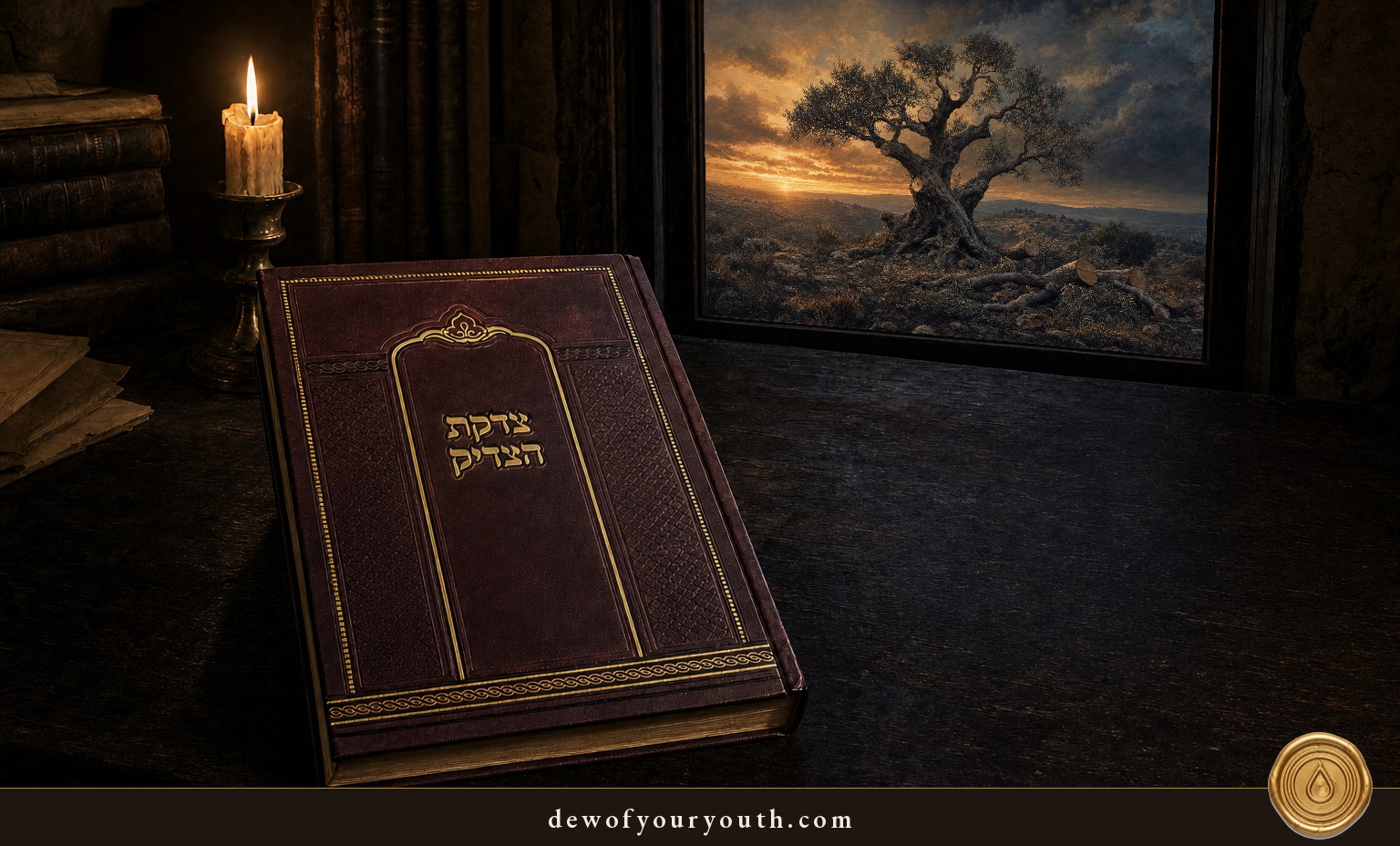
My father and I learned paragraphs 77 and 78 of Tzidkat HaTzaddik (“The Righteousness of the Righteous”): Rav Tzadok’s book of short numbered teachings on spiritual life.. Both are about family. He’s been on that theme for a while now.
Rabbi Tzadok HaKohen of Lublin (1823–1900), Hasidic thinker and author of Tzidkat HaTzadik. starts 77 off by telling you who to stay away from:
אפילו אדם גדול ביותר אם יש בו פגם במשפחתו אין להתדבק בו, כי אם הוא מפני גדלו אין זה מזיק לו, יזיק לזרעו.
Even a really great person, if he has a Pegam mishpacha: a flaw in a family’s lineage, such as a forbidden union somewhere in the line., don’t cleave to him. Because even if he’s so great that it doesn’t hurt him, it’ll hurt his kids.1
“Cleave to him” could mean becoming his follower, or it could mean marrying into his family. His proof suggests the second.
Even if you were Yehoshua
The proof is a story in the Gemara.2 A man came to Rav and asked about the child of a non-Jewish father and a Jewish mother. Rav ruled that the child’s lineage is fine. The man was that child. “So give me your daughter,” he said.
Rav wouldn’t.
Rav’s grandson, Shimi bar Chiya, pushed him: so you don’t really believe your own ruling? And Rav said, “Even if he were like Yehoshua bin Nun, I wouldn’t give him my daughter.”
Very frank. They didn’t sugarcoat things the same way. Yehoshua bin Nun was a pretty big guy, and Rav is saying: even him, no.
Rav Tzadok notices the choice of name. Rav said Yehoshua, not Moshe. Usually when you want to say “the greatest person imaginable,” you say Moshe. In brackets, he notes that the halachic authorities learned from this that you aren’t allowed to say “even if he were like Moshe,” but that there’s also a reason for it.
The reason:
כי משרע״ה הוא שורש התורה, ומצד כתר התורה אין לחוש למשפחות, וכתר תורה מונח לכל.
Because Moshe Rabbeinu is the root of the Torah, and from the side of the Keter Torah: the distinction that comes from Torah learning, which the Sages say is open to anyone who wants it. there is no need to worry about families. The crown of Torah lies ready for anyone.
He brings the Mishnah that a A child of a forbidden union such as adultery or incest, who may not marry into the general community. who is a Literally “a student of a wise man”: a Torah scholar (pl. talmidei chachamim; abbreviated ת״ח). takes precedence over a High Priest who is ignorant.3 You have an ignoramus High Priest on one side and a mamzer who’s a scholar on the other (apparently that’s possible), and the mamzer gets the honor.
That, Rav Tzadok says, is why Moshe took in the Erev rav: the non-Israelites who left Egypt with Israel; the Sages blame them for the Golden Calf and later troubles. that left Egypt with Israel. We’ve been getting pummeled because of those people ever since. But taking them in was part of Moshe being Moshe. It’s not for him to worry about pedigree. Torah doesn’t care about your Family lineage and the standing that comes with it..
So had the man been “like Moshe,” meaning the great Torah scholar of his generation, Rav would have given him his daughter. The Sages actually used Moshe’s name that way. When someone said something true in Torah, they’d tell him, “Moshe, you’ve spoken well.”4 Moshe was a man, but the idea of Torah’s truth is embodied in him.
Yehoshua is something else. He comes from Yosef, through Ephraim, and Yosef is the archetype of the A righteous person; tradition calls Yosef (Joseph) the tzaddik., the righteous man. Rav Tzadok calls Yehoshua צדיק מושל ביראת אלהים, a righteous man who rules in the fear of God.5 His main thing was fear of Heaven. For that kind of greatness, now you have to start worrying about the family.
A box of reptiles
Then he pulls in leadership:
אין מעמידין פרנס על הצבור אא״כ קופה של שרצים תלויה לו מאחוריו.
You don’t appoint a Parnas: a communal leader or administrator. over the community unless a box of creeping things hangs behind him.6
A box of reptiles hanging behind him means a skeleton in the family closet, so that if he gets too full of himself, you can tell him, “Look behind you.” The Gemara’s example is Shaul, whose house had no blemish and whose kingship didn’t last, against David, who had Ruth the Moabite in his ancestry.
And it says בי מלכים ימלכו, “by me kings reign.” Who’s “me”? The Torah.7 So even the people with fancy pedigrees are ruled through Torah. Family dynasties, for Torah, are not a thing. Unfortunately, now they are. But whatever.
Rav Tzadok goes further: ואדרבא הללו ראוים יותר לכך. On the contrary, the people without the pedigree are more fit for it:
הזהרו בבני עניים שמהם תצא תורה, כי מקום התורה דוקא בכלים שבורים.
“Be careful with the children of the poor, for from them Torah will come forth,” because the place of Torah is specifically in broken vessels.8
The foundation of the The rabbinic tradition of interpretation and law, eventually written down in the Mishnah and Talmud. is Rabbi Akiva ben Yosef (c. 50–135 CE), the towering sage of the Mishnah, martyred by the Romans., who came from a family of converts. A leading sage of the Mishnah in the second century, student of Rabbi Akiva., whose colleagues couldn’t get to the bottom of his reasoning, also descended from converts.9 And the descendants of Yitro, Moshe’s father-in-law, a priest of Midian, came up from the City of Palms to learn Torah.10 None of these people had lustrous families, and it didn’t matter. Torah is different.
But where the greatness is righteousness, the Yehoshua kind, a tzaddik who rules in the fear of God, there you should go after people without a blemish in the family. What exactly falls on which side, Torah or righteousness, he doesn’t spell out.
What counts as a blemish?
“A blemish could be a lot of different things,” my father said. “With that much leeway, without knowing what he’d view as a blemish, it could be a super narrow-minded thing. Or it could be very specific to certain situations.”
He’s not clear on it. We could speculate. The Gemara’s case is a mixed parentage, but פגם משפחה could be anything. Who knows what it meant in Lublin? Maybe your uncle wore jeans.
I’m not a historian, so take this with a grain of salt. But I suspect that in Europe nobody needed it spelled out, because it was so obvious what a blemished family was.
As far as I’ve heard from people who do know the history, Eastern European Jewry had a clear class divide: the Yiddish: “fine Jews,” the families of standing, whether through learning, money or both. and the Yiddish: “simple” or “coarse” Jews, the common folk without learning or family standing.. It isn’t clear whether standing came from Torah or money or both. The simple Jews the Rabbi Yisrael ben Eliezer (c. 1698–1760), founder of Hasidism. drew close were the proste, the coarse Jews. Jews in general were an underclass in Europe, but class permeates all of Europe, apparently. Europeans view society through the prism of class, and even inside the Jewish community there were sheyne families and proste families.
One theory holds that the early waves of Jewish immigrants to America came mostly from the proste. That’s supposed to explain something about American Jews: we don’t like the class thing. We despise it. We think it’s pretentious and stupid. We also don’t like authority.
“The unwashed,” my father said.
The people who got the short end of the stick from this stupid class system. I guess if you were on top of it, you thought it was a great class system.
Anyway, that world is gone. You can’t just take its pecking order and plop it down on ours. It may be that Rav Tzadok never defined a blemish because his readers lived inside the answer. We don’t. This is why understanding the Gemara isn’t so hard. Understanding pre-war Europe is hard. Understanding ancient Babylonia, good luck with that.
A journal entry
“Why is this paragraph even here?” my father asked. Is it advice for the A righteous person; tradition calls Yosef (Joseph) the tzaddik.?
It would be easier to answer if we were reading a book. Sometimes, after you’ve read the whole thing, you realize a paragraph set up a paradigm he uses for the rest of the work. And sometimes he just had an idea and wrote it down.
“It’s like a journal entry,” my father said.
I keep coming back to this: imagine the Rabbi Moshe Chaim Luzzatto (1707–1746), Italian kabbalist and ethicist, author of Mesillat Yesharim and Derech Hashem. seeing this book. You know what he’d say. This is not a book.
I can review what Rav Tzadok said. I can’t review why he said it. Some of the time it’s clear; some of the time he paints vast ideas and I don’t know why. This is where you get your points of masochism for reading a book. Yes, we’ve gone through every one, even the ones where go figure what the heck he wants. Even back in the paragraphs on blessings, his insights were all over the place in how accessible and interesting they were. There’s lots of deep stuff in here. There’s also this.
Still, there’s a dynamic here worth filing away: the individual against the family. Torah is an individual thing. Anyone can take the crown. Righteousness is bound up with where you come from. You can become a tzaddik, but you can’t necessarily hand it down in one generation. We’ll watch for it to come back.
Wicked children
Paragraph 78 picks up the same thread:
פעמים גם בנים רשעים אפשר שיהיה נצמח איזה טובה לאב.
Sometimes even from wicked children some good can sprout for the father.11
Usually it’s the other way around. The Sages say a son is like his father’s legs: after you leave this world, how do you go anywhere, do anything? Through your children. Their good deeds count for you somehow. So having wicked children is normally not a good thing.
Rav Tzadok’s example is Avraham, who had Yishmael and the sons of Keturah, שיצא הפסולת על ידיהם: the Pesolet: the refuse left after processing, such as chaff or husks separated from grain. went out through them.
Pesolet is the undesirable byproduct. You process your wheat, you get your flour and you get your pesolet.
“The husks,” he said.
Exactly. All the bad that came down from Terach and Nachor, the idolatry of that world, got shunted into Yishmael and Keturah’s sons, and Yitzchak came out clean.
“It’s like a pruning,” my father said.
This continues paragraph 77, where your righteousness depends on your family line. It isn’t just you, it’s where you come from.
“A genealogy of morals,” my father said.
He has a whole theme going. We talked about epigenetics when he was discussing what parents pass down.
My father had always heard the sons of Keturah connected with Asia and Eastern mysticism. People are into that. The Torah says Avraham sent them east (Genesis 25:6), so there’s something to it.
I heard Rabbi Yitzchak Breitowitz of Ohr Somayach give a whole spiel on it, about why Jews are attracted to Eastern religion. He said nine out of ten Western converts to Buddhism are Jewish. He’s very interesting to listen to, partly because he has weird ideas. Interesting ideas, I should say. I have weird ideas too.
I’ve heard people say it before, and it may not be wrong. I just don’t like it when people say everything really comes from one place, whether it’s Catholic culture or anything else. Maybe. Or maybe the Indians had their own thing going on, nothing to do with us.
And I don’t know where we get that Keturah’s sons were evil in the first place. I’ve never heard anything bad about them. But they weren’t Yitzchak.
Unmaking offspring
There’s a condition:
אלא שבזה צריך שיזכה האב שיופקע תורת זרעו מהם.
But for this, the father has to merit that the status of his offspring be uprooted from them.
Avraham was told כי ביצחק יקרא לך זרע, “through Yitzchak shall offspring be called yours.”12 The others aren’t counted as his line. So basically the Abraham Accords are not a thing?
Not so fast. This is one data point. Yitzchak was certainly Avraham’s main offspring, but to pin down what Rav Tzadok means, you have to take it in the broader context, and in many ways the children of Yishmael are considered related to Avraham. The very next verse says of Yishmael, כי זרעך הוא, “for he is your seed.”13 Anyway, if we can sell our tech products to the UAE and I get cheap flights to Morocco and Bahrain, I’m for it.
His second case is the ten tribes. The Gemara says that in one place where the exiled tribes settled, the Sages didn’t move from there until they had declared them full gentiles.14 This has practical consequences. If a gentile betroths a Jewish woman, it doesn’t take effect. But if he might descend from the exiled Israelites, maybe it does, and she’d need a A Jewish bill of divorce.. So the Sages un-Jewified them. They canceled them, as we say in modern-day nomenclature.
Something similar happened with the Samaritans. They’re Israelites, but halachically we don’t count them as Jews. Not entirely, though: unlike the tribes the Sages declared full gentiles, if a Samaritan betroths a Jewish woman, we do require a A Jewish bill of divorce. A get mi-safek is one required out of doubt, in case the marriage took effect. out of doubt. And they’re remarkably close to us. In practice their religion is a lot like ours. We both put the Five Books of Moses above everything else. They don’t accept the Prophets and Writings, but we also hold much of the Prophets and Writings to be less central than the Five Books. Our tradition tells a story in which they were converts, but they probably descend, at least in part, from the northern tribes.
I like to believe that when Mashiach comes, the Samaritans will come back and be part of Israel again.
Rav Tzadok also points to the Rabbi Moshe ben Nachman (Nachmanides, 1194–1270), Catalan Torah commentator, Talmudist and kabbalist. on שורש פרה ראש ולענה, “a root that bears gall and wormwood,” where Moshe warns of a family whose heart turns away.15 The Ramban reads the root as the father and the branch as the son: the root standing there that day carries the generations that will grow from it. It’s the same image as the pruning. Cut the bad branch away, and the tree grows.
Chizkiyahu’s son
Then the story of King Chizkiyahu.16 In the book of Kings, it isn’t clear why the prophet Yeshayahu comes to him and announces that he’s going to die. The Gemara explains: Chizkiyahu had no children, deliberately. He had seen through Ruach hakodesh: insight granted by God, a level below prophecy. that his son would be Menashe.
“Not our friend,” my father said.
Not the Menashe we bless our sons by on Friday night. The evil Menashe. It’s super confusing. Like Micah: there’s the prophet Micah, and then there’s the idol of Micah.
So Chizkiyahu decided it was better not to have children at all. Yeshayahu told him: you’re going to die, because having children is a commandment. And Chizkiyahu said, but I saw what was going to come out of me.
If that line isn’t where the phrase “a little knowledge is a dangerous thing” comes from, it should be.
Yeshayahu answered, בהדי כבשי דרחמנא למה לך: what business do you have with the hidden things of the Merciful One? You’re required to do what the Torah says, and have children. Chizkiyahu prayed, married Yeshayahu’s daughter, and had Menashe. Menashe’s grandson was Yoshiyahu, one of the best of them. Mixed bag, those kings.
Menashe is one of the few who, the Mishnah says, have no share in the The World to Come.. You’ve got to be a really bad hombre to have no place in the World to Come. And yet:
ומ״מ היה נאבד ח״ו משיח בן דוד וכל השלשלת הקדושה מן העולם אלו לא נולד.
Nevertheless, The Messiah: the anointed king from the house of David who will bring the redemption. son of David and the whole holy chain would have been lost from the world, God forbid, had he not been born.
Without Menashe, the line of David ends. At that point, a lot of people thought Chizkiyahu was Mashiach and it was only a matter of time until he revealed himself.17 Chizkiyahu may have thought so too. Maybe he could have been, if they had merited it. Maybe that’s why he didn’t think the end of his line was a problem: Mashiach would come, problem solved. Apparently, problem not solved.
Happy about the wicked son
Rav Tzadok’s next proof is a pleasant surprise. In The Torah portion of Exodus 10–13, covering the last plagues and the first Passover., when Moshe tells the people about the Passover service, they bow down.18 Rashi says they were celebrating the news that they would have children.
But look at the verse they were celebrating: “When your children say to you, what is this service to you?” And that, the The text read at the Passover Seder, retelling the Exodus. says, is the question of the wicked son. To you, and not to him. He takes himself out of it, and so the Haggadah says, “blunt his teeth.” Had he been in Egypt, he wouldn’t have been redeemed.
So they knew they were talking about a real , a bad hombre, a guy whose teeth you’ve got to blunt, whatever that means. And they still bowed down for joy at the news that he’d be born. Sometimes even having a wicked child is good.
And then, in his pedantic mode, Rav Tzadok notes that the Midrash says the opposite.19 King Shlomo prayed that if a person asks for a son and the son will be wicked, God should not give him one.
“So what’s the bottom line?” my father asked.
It can be said in one sentence. Normally wicked children are bad for you, but sometimes they’re good: either they aren’t counted as your offspring, and they carry off what you didn’t want, like Avraham’s other sons; or they’re a necessary link in the story, like Menashe. I’m not sure exactly how Menashe fits, since he clearly is counted in David’s line. That’s the whole point.
“He’s a husk,” my father said.
And I don’t think Rav Tzadok brings the Midrash to knock down what he’s just said. He’s saying it isn’t simple. As for what his point is, I don’t know. We’d have to get Rabbi Kitov to explain it to us. And once we’re doing that, we might as well get Rav Tzadok. Although I feel like we’re more likely to understand Kitov.
Full circle
Israeli Hasidic author (1912–1976), born Mokotovsky, known for Sefer HaToda’ah on the Jewish year; his father was a disciple of Rav Tzadok. was one of the few people who was Hasidic and knew how to write. Not “a good writer for a Hasid.”
“No,” my father said, “he’s a good general writer.”
He doesn’t write with perfect diction, like the Ramchal or Shmuel David Luzzatto (1800–1865) of Padua: Italian Jewish scholar, poet, grammarian and Bible commentator.. But he’s very readable and very clear. Rav Tzadok is not.
His real name was Mokotovsky. I see why he changed it. His father was a devoted Hasid and a close student of Rav Tzadok. Kitov himself was born too late to have known him. But in the edition we’re learning from, he restored passages that had dropped out of the printed text, like paragraph 75, from versions he found in his father’s notes.
“So full circle,” my father said.
Full circle. A son carrying forward what his father received from his rebbe, in the middle of two paragraphs about what children do for their fathers.
“The Lion King,” my father said.
Yevamot 45a. ↩︎
Horayot 13a: ממזר תלמיד חכם קודם לכהן גדול עם הארץ. ↩︎
Shabbat 101b: משה, שפיר קאמרת. ↩︎
II Samuel 23:3. ↩︎
Yoma 22b. Rashi there explains the box of creeping things as a blemish in the family, and that David descended from Ruth the Moabite. ↩︎
Proverbs 8:15. ↩︎
Nedarim 81a. ↩︎
Eruvin 13b. On his descent from converts, Gittin 56a. ↩︎
Judges 1:16; Sanhedrin 104a. ↩︎
Genesis 21:12. ↩︎
Genesis 21:13. ↩︎
Yevamot 17a, at the end of the first chapter. ↩︎
Deuteronomy 29:17, and the Ramban there. ↩︎
Berakhot 10a, on II Kings 20:1. ↩︎
Sanhedrin 94a says God wanted to make Chizkiyahu Mashiach. ↩︎
Exodus 12:26–27, and Rashi there. ↩︎
Tanchuma Terumah 9, as Rav Tzadok cites it. ↩︎