The Saranduk / Shore Family: An Overview
Introduction
Over the past three years I’ve done research into the Saranduk / Shore family. With the help of resources like JewishGen and FamilySearch, and by making connections with known family members and new ones I met over the internet, I believe I’ve been able to establish connections and find evidence well beyond what was previously available to us. But because these updates were happening in real time, it’s hard to get a sense of the general picture — what the background is, what was already known, and what has been newly discovered.
As I’ve taken a break from active research, I decided it was time to write a basic guide to what is known about the Saranduk / Shore family.
Source Materials
My father R’ H.S. Shore shlit"a was an instrumental source of knowledge throughout my research. Much of my work has been guided by findings from my great-aunt Ruth Mondlick of blessed memory (via her son David Mondlick), and my father’s cousin Rabbi Shmaria Shore shlit"a.
The primary documentary sources were:
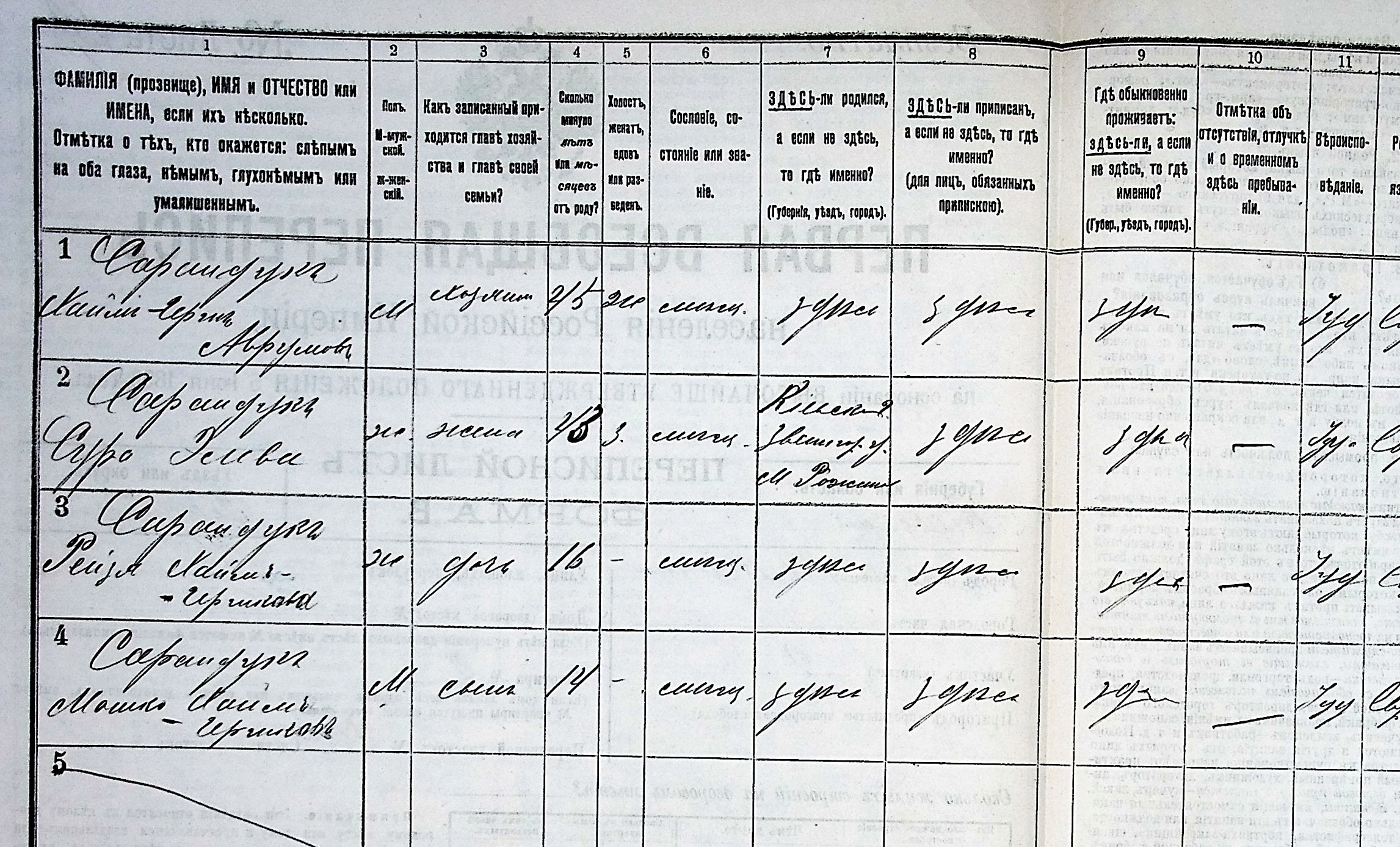
- Ukrainian Revision Lists — Government census of the Russian Empire used for taxation purposes. Indexed and made searchable by JewishGen.
- Cherkassy Church Books — Community ledgers of births, marriages, divorces, and deaths. Often written in Russian on one side and Hebrew/Yiddish on the other. Found via JewishGen and FamilySearch.
- Ship passenger lists.
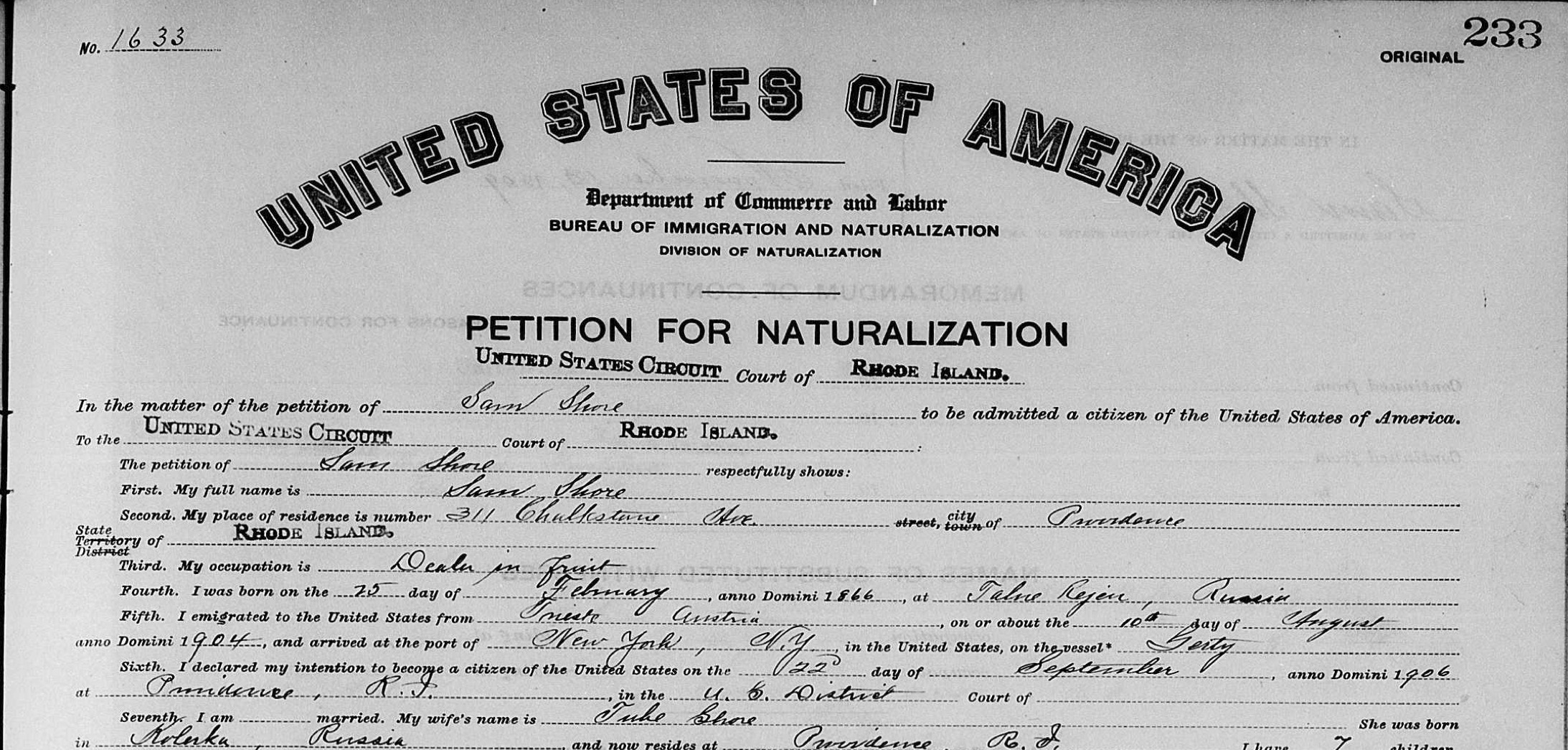
- Immigration papers — Usually found via FamilySearch.
- Census records — Usually found via FamilySearch.
- Tombstone inscriptions — Usually found on findagrave.com.
- Aunt Ruth’s notes, made available by her son David Mondlick.
- Rabbi Shmaria Shore’s notes, from research he conducted approximately 40 years ago.
- Nordine Ginsburg, who was instrumental for my research on her great-grandparents Philip and Netty (Saranduk) Shore.
- Various long-lost relatives found on platforms such as FamilySearch and MyHeritage.
Ukraine to America
As a family that emigrated from Ukraine to America, the central challenge was matching people across the Atlantic — mapping individuals found in American records to individuals found in Ukrainian records.
The starting point was the passenger manifest of the ship they arrived on: the S.S. Gerty, which sailed from Trieste on August 18, 1904, and arrived in New York on September 6, 1904. Three generations of Saranduks were traveling on the same ship, which gave us a great deal to work with.
The manifest listed Chaim Hersch Saranduk (age 55), his wife Sura (age 50), a married daughter-in-law Beila, and daughters Rosa and Pessie — all bound for Buffalo, NY. On the same manifest, his son Schmarje (Sam Shore, age 38) and wife Tube (Tillie, age 33) traveled with their six young children, bound for Providence, RI.
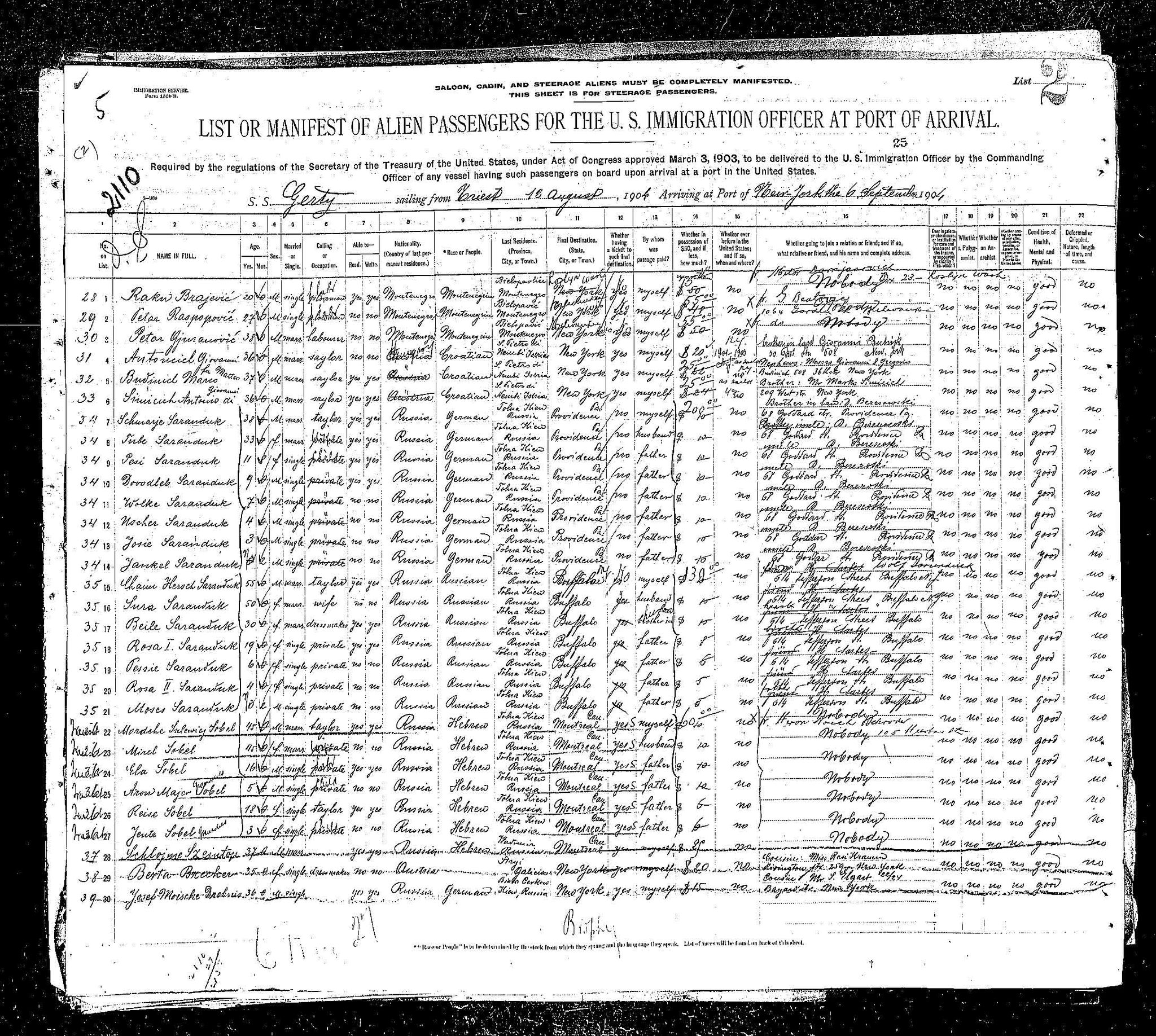
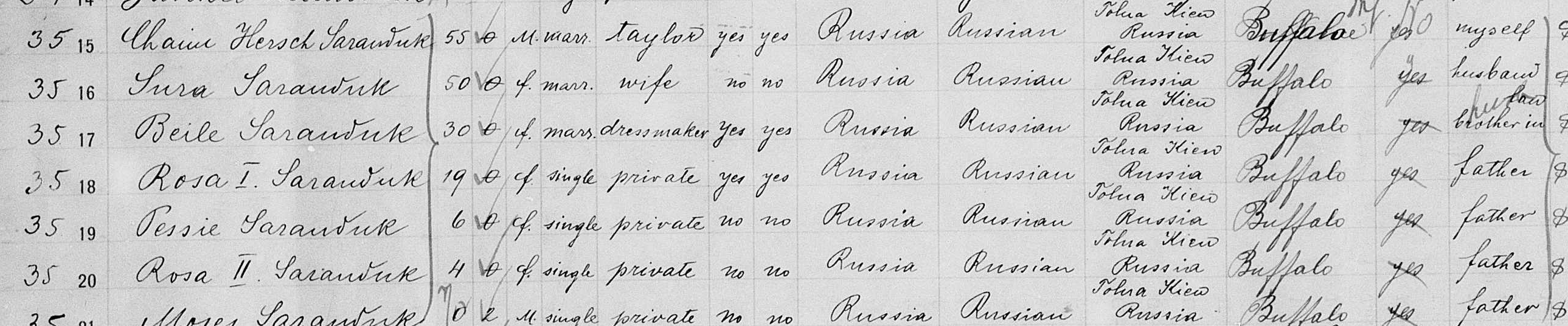
Matching Chaim Hersch Saranduk to Hyman Shore was the foundational link. The evidence was convergent from multiple independent sources:
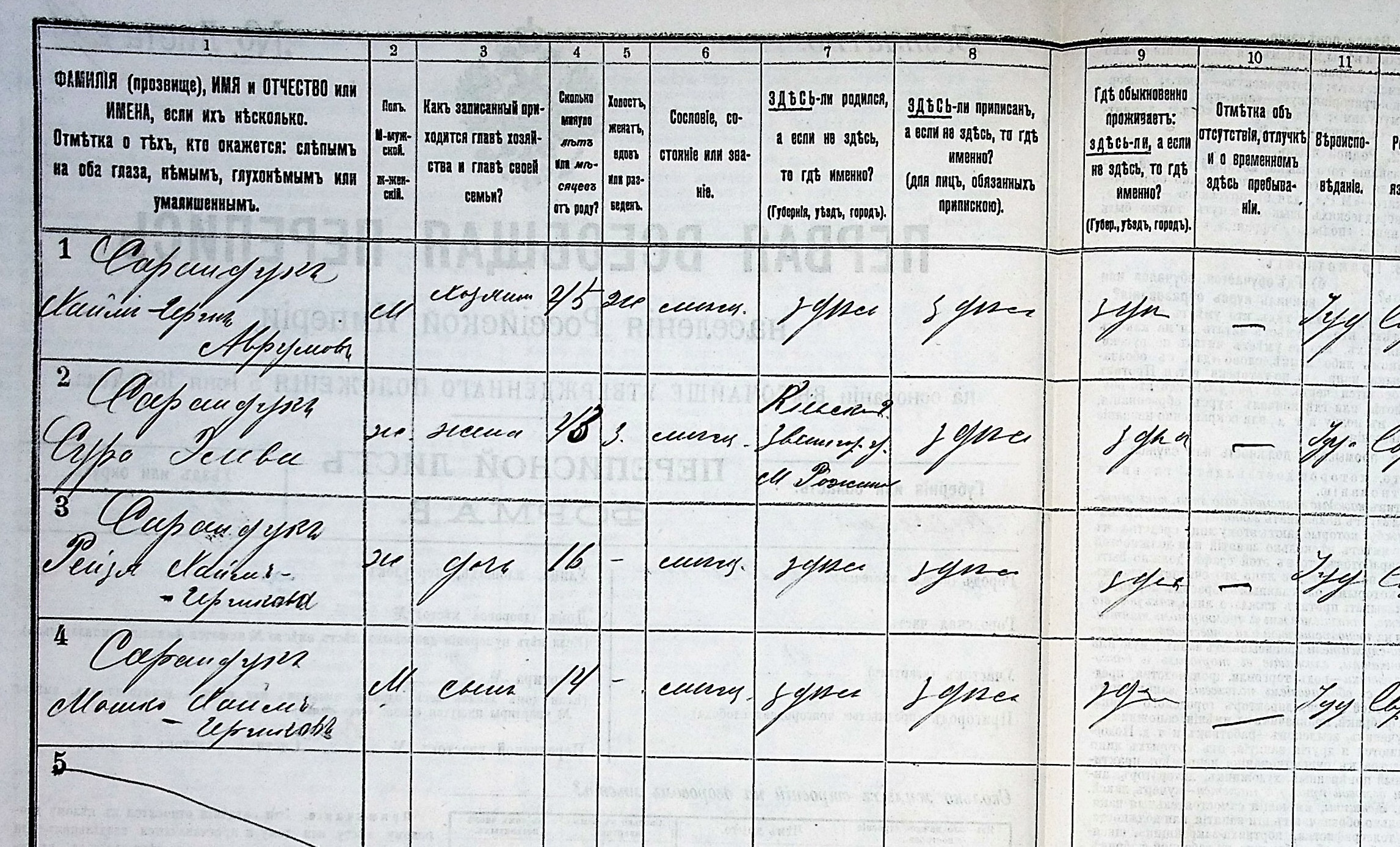
- The 1858 Talne census records a Khaim Hersh Saranduk, son of Avrum, aged 9 — placing his birth in ~1849, consistent with “age 55” on the 1904 manifest.
- His father is listed as Avrum son of Khaim, consistent with Hyman Shore’s tombstone inscription Chaim Tzvi ben Avraham. (“Hersh” is the Yiddish form of Tzvi; his religious name was Chaim Tzvi.)
- His son Shmarje’s children on the manifest — Pesi, Dovodleb, Wolke, Uscher, Yosi, Yankel — match the known names of Sam and Tillie Shore’s children.
- His daughter Rose and son Moses on the Buffalo portion of the manifest match Morris Shore and Rose Shore Grossman, both buried at Lincoln Park Cemetery in Rhode Island.
No other person named Chaim Hersch Saranduk, born the same year, from Talne, has been found in any record.
The Talne Family: Avrum Saranduk and His Children
The direct ancestor of the American Shore family was Avrum Saranduk of Talne, documented as head of household across nearly fifty years of Revision Lists:
- 1850: Avrum, age 26 (b. ~1824), son of Khaim Gersh. Wife Khaya, age 23. Children: Malka (age 6, b. ~1844) and Gersh (age 1, b. ~1849 — the future Hyman Shore).
- 1858: Avrum, age 34. Wife Khaya, age 32. Children: Khaim Hersh (age 9) and Moshe Yankel (age 6). Malka is no longer present, likely married.
- 1897: Avrum, age 75. Wife Khaya, age 70. His grandson Shmariy (Sam Shore, age 28) appears in the household with his wife Tuba and three young children. Avrum’s sister, Khana Pysenko (age 65), is also listed — a woman who appears in no family oral history and would be entirely unknown without the census record.

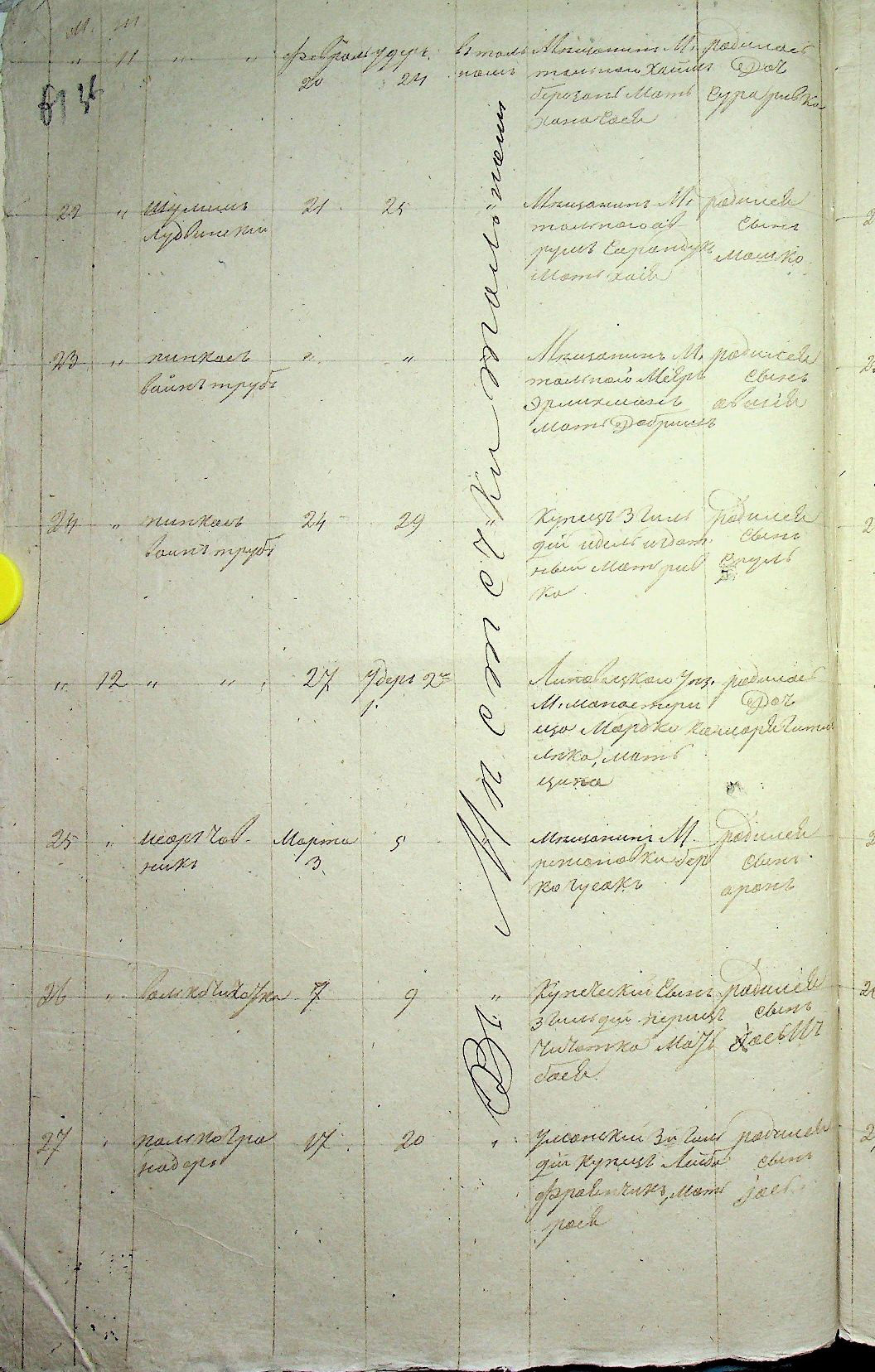
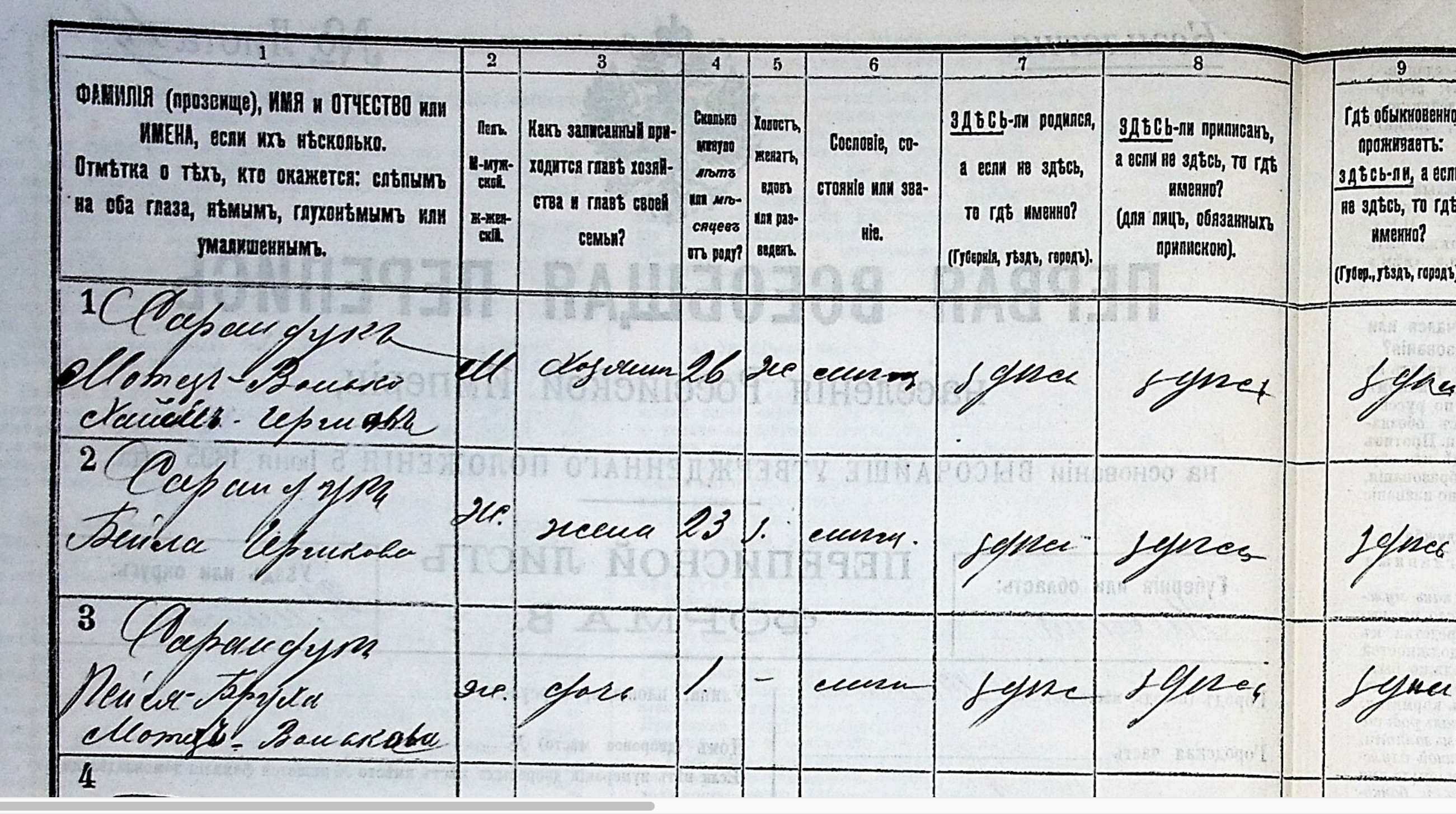
The 1850 record was a recent addition to the JewishGen database and revealed for the first time that Hyman Shore had an older sister named Malka (b. ~1844). The same 1897 round of records also captured a separate household: Motez Volko Saranduk (Mordechai Ze’ev), age 26, son of Khaim Gersh — Hyman Shore’s son William, who had emigrated ~1902 and whose American descendants took the name Serin rather than Shore.
A quick aside
Enjoying this post?
Come along on WhatsApp or Telegram — new posts, reflections, and the occasional spiral.
How Far Back the Records Go: Torgovitsa and Leyb
The earliest documented Saranduk ancestor is Leyb Saranduk, who does not appear directly in the records but is established as the father of two sons in the 1818 Torgovitsa Revision List — the earliest known document for the family. At that date the name was spelled Srondik (СРОНДИК), later evolving to Saranduk (САРАНДУК).
The working reconstruction of the senior line, drawing on the 1818 and 1836 Torgovitsa records together with the Talne records:
flowchart TB;
  Leyb["Leyb Saranduk/Srondik (Torgovitsa)"]
  Leyb --> Avrum1["Avrum son of Leyb"]
  Leyb --> Mordko["Mordko son of Leyb (b. ~1793)"]
  Avrum1 --> KhaimGersh["Khaim Gersh (b. ~1798)"]
  KhaimGersh --> AvrumTalne["Avrum of Talne (b. ~1824)"]
  AvrumTalne --> Malka["Malka (b. ~1844)"]
  AvrumTalne --> Hyman["Khaim Hersh / Hyman Shore (b. 1849)"]
  AvrumTalne --> MosheYankel["Moshe Yankel (b. ~1852)"]
There is an open question at one link in this chain. The 1836 Torgovitsa Revision List records an Avrum Nikhem Saranduk, age 11 (b. ~1825), son of a deceased Khaim, living with his widowed mother Khvulya and sister Beyla. The birth year and father’s name closely match the Avrum of Talne (b. ~1824, son of Khaim). However, the mother’s names don’t reconcile easily (Khaya Leya in 1818 vs. Khvulya in 1836), and Avrum’s younger sister Khana — who appears in the 1897 Talne census — is absent from the 1836 Torgovitsa household. This identification cannot be confirmed or ruled out with the available evidence.
Hyman & Sarah Shore
Hyman Shore (Khaim Hersh Saranduk, b. ~1849, Talne) is the oldest Saranduk known to have emigrated to America. His wife Sarah Mamorofsky (Sura, b. ~1854) had a father with the Hebrew name Eliyahu, as recorded on her tombstone.
They had at least five known children:
- Sam Shore (Shmariahu, b. 1868)
- William Serin (Mordechai Ze’ev / Wolf, b. ~1874) — emigrated ~1902, took the name Serin
- Tillie Lisagor (b. 1882)
- Rose Grossman (b. 1883)
- Morris Shore (b. 1886)
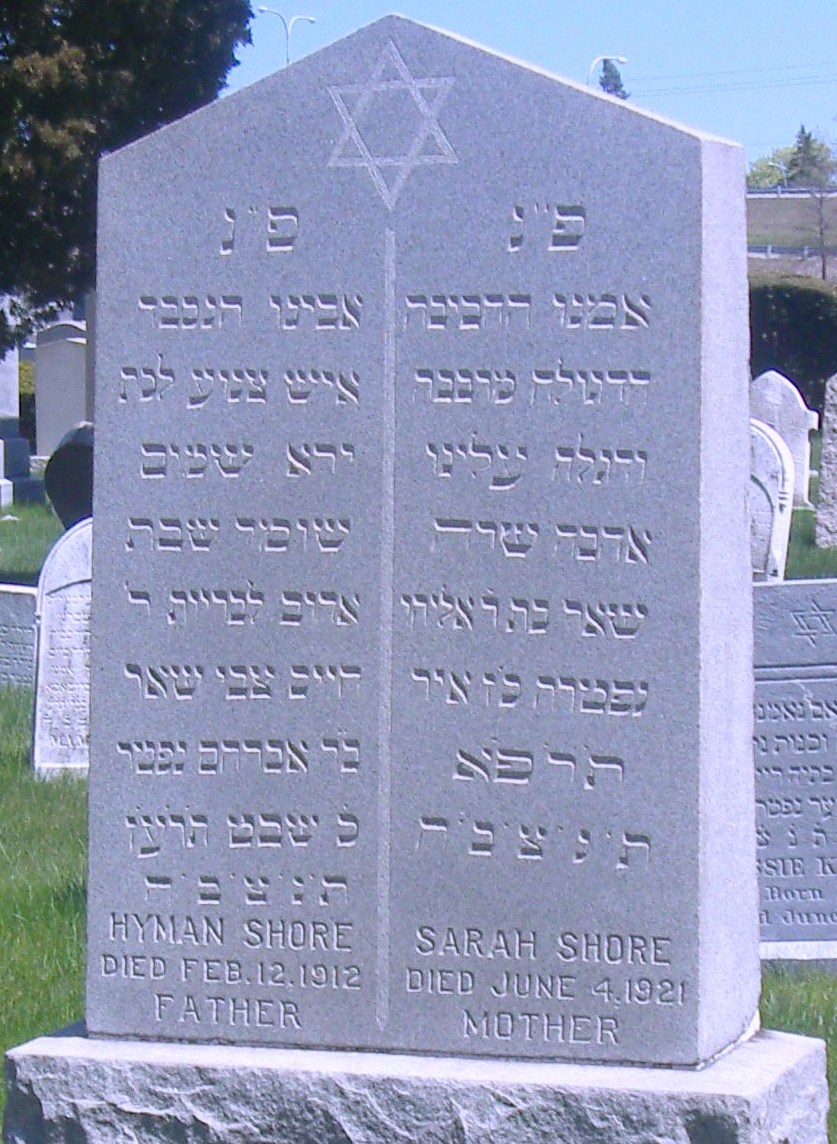
They arrived on the S.S. Gerty in 1904. Hyman initially headed to Buffalo (to join William), before settling in Rhode Island. He died February 12, 1917 — the English date on his tombstone reads 1912, but the Hebrew date on the same stone, and his death certificate, both point to 1917. Sarah died June 4, 1921. Both are buried at Lincoln Park Cemetery in Warwick, RI. Age figures on American documents for both are inconsistently recorded; the 1858 census birth year of ~1849 is the most reliable anchor.
Sam & Tillie Shore
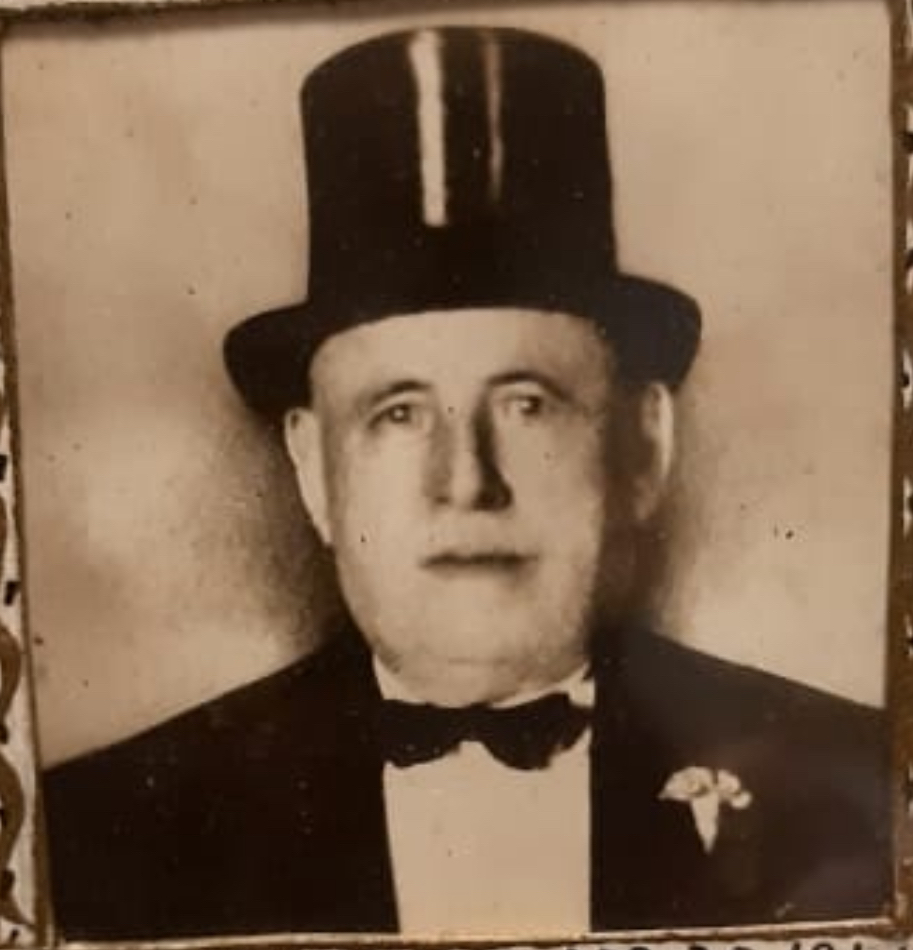
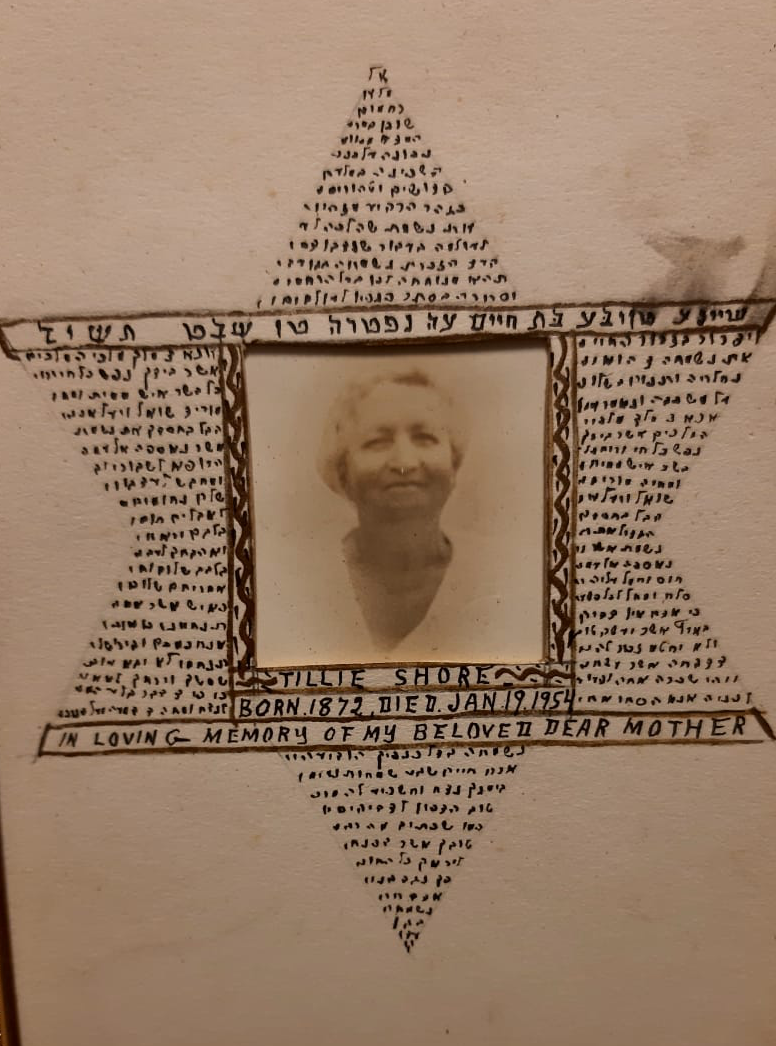
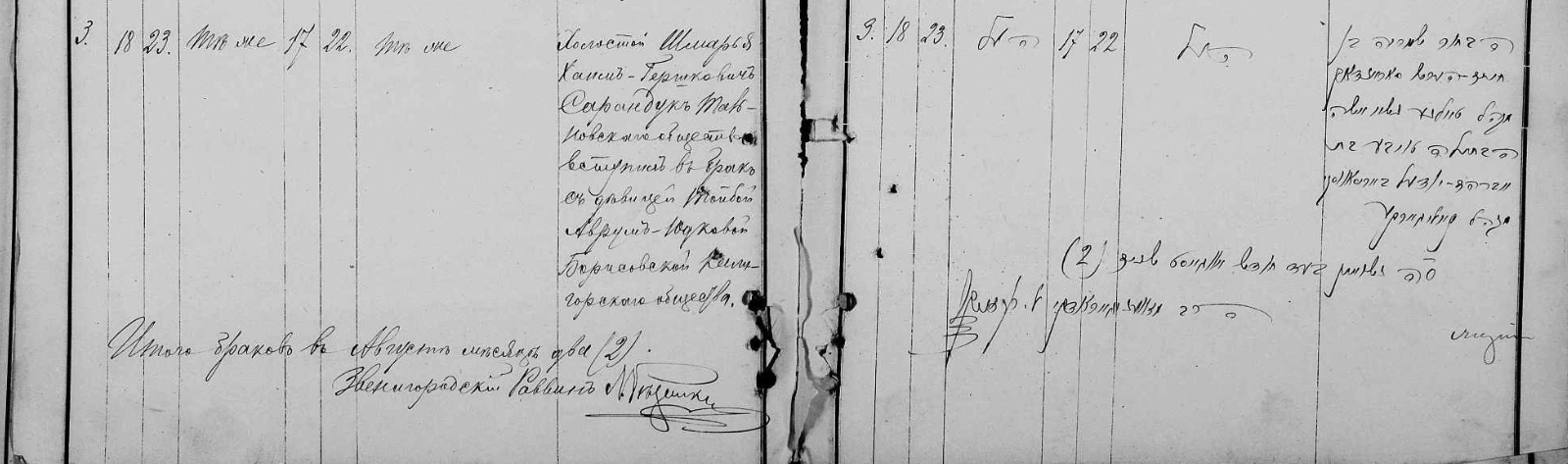
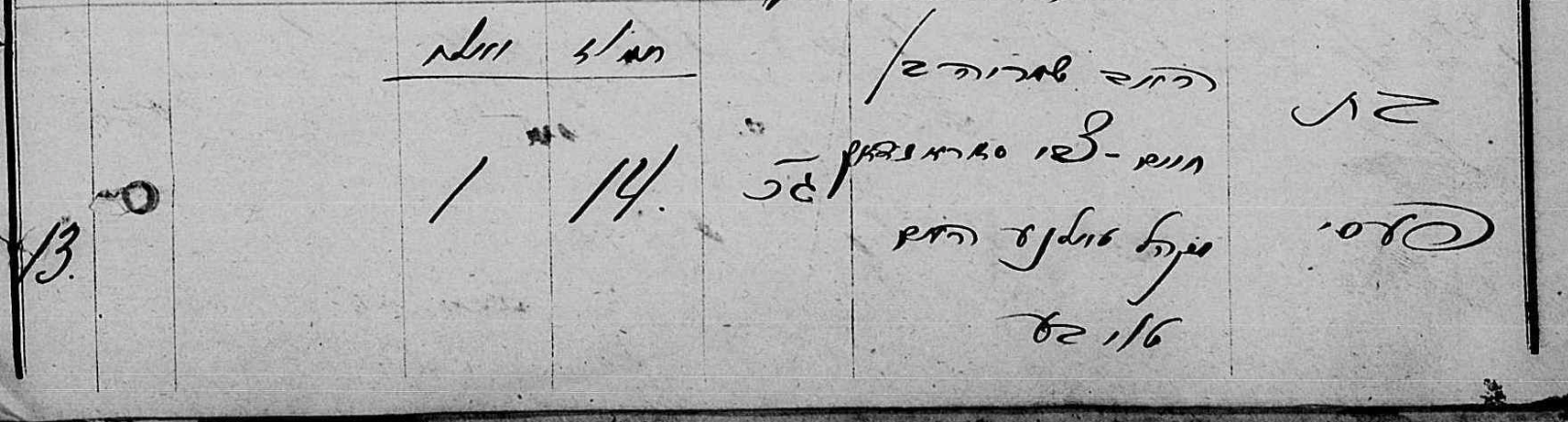
Sam Shore (Shmariahu, b. March 10, 1868, Talne) was the eldest son of Hyman and Sarah. The Cherkassy Church Books provided a key finding: his marriage to Taube (Tillie) Beresovsky was recorded on August 17, 1888 in Talne. The Hebrew record names him Shmaria ben Chaim Tzvi and her Toyba bat Avraham Yudel Beresowsky — the most direct documentary link between his Hebrew name and his secular identity.
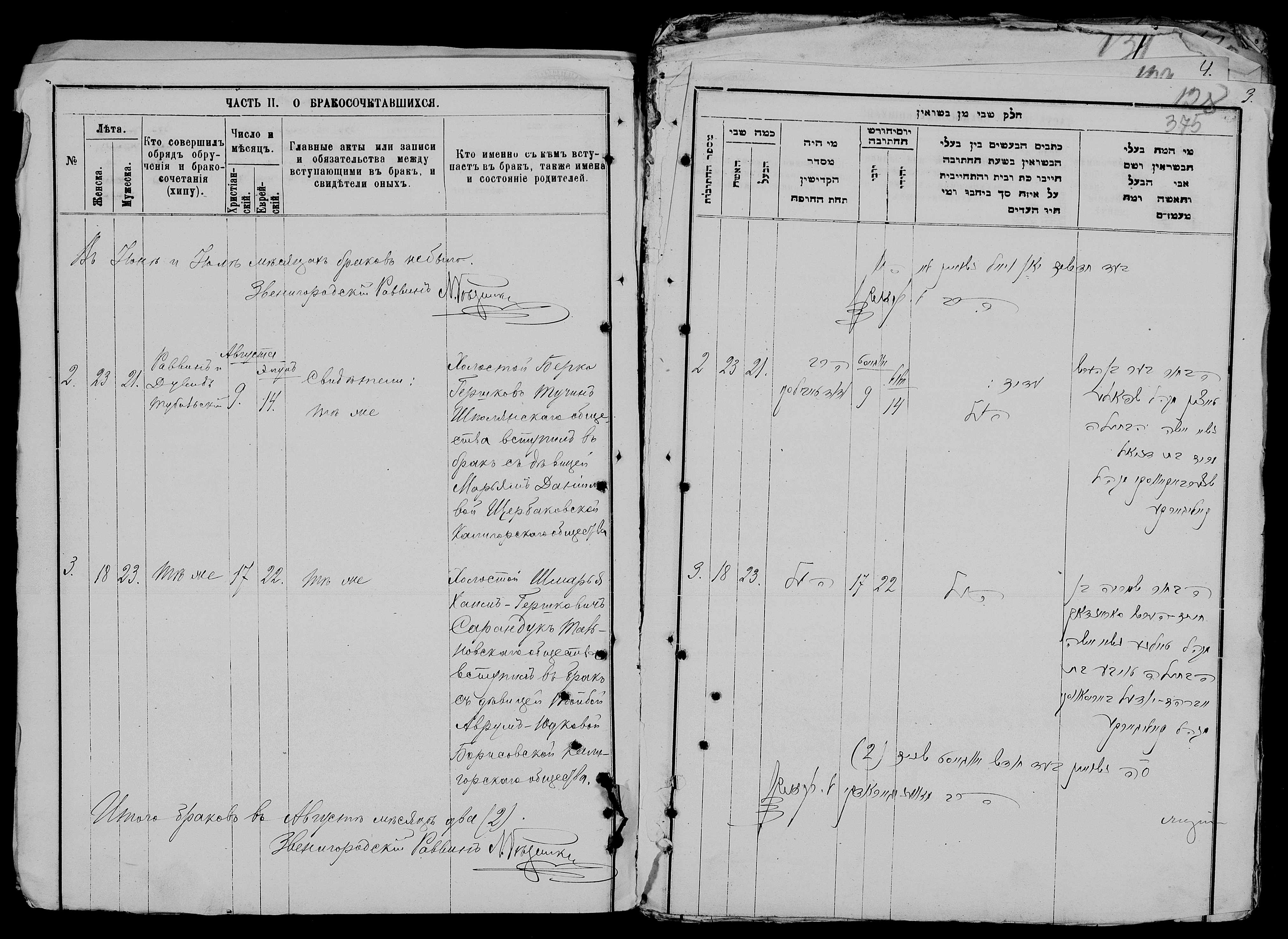
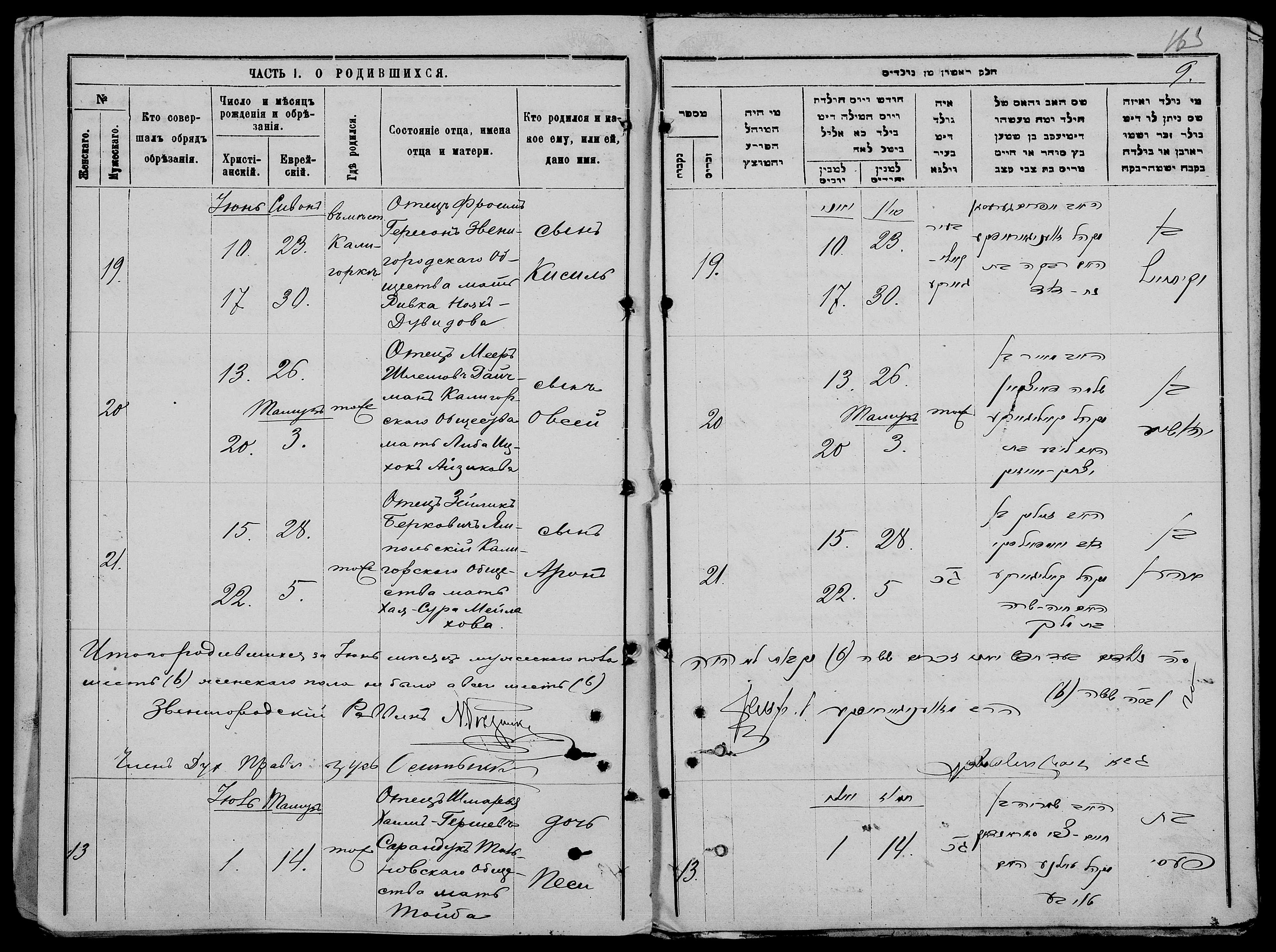
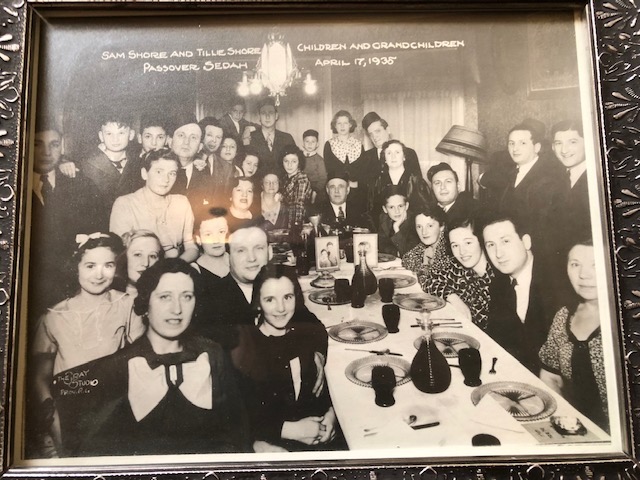
Tillie was born August 1, 1871, and came from the Katerynopil / Mokra Kaligorka area, a few hours from Talne. Her father Avraham Edel ran a tavern. A persistent family legend — recorded independently in both Rabbi Shmaria Shore’s notes and Aunt Ruth’s notes — holds that her mother died on the boat to America rather than eat non-kosher food, and that her body was brought to Israel for burial.
In Providence, Sam became a central figure in the immigrant Jewish community:
- First president of Sons of Jacob Synagogue — now a protected historical landmark on Douglas Avenue, Providence.
- Founded the Hebrew Free Loan Society and the Hebrew Free Sheltering Center in Providence.
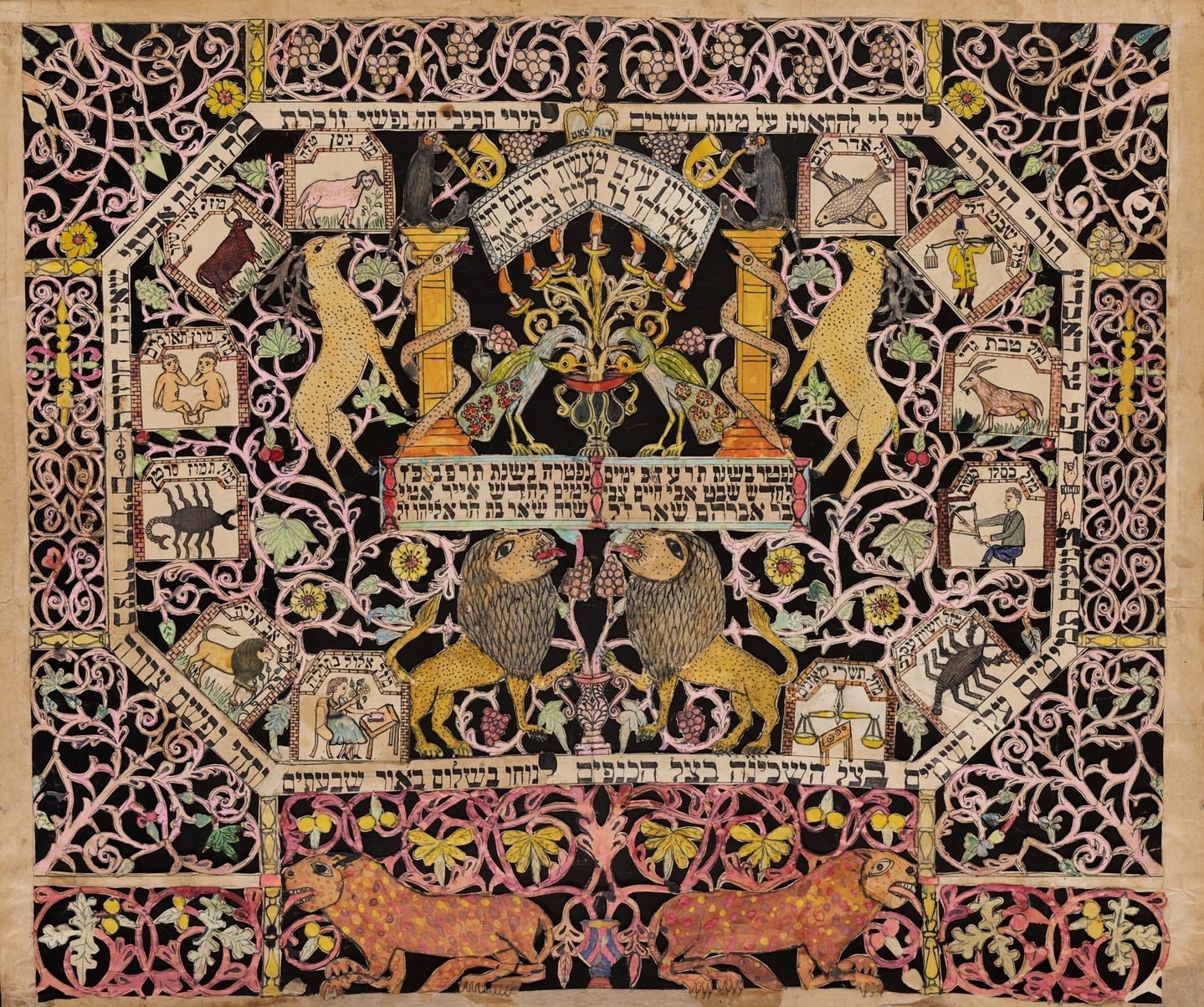
- A folk artist: he painted the fresco at Sons of Jacob Synagogue and created paper cuttings, several of which are preserved at the Museum of Fine Arts in Boston.
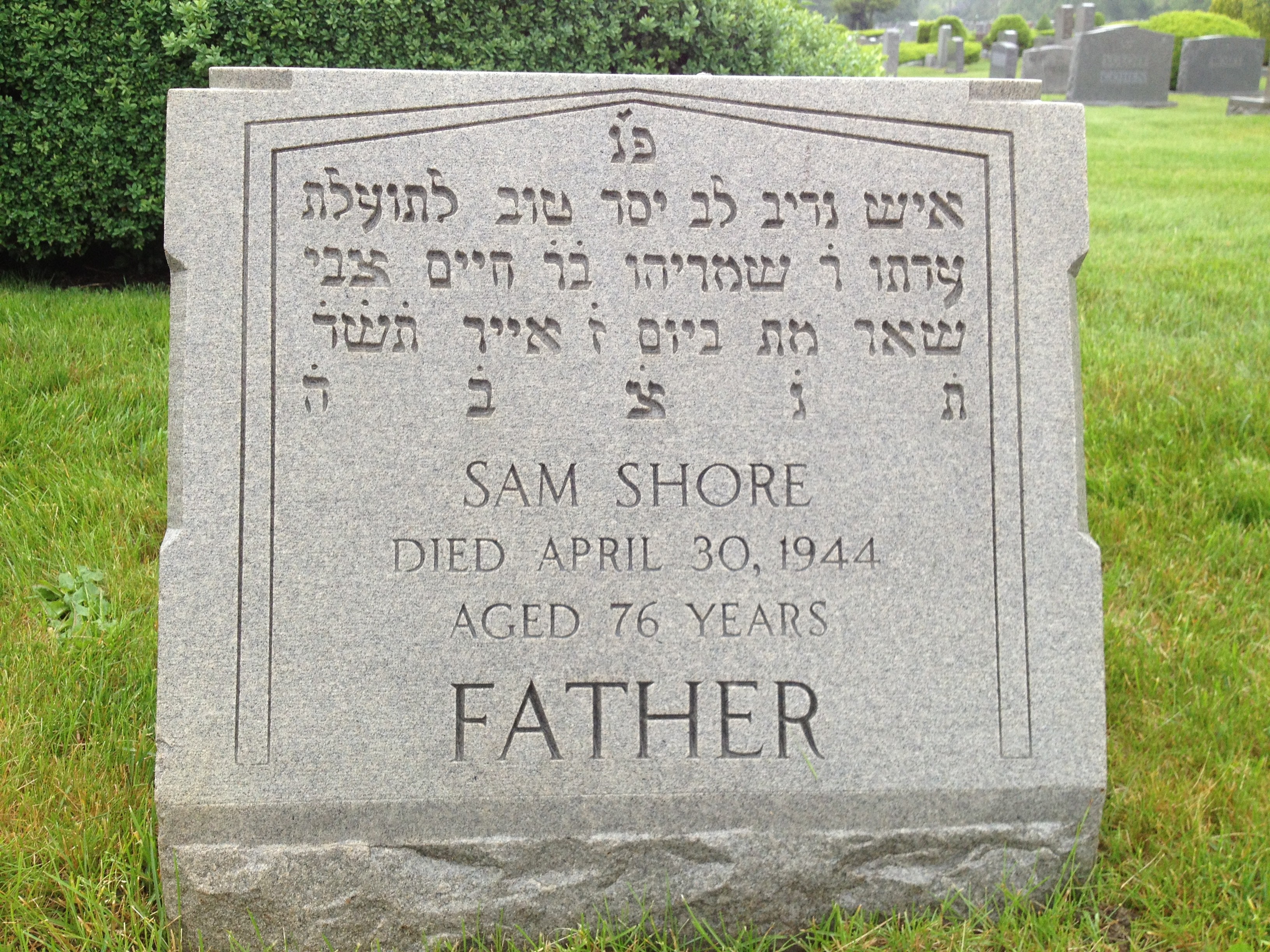
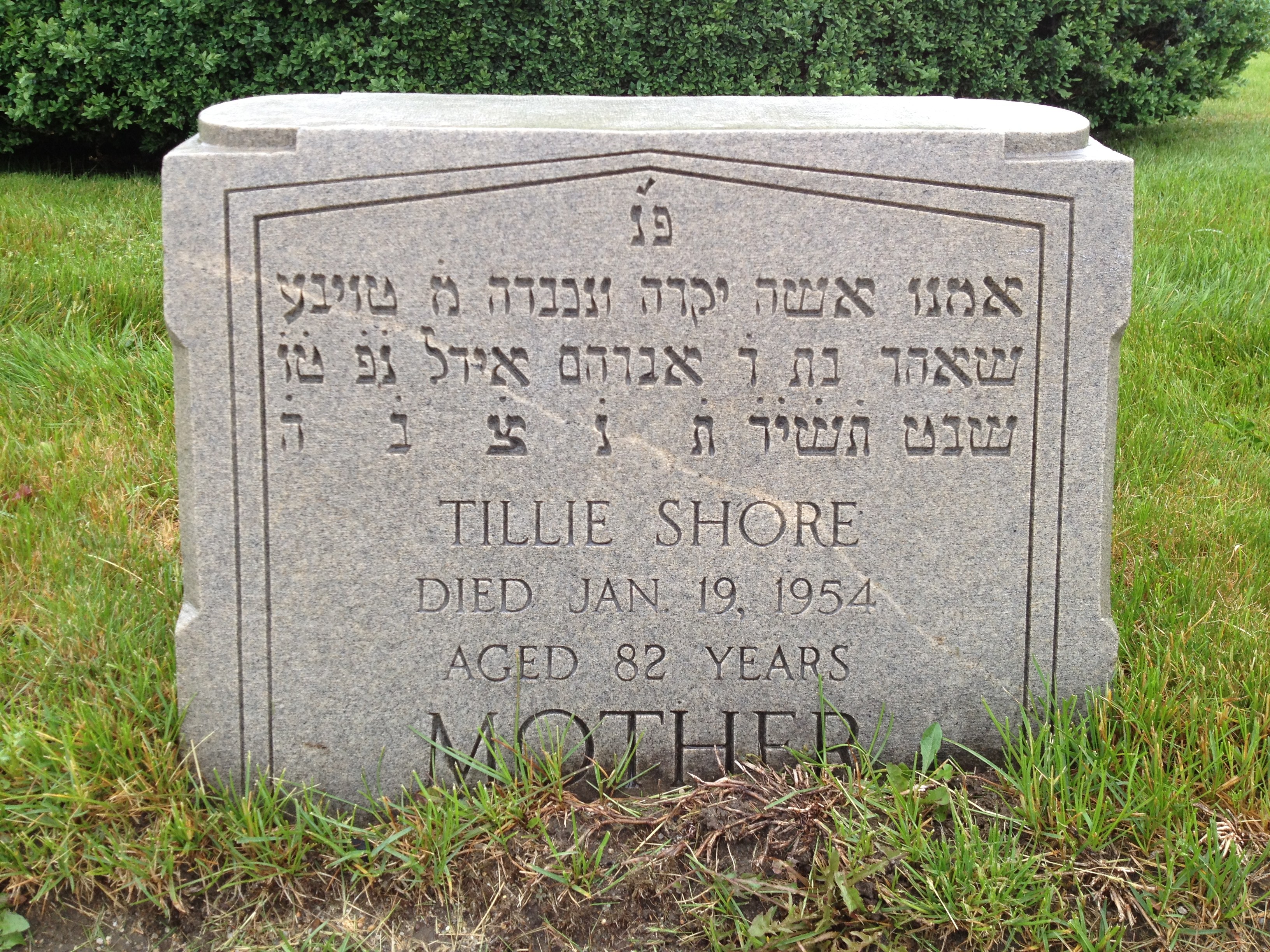
He died April 30, 1944. Tillie died January 19, 1954 (Tu b’Shvat). Both are buried at Lincoln Park Cemetery. They had seven children, including Samuel Oscar (Asher) Shore — the primary conduit for family oral tradition that eventually reached Ruth Mondlick and shaped much of this research.
Moshe Yankel’s Branch: Philip & Netty Shore
Moshe Yankel Saranduk (b. ~1852, Talne) was Hyman Shore’s younger brother. He had three known children: Philip (Pinhas), Abe (Abba), and Max (Matisyahu). Philip’s branch is the most fully documented.
Philip Shore (Pinhas) married Netty Farber (Nechama) and represents the second major emigration from the family.
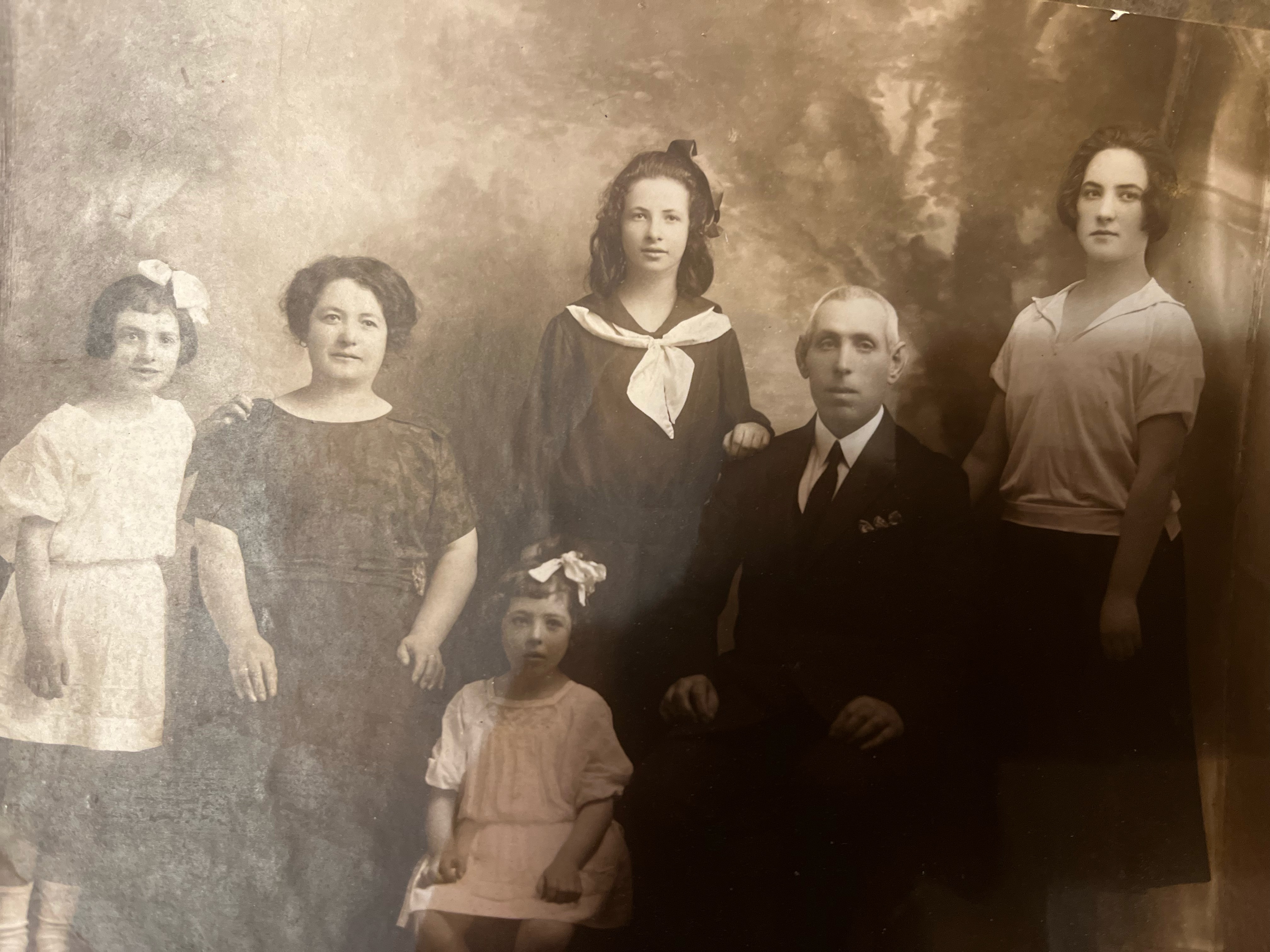
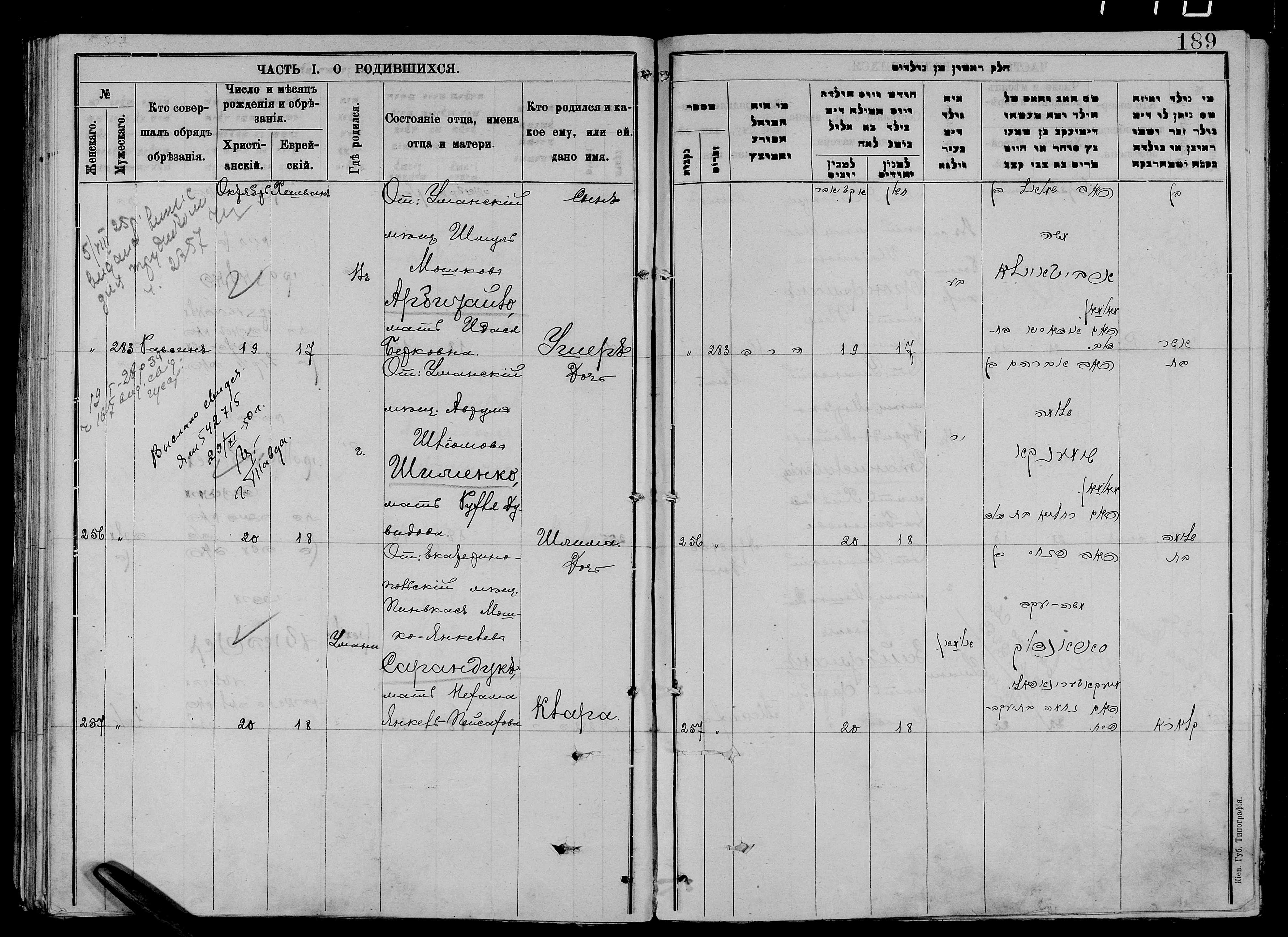
Philip and Netty emigrated from Katerynopil, arriving in New York on the S.S. Majestic in 1926 — more than twenty years after the Hyman Shore branch. According to family oral history passed down by their granddaughter Nordine Ginsburg, they had two leather shops and the daughters had private tutors — unusual for girls at the time. When the Bolsheviks raided their town, the family fled with little more than the clothes on their backs, went first to France, and then Philip came to America ahead of the family to find work and housing before bringing them over.
Philip and Netty’s naturalization papers are one of the few places where the surname change from Saranduk to Shore is made explicit in writing. The birth record of their oldest daughter Clara (later Irene Shore Roth) in the Cherkassy Church Books names her father as Pinkhas ben Moshe Yaakov Saranduk — directly connecting the Katerynopil branch to the Ukrainian census records. Philip is buried at Lincoln Park Cemetery with the Hebrew inscription ר׳ פינא ב״ר משה יעקב שאהר, confirming the Moshe Yankel link.
The Name
The earliest known spelling, in the 1818 Torgovitsa Revision List, is Srondik (СРОНДИК), already suggesting that the written form was somewhat arbitrary. In America, the Saranduk name was dropped immediately — though a few documents capture the transition explicitly, most notably Philip Shore’s naturalization papers.
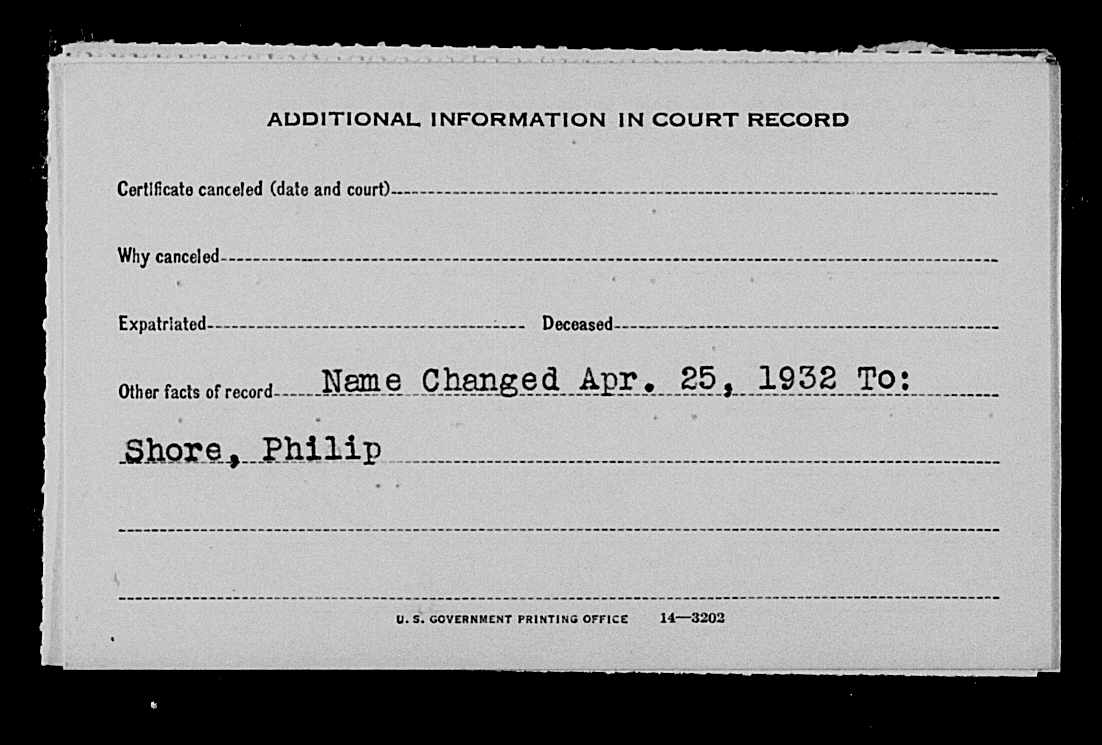
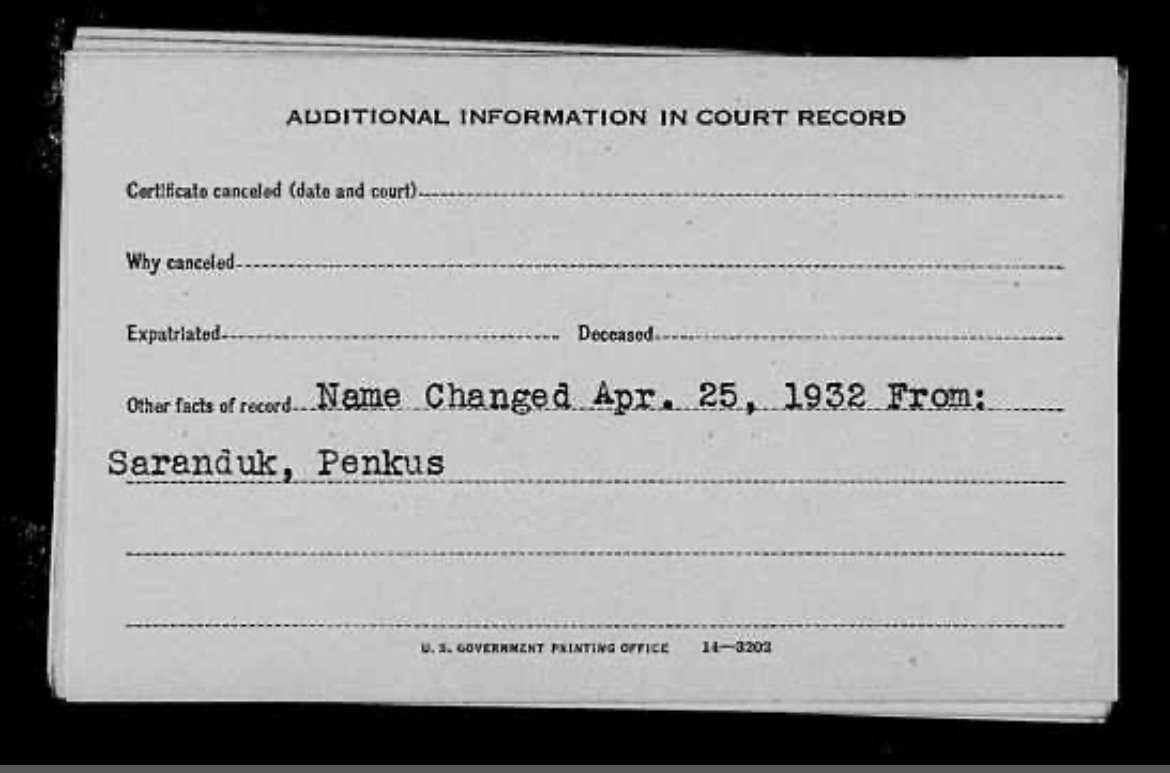
One branch — the descendants of William (Wolf Saranduk), Hyman Shore’s son — took the name Serin rather than Shore. The two families were apparently in contact: the 1904 Gerty manifest lists William (Motez Volko) as having preceded the family to America by two years, and the Philip Shore branch’s 1926 manifest listed Max Shor as their contact in Providence. The Serin branch is the subject of ongoing research.
The meaning of the name is unknown. Native Russian and Ukrainian speakers have found no meaning in it. The name appears consistently in Hebrew records going back to 1818, which suggests the family used it themselves over generations. In America it was dropped immediately — Shore by most branches, Serin by William’s descendants.
What Remains Open
- The Avrum Nikhem question: Whether the 1836 Torgovitsa Avrum Nikhem and the Avrum of Talne (1850–1897) are the same person remains unresolved.
- The Mordko branch: Revision List records document a parallel Saranduk line descending from Leyb through Mordko (rather than Avrum). Cherkassy Church Books show Saranduk births in Mokra Kaligorka through the 1890s that likely belong to this branch, but the connection to the Talne line has not been established.
- The Serin branch: William (Mordechai Ze’ev) Saranduk and his descendants took the name Serin. Their story has been partially traced but not yet written up in full.
- Female lines: Several women were recovered from census records who have no place in the oral tradition — Malka (Hyman’s older sister), Khana Pysenko (Avrum’s sister), Beyla (possibly Avrum’s sister in the Torgovitsa hypothesis). Their descendants, if any, would carry different surnames and may be impossible to trace.
A quick aside
Enjoying this post?
Come along on WhatsApp or Telegram — new posts, reflections, and the occasional spiral.