The Sun in Eclipse: Tzidkat HaTzaddik 79–80
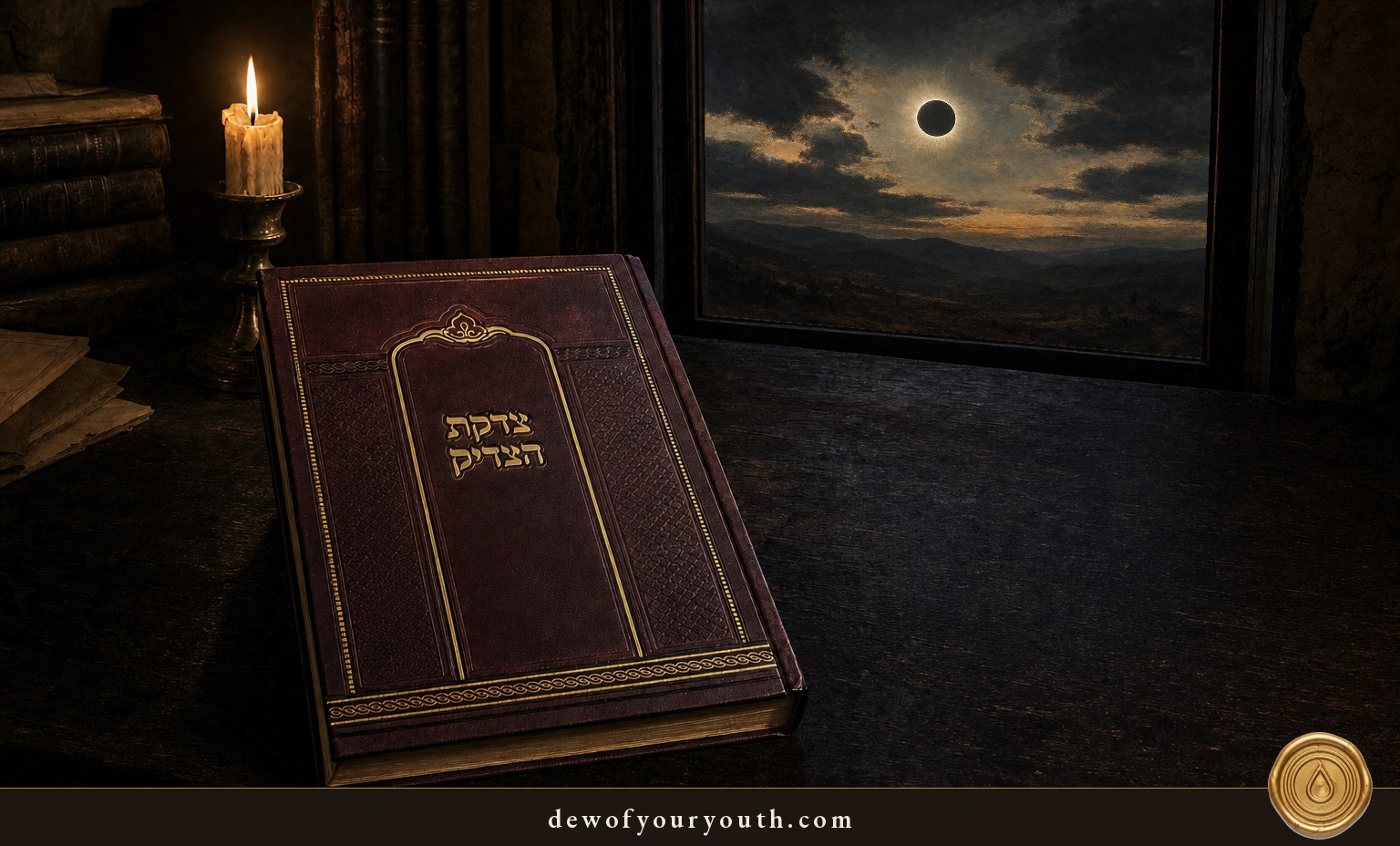
My father and I learned paragraphs 79 and 80 of Tzidkat HaTzaddik (“The Righteousness of the Righteous”): Rav Tzadok’s book of short numbered teachings on spiritual life.. After the last few, these were oddly accessible.
“It was interesting,” my father said.
It was.
What does God care?
Rabbi Tzadok HaKohen of Lublin (1823–1900), Hasidic thinker and author of Tzidkat HaTzadik. opens 79 with the question of a Pegam: a flaw or defect. A pegam lemaalah, “a blemish above,” is the damage the Kabbalists say sin does in the upper worlds., the damage sin is supposed to do on high:
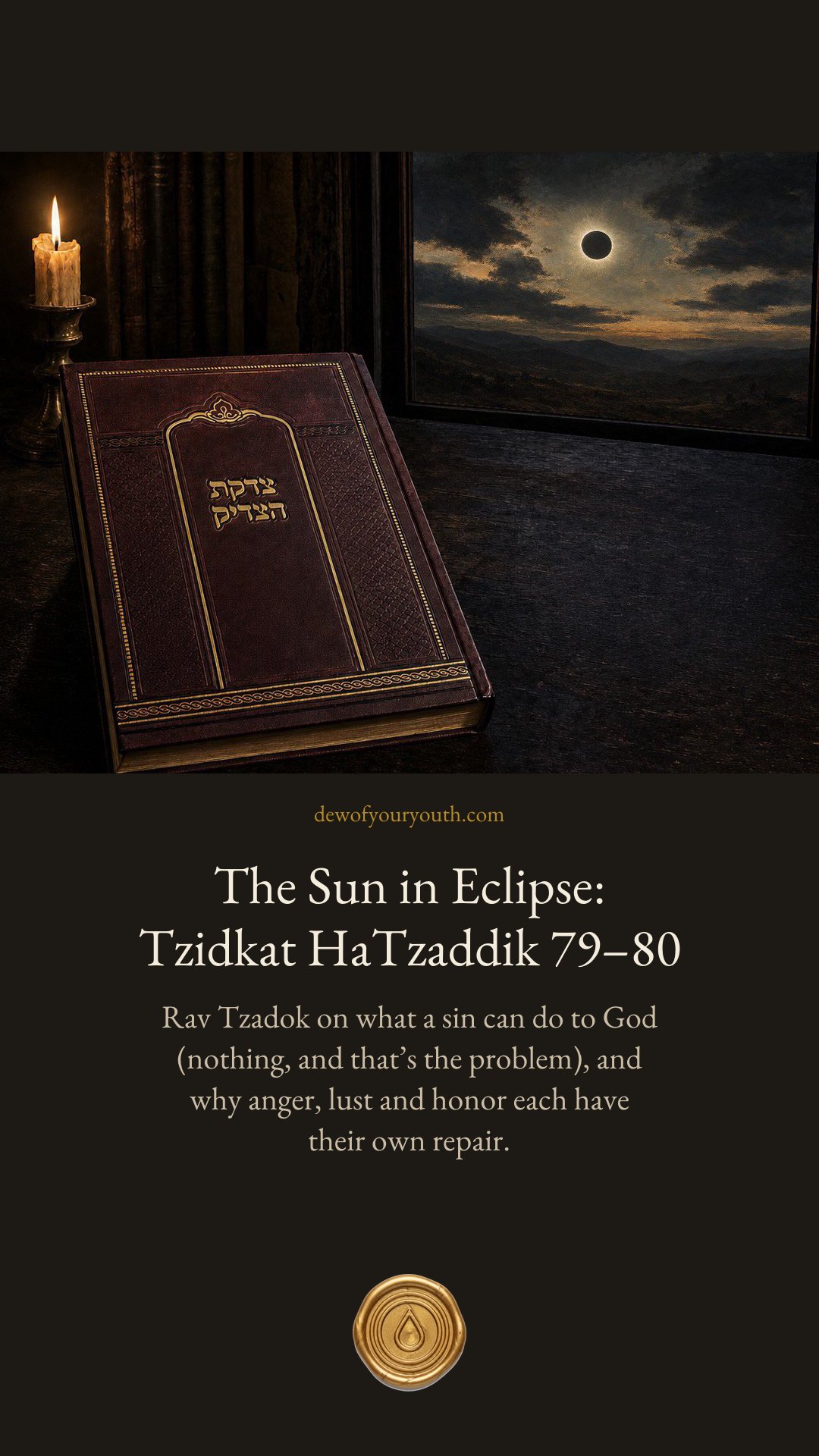
ענין הפגם למעלה ע״י עונות הוא ע״ד מה שאנו אומרים שהחמה לוקה.
The matter of the blemish above through sins is like what we say, that the sun is afflicted.1
The Hebrew for a solar eclipse is החמה לוקה, the sun is struck. But nothing happens to the sun in an eclipse. It’s at full strength. As far as the sun is concerned, it’s totally fine.
Except, Rav Tzadok says, the whole point of the sun is to shine on the earth. When its light is blocked from reaching us, that is an affliction of the sun, from the sun’s side. You could say nothing happened to it, and you’d be wrong.
Every night is a smaller version of the same thing. The sun isn’t shining on us, but when the moon is out it isn’t a complete affliction, because, as everyone knows, moonlight is sunlight. We call it the light of the moon, but people who understand know it’s really the sun, reaching us indirectly. At the end of the month, or during an eclipse, when even the moon isn’t shining, that is the sun’s complete affliction.
And this, he says, is exactly how it works above. He brings the Gemara: יותר ממה שעגל רוצה לינק, פרה רוצה להניק. More than the calf wants to nurse, the cow wants to nurse it.2 The whole purpose of everything flowing down from God is to give to Israel. When Israel sins and doesn’t take in the light of knowing God clearly, it counts, so to speak, as exhaustion in the heavenly household. That is the destruction above. Exile is the night, and there are levels within the exile itself.
When Rav Tzadok says Israel, he doesn’t mean a government. He means the people of Israel, the children of Yaakov, whose other name was Israel. The flow from above is meant for “The assembly of Israel”: the Jewish people as a single whole; in Kabbalah, also a name for the Shechinah., as we say: the assembly of Israel, the whole people taken as one. That isn’t the Knesset in Jerusalem.
But it isn’t only the people, either. Israel includes the Land. The assembly of Israel is the people wherever they are, and it’s most complete when the people are in the Land of Israel.
I always found it a little pretentious to name the parliament the Knesset, for exactly that reason. But that’s too much of a digression for today.
So what does God care if you break The Sabbath, from Friday sunset to Saturday nightfall.? It’s a question people always ask. God is infinite. What difference does it make to Him?
None. God is doing fine. There’s nothing you can do to God. What He made, He made in order to do good, and when you smoke on Shabbos, at some level He can’t fully shine into the world. The sun is fine. We’re the ones in the dark.
I once heard from a man who worked with at-risk kids that you take what you can get with some of them. One kid texted on Shabbos, did drugs, whatever. But he would never drive on Shabbos, because, in his words, “if you drive on Shabbos, you’re pissing off God.” (Big Lebowski vibes here.)
There’s some truth in it. Not in the sense that you’re getting under God’s skin, but in the sense that God made a world where godliness is supposed to flow down and do good, to Israel and to the world through Israel. And you’re standing in the way.
No light, no affliction
Then he adds a line about the nations. The Gemara reads ראה ויתר גוים, “He saw and released the nations,” as part of what happened at Sinai, and Moshe asked that the The indwelling presence of God in the world. not rest on the nations.3 So, Rav Tzadok says, they don’t receive this light at all, and there’s no affliction there.
I take him to be talking about the Shechinah specifically. The nations could have other revelations, other ways to God, that aren’t this. But this particular emanation was meant for Israel, so when it doesn’t reach someone it was never aimed at, nothing has been lost.4
Most people in the world don’t know the difference between the hand Leather boxes holding Torah passages, worn on the arm and head during weekday morning prayers. and the head tefillin, and the universe isn’t lacking anything because of it. If your cat doesn’t understand string theory, that is not an affliction of string theory. Maybe it does understand. I don’t know.
“Only Schrödinger’s cat,” my father said.
Schrödinger’s cat either did or didn’t. But when the Shechinah can’t reach the people it was meant for, that is an affliction of the Shechinah itself. That’s why, in Kabbalah: the Jewish mystical tradition, whose central text is the Zohar., when you mourn the exile, you’re meant to mourn not only our pain but the pain of the Shechinah.
The repair for anger
Paragraph 80 goes from the blemish to the repair. It’s a list:
תיקון לכעס שינוי מקום.
The Repair, rectification; in teshuvah, the repair of what a sin damaged. for anger is a change of place.5
“He’s going through the vices,” my father said.
He is. Anger first, and the Torah’s answer to anger is exile.6 What’s the ultimate expression of anger? Murder. If you murder on purpose, we have capital punishment. But a guy who kills by accident still has that thing in him. Obviously, the fact that he did it means something. So what do we tell him? Go into exile. Go to one of the Arei miklat: six cities, three on each side of the Jordan, where someone who killed by accident could flee and live..
Now he points out, in brackets, that you don’t become a nomad. You go to a refuge. Why?
כי באמת יש פחד יצחק וגבורות קדושות שטוב.
Because truly there is the Fear of Yitzchak, and holy strengths that are good.
Anger isn’t entirely unkosher. There’s proper anger and improper anger. Avraham is Lovingkindness; in Kabbalah, the divine attribute of giving without limit, associated with Avraham., Yitzchak is Strength, restraint, judgment; in Kabbalah, the divine attribute of limits, associated with Yitzchak., and פחד יצחק, the Fear of Yitzchak, is the gevurah side.7 There’s a holy version of it, and it’s good. That’s the Gemara about the young Torah scholar who boils over: it’s the Torah heating him up.8
We’re not looking for someone so cut off from this world that nothing gets to him. That’s not the Torah’s idea of a refined soul. אוהבי ה׳ שנאו רע, those who love God hate evil.9 It doesn’t say those who love God are like, it’s cool, everything’s good. Even though it’s a big, big theme in Tzidkat HaTzaddik that everything is good in the end.
So if anger were just bad, you’d keep moving forever. You’d be like Cain. He murdered somebody and he had to be נע ונד, a wanderer, for the rest of his life.10 With us it isn’t like that. You’re uprooted, but you go to a specific place.
And Cain, he says, had no city of refuge at all. That’s only for Israel. I hope he talks about Cain more later.
Gilead and Shechem
If you look at where the cities of refuge were, there were six: three across the Jordan in Gilead, and three in the Land, one of them in Shechem. The simple reason for three in Gilead is that Moshe set them aside and he couldn’t go into the Land. But that’s not enough. If one would do, he’d have done one. The Gemara says there were a lot of murderers in Gilead, and in Shechem too.11
Then Rav Tzadok:
כי אין הש״י בא בטרוניא.
Because God does not come to His creatures with grievances.
God doesn’t give you things just to be evil. If people there are murderers by nature, then most likely they also have the ability to use that for holiness, the holy heat the city of refuge stands for. When it gets out of hand, it comes out as murder. So Gilead and Shechem must have had an outsized potential for holy anger, and it came out as outsized murder.
And both are in Yosef’s portion. Ephraim was in Shechem and Menashe in Gilead. Why Yosef? Because לא תרצח and לא תנאף, do not murder and do not commit adultery, are opposites, כנודע, as is known. Your biggest weakness is your biggest strength, which is his theme again.
“Why are they opposites?” my father asked.
He says “as is known,” so he doesn’t tell us. We could speculate.
“One is generative, and one is destructive,” my father said.
One is cooperative and the other is adversarial. One is you forcing your will on somebody and ending his ability to have a will at all. There are lots of ways you could cut it.
There’s another Gemara, in Nedarim, that fits.12 Ulla was going up to the Land of Israel, and two men from Bei Chozai joined him on the road. One of them got up and slaughtered the other. Then he turned to Ulla: “Did I do well?” Ulla, fearing for his own life, said yes, and even told him to open the cut wider. When Ulla got to Rabbi Yochanan, he asked whether he had, God forbid, encouraged a sinner. Rabbi Yochanan told him he had saved his own life.
So Rabbi Yochanan is surprised. It says ונתן ה׳ לך שם לב רגז, God will give you there a trembling heart.13 That’s about Babylon, about exile! How does a guy get that angry in Eretz Yisrael? And Ulla says, at that point we hadn’t crossed the Jordan yet.
Hadn’t crossed the Jordan. So where are they? Gilead. This murder happens right there, in Rav Tzadok’s Gilead, and the Gemara doesn’t say it’s because the people there are violent. It says it’s because they’re outside the Land, and outside the Land you get the angry heart of exile. Gilead isn’t just murderers. It’s anger. And if the fix for anger is a change of place, then of course the angriest place gets the most cities of refuge.
Achav’s claim
Then a teaching he heard:
שערך וגו׳ מהר גלעד.
“Your hair is like a flock of goats streaming down from Mount Gilead.”14
It’s from the Song of Songs. Hair, he says, is the judgments and strengths in a person, and those are the holy things of Mount Gilead. It fits with things like the Someone who takes a vow to abstain from wine, avoid the dead and let his hair grow., who grows his hair long, while the A priest: a male descendant of Aharon (Aaron), Moshe’s brother and the first high priest (pl. kohanim)., who stands for kindness, can’t.
My father was struck by how they had a verse for every occasion. I’ve read the Song of Songs many times. I just don’t have it at the draw of a hat.
Then he reads King Ahab, king of the northern kingdom of Israel and Eliyahu’s great adversary.. When Achav wanted to go to war, he said to his servants, הידעתם כי לנו רמת גלעד, “Do you know that Ramot Gilead is ours?”15 Ramot Gilead was a city of refuge.16 Achav knew there was nothing that couldn’t be repaired except the killing of the prophets. So he wanted Ramot Gilead, the city of refuge for the killer, to say that his killing had been holy. That’s what לנו means: it’s ours. But it didn’t work.
The prophets died sanctifying God’s name. That was their merit, not his.
Rabbi Twersky told me a story about the Rabbi Yisrael Hopstein (1737–1814), Hasidic rebbe of Kozienice in Poland.. I’m pretty sure it was the Kozhnitzer Maggid. People used to come to him for a tikkun, a repair for their souls. Once a soul came to him from among the people who killed the prophet Zechariah in the Temple courtyard (II Chronicles 24:20–22; Gittin 57b). All these years later, it still needed a tikkun. Obviously, not a cool thing to do.
The soul asked the Maggid what he was meditating on, which mystical unifications he was doing. The Maggid told him. The soul wasn’t impressed: what you’re doing now, even the children in our time understood. And he went through the whole thing and explained it to him. So the Maggid said: fine, you’ve convinced me you’re very deep in all these secrets. So why were you such a jerk?
Their rationalization, apparently, was that Zechariah’s prophecy was so harsh, and they weren’t going to listen anyway, that out of compassion for them he should have kept quiet and taken the punishment on himself. Since he didn’t, they killed him.
It’s a very Rav Tzadok kind of story. The people who do terrible things aren’t always just some debauched guy. Sometimes they have very warped priorities. Sometimes being debauched and having warped priorities is the same thing.
Lust and honor
Back to the list:
ותיקון לתאוה שינוי מעשה, שבא דבר עבירה לידו וניצול הימנה, בזה נתקן הקודם.
The repair for lust is a change of deeds: the opportunity to sin comes to him again and he is saved from it, and by this the earlier one is repaired.17
Anger you can’t just decide not to have. You’re not in control when you’re angry, so you change your place. Lust is different. The repair is that the same thing comes your way and you don’t do it.
ותיקון לכבוד שינוי השם.
And the repair for honor is a change of name.
That’s why, he says, changing the name of someone who is sick helps.18 Sometimes, he says, one man is pushed aside for another. Say someone is in a leadership role, the time has come for someone else to take the reins, and he’s pushed aside, and he gets sick.
The rule is אין מלכות נוגעת בחברתה, one kingship doesn’t touch another, not even by a hair’s breadth. King David asked to die on a Sunday rather than on Shabbos, and was told: not even one more day. Your son Shlomo’s reign has already arrived.19
And kingship isn’t just the literal kind. Rav Tzadok says it is any kind of honor or authority, even over your own wife and children, because there’s no Jew who isn’t called the son of a king. Your honor is your kingship. So when the decree falls on that kingship, the repair is a new name. Then איננו האי גברא כלל: he isn’t that man at all.
Everyone has an aspect of kingship in them. The story goes that someone once told Rabbi Avraham Yitzchak HaKohen Kook (1865–1935), the first Ashkenazi Chief Rabbi of the Land of Israel. about a madman in town who thought he was Mashiach, and asked him to help. Rav Kook explained to the man that every Jew has an aspect of The Messiah: the anointed king from the house of David who will bring the redemption. in him. It’s just not something you’re supposed to reveal to everybody.
Repair, not removal
Notice what he isn’t saying. The blemish in 79 was from sins. In 80 he’s not even necessarily talking about sins. The sin would be what you do because of these things, like killing someone in anger. He’s not talking about destroying anger. He’s talking about fixing it, so you have the right anger and not the wrong anger. If yours is the wrong kind, maybe you need to change where you are.
“He’s big into sublimation,” my father said. That seems to be his theme throughout, channeling. Even your weak points, even your shortcomings.
It becomes clearer the more we read. You have a The Five Books of Moses; more broadly, the whole body of Jewish teaching. that’s yours. And every bad quality you have is there to be repaired, not done away with. That’s very Hasidic in general. But Rav Tzadok takes it further than most. Your biggest weakness is your biggest strength.
I’ll say that I don’t love the motivated reasoning this can turn into. It’s very easy to make every Jewish crook into a great soul who went wrong. The reason he was such a crook is that he had such deep appreciation for something holy.
“He was really a big A person devoted to acts of kindness.,” my father said.
Right. Bernie Madoff was a big baal chesed, and the other con artist is just a con artist.
These ideas aren’t for diagnosing other people. They’re practical for the person himself. If a man realizes he has a terrible desire, the first thing is not to act on it. For lust, Rav Tzadok says it outright: the repair is that the chance comes and you don’t do it. But he also needs to appreciate that the drive behind it can be used for holiness.
A debauched person who doesn’t do the repair is still debauched. We haven’t redeemed him by explaining him.
This reminded me of the The major work of Rabbi Chaim of Volozhin (1749–1821), the Vilna Gaon’s leading student, on the cosmic power of human action.. Rabbi Chaim of Volozhin writes that even a minor sin can wreck far more than Nebuchadnezzar and Titus destroyed. They couldn’t touch anything above, because they had no root up there. It was our sins that weakened the strength above and defiled the Temple on high, and that is what gave them the power to destroy the Temple below.20 It’s the same idea as Rav Tzadok’s eclipse. They were what they were. You’re taking the king’s own treasures and using them against him.
So this isn’t even specific to Rav Tzadok. It’s the universal thing. Even the A Lithuanian-style Jew; here, the analytical yeshiva tradition that came out of Lithuania. agree.
Pesachim 112a, Rabbi Akiva to Rabbi Shimon bar Yochai. ↩︎
Habakkuk 3:6, read in Bava Kamma 38a as God releasing the nations’ property after they failed to keep the seven Noahide laws. Moshe’s request that the Shechinah not rest on the nations is in Berakhot 7a. ↩︎
I wrote about where I stand on this when we learned paragraph 75. ↩︎
Numbers 35. ↩︎
Genesis 31:42. ↩︎
Taanit 4a: האי צורבא מרבנן דרתח, אורייתא הוא דקא מרתחא ליה. ↩︎
Psalms 97:10. ↩︎
Genesis 4:12. ↩︎
Makkot 9b, on Hosea 6:8–9. ↩︎
Nedarim 22a–b. ↩︎
Deuteronomy 28:65. ↩︎
Song of Songs 4:1 and 6:5. ↩︎
I Kings 22:3. ↩︎
Deuteronomy 4:43; Joshua 20:8. ↩︎
Compare Yoma 86b on the complete penitent: the same opportunity, the same woman, the same place, and he holds back. ↩︎
Rosh Hashanah 16b lists a change of name among the things that tear up a person’s decree. ↩︎
Shabbat 30a. ↩︎
Nefesh HaChaim 1:4: בחטא קל ח״ו, הרבה יותר ממה שהחריב נ״נ וטיטוס. ↩︎