Your Sins Are Not Yours: Tzidkat HaTzaddik 75–76
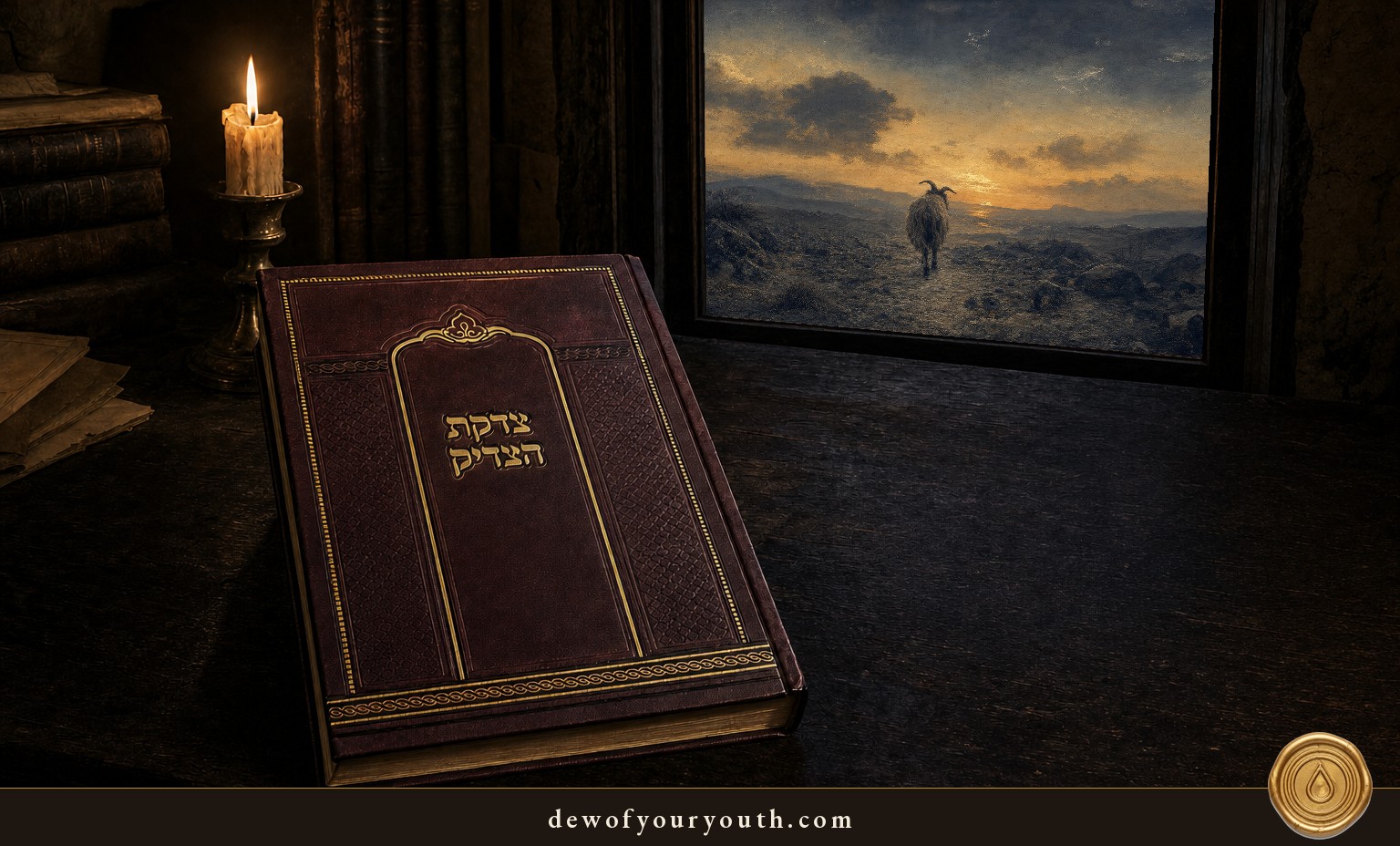
My father and I learned paragraphs 75 and 76 of Tzidkat HaTzaddik (“The Righteousness of the Righteous”): Rav Tzadok’s book of short numbered teachings on spiritual life.. Paragraph 74 is marked חסר, missing, so we did that one too. That’s all there is to do.
Rabbi Tzadok HaKohen of Lublin (1823–1900), Hasidic thinker and author of Tzidkat HaTzadik. opens 75 with:
העבירות בנפש הישראלי אינם קנין עצמיי, רק מקריי. ולכך יש להם פדיה.
The sins in the soul of a Jew are not an essential acquisition, only incidental. Therefore they can be redeemed.1
You make a An acquisition: the act that makes something legally yours, and the thing so acquired. on something when you take ownership of it. And עצם is a bone, or it’s essence. So your sins aren’t yours in essence. They just happen to be yours.
“I usually blame them on other people anyway,” my father said.
That’s exactly what he’s saying. Blame other people for all your shortcomings.
Gold bricks and oxen
Rav Tzadok brings the verse from Psalms, והוא יפדה את ישראל מכל עונותיו, “He will redeem Israel from all its sins,” and goes on:
כמו קדושת דמים יש לה פדיון שדבר אחר נתפס תמורתו וחלה עליו הקדושה, כך הוא מחלל את ישראל באחרים.
Just as Kedushat damim: property dedicated to the Temple for its monetary worth only, which can be redeemed for money. can be redeemed, because something else is seized in its place and the holiness falls on it, so He redeems Israel through others.
You need a little Temple law for this. When you dedicate something to the Temple, it’s Property consecrated to the Temple., and it can be holy in one of two ways. An animal you set aside as a An offering brought in the Temple (pl. korbanot). is holy in itself, “Holiness of the body”: an object consecrated in itself, such as an animal designated as an offering. It cannot simply be redeemed.. You can’t redeem it unless something happens to it and it can’t be offered anymore.
But say you announce that this gold brick belongs to the Temple. Only its value is holy. So you redeem the brick and hand over what it’s worth. In fact you probably should. What are they going to do with a gold brick?
Try that with an animal and it backfires. You’ve got a perfectly kosher but not especially nice ox, and you say it’s a korban. Then you think, actually, I have a better one, let me switch. The Torah says now they’re both holy.2 You can’t swap, not a good one for a bad one and not a bad one for a good one.
Sins, Rav Tzadok says, are the gold brick. They can go onto someone else. He brings ואתן אדם תחתיך, “I will give a man in your stead,” from Isaiah, and the goat that carries off Israel’s sins on The Day of Atonement, ten days after Rosh Hashanah, when the year’s judgment is sealed., and the Sages saying the sins get put on the head of Esau, Jacob’s twin brother; in rabbinic literature, the ancestor of Rome and the archetype of Israel’s adversaries..3 Whatever that means.
You can’t sell your good looks
Mitzvot are the ox:
אבל מצוות הם קדושת הגוף ואין להם פדיון.
But mitzvot are holiness of the body itself, and they have no redemption.
His verse is from the Song of Songs, אם יתן איש את כל הון ביתו באהבה בוז יבוזו לו: a man could give away everything he owns for love and he’d just be laughed at. You can’t buy a mitzvah. Then he points us to a A responsum: a rabbi’s written answer to a question of Jewish law. of Head of the academy at Pumbedita (939–1038), the last great Gaon and author of hundreds of responsa. that the Rabbi Moshe Alashkar (1466–1542), Spanish-born rabbi in Egypt and Jerusalem whose responsa preserve earlier geonic rulings. quotes, about a man who sold his mitzvot. Doesn’t work.4
“What does it even mean to sell a mitzvah?” my father asked.
Say I forgot to put on Leather boxes holding Torah passages, worn on the arm and head during weekday morning prayers.. I say to you, “I’ll pay you, and you give me the merit of the tefillin you put on today.” People have all sorts of weird ideas about selling their merits. Rav Hai calls it הבל, nonsense.5 Rav Tzadok is telling you why. A mitzvah isn’t something you own. If someone says, “I’ll give you a million dollars for your good looks,” you can’t sell them. They’re you. You could try, but it’s not going to work.
“You can’t will somebody into being a cardiac surgeon,” my father said. Your friend Sydney walks into the operating room and you tell him, “Go ahead, you can do the surgery now.”
You don’t get to heaven and find out you need this many mitzvot to ride the ride. Your mitzvot are part of you. Your sins are more like debts. Somebody else can pay a debt for you.
Esav’s imaginary birthright
Then, in brackets, he answers a question you didn’t ask. If you can’t sell holiness, how did Esav sell Yaakov the The firstborn’s status; before the Temple service passed to the priests, it included the right to bring the offerings.? That was the right to bring the offerings, a sale of something holy.
שמעתי לפי שהוא היה בכור בדמיון ולא באמת, לפיכך הועילה מכירה בדמיון.
I heard that it is because he was a firstborn in imagination and not in truth, so a sale in imagination worked.
Esav came out first, but he was never the firstborn in essence. Rav Tzadok is telling you not to get confused by the story of the lentil stew: it does not show that holiness can be sold. It shows that Esav never really had it.
My father asked whether selling the birthright isn’t more like signing over your will to somebody, a property transaction. That question is exactly what Rav Tzadok is getting at. Things like this are not property. They’re part of you.
Don’t tell the antisemites
Selling sins does work, he says: the other person becomes the substitute. He uses this to explain a line in the Gemara, that punishment comes to the world only because of Israel.6 The nations’ share in it is to suffer along with us; they are Israel’s ransom. When we do something wrong, everyone pays. I explained this as a kindness to Israel: someone else is helping pay the debt. But the good that comes to Israel as hidden reward, the nations have no share in.
“Don’t tell the antisemites that,” my father said. They could say, “Even the Jews believe they’re the cause of everything.”
It’s a Gemara; we’re not going to disown it. But antisemites have a long habit of pulling lines out of the Talmud, not to understand them but to use them as weapons. One sentence, read with no interest in what it means or where it sits in the tradition, tells you very little. And if they came to us and said, “We demand that you do Repentance; literally “return.”,” fine. They would have a point. But that is not usually what they do. Usually they try to kill us, and make it harder for us to do what’s right, not easier. If they knew what was good for them, they would make sure we could sit and learn and do the mitzvot properly.
But we don’t make the rules.
Since my father had warned me not to tell the antisemites, I figured we’d just pile it on. With the nations of the world, Rav Tzadok says, it is the reverse:
החטאים אצלם קנין הגוף בעצם ואין לו פדיון, משא״כ הטוב יש לו פדיון. ועל זה הוא הגלות שישראל קולטים אותו.
With them, the sins are an acquisition of the body itself and have no redemption, whereas the good has redemption. And this is what the exile is for: Israel takes it in.
Israel is sent out among the nations to take in the good that they do. I understood it as raising the In Lurianic Kabbalah, fragments of holiness scattered and trapped in the world, which human action can redeem and raise back to their source..7
None of this is a closed door. A non-Jew can do teshuva. He can convert. He can become a A non-Jew who keeps the seven laws that the Talmud says are binding on all the descendants of Noah.. A convert becomes part of Israel. A Noahide, even a righteous one, is still not Israel in this respect, though it may be that someone who attaches himself to Israel takes on something of it.
I don’t really understand what any of these things mean. If I understood what the holiness of Israel actually was, I would be a much greater person.
I’m explaining Rav Tzadok here, and I should say where I stand. I do believe the merit of our ancestors is something special, and what he says about it is true. Something of Avraham, Yitzchak and Yaakov really is passed down. We talked about that when we learned paragraphs 62–63.
I also believe that all of humanity has strong pathways to God. Any person can reach moral greatness, closeness to God, and a place in the World to Come. That isn’t a modern add-on. It is classical Jewish thought: the righteous of the nations have a share in the World to Come, and the Rambam writes that not only the tribe of Levi but any person in the world whose spirit moves him can set himself apart to stand before God and become holy of holies (Tosefta Sanhedrin 13:2; Rambam, Hilkhot Melakhim 8:11 and Hilkhot Shemitah VeYovel 13:13). I don’t think every Kabbalist would put it that way. Rav Tzadok’s paragraph comes from that world, and I’m learning it as his view, not the last word.
And I’m not disagreeing with Rav Tzadok or the Gemara when I say that “punishment comes to the world only because of Israel” is beyond my understanding. I just don’t think you can build an account of why a flood or an earthquake happens out of a single line of Gemara. That isn’t good reasoning for someone who believes in the Gemara, let alone for someone who doesn’t. I can explain what he says. I can’t tell you why a particular disaster happens to anyone.
Tzaddik and chasid
I had been listening to a class by Rabbi Haber on another part of Tzidkat HaTzaddik. He says that if you have a good nature and you follow it and do what Literally “the Name”: a reverent way of referring to God. wants, that is the aspect of a A righteous person; tradition calls Yosef (Joseph) the tzaddik., a righteous person. If you have a bad nature, and you don’t want to, and you take that bad and transform it into good for Hashem, that is the aspect of a A pious person; in this sense, one who goes beyond what is required.. Everyone has both.
That, he says, is why we don’t call the righteous among the nations צדיקי אומות העולם. We call them “The pious of the nations of the world”: the rabbinic term for righteous non-Jews.. A convert, by contrast, is a A convert to Judaism (pl. gerim). tzedek, a convert of righteousness: the aspect of tzaddik.
We Jews believe in original sin. We just believe it is specific to non-Jews.
“Oh really?” my father asked. “Is that right?”
We do believe that mankind fell after Adam’s sin. The Gemara says that when the serpent came to Chava, he put a Zuhama: the spiritual contamination the serpent introduced into Chava, and through her into humanity (Shabbat 146a). into her, and the filth of Israel ceased when they stood at Sinai.8 It took Avraham, then Yitzchak, then Yaakov to build the momentum, and at Sinai the serpent’s filth left us. We were scared straight. Then we made the Golden Calf and got something new, which is why we still have an internal The evil inclination: the drive in each person toward sin; its counterpart is the yetzer tov, the good inclination..
“That’s also kind of genetic, you might say,” my father said.
Heritable changes in how genes are expressed, without any change to the DNA itself., even, as we put it when Rav Tzadok was talking about what parents pass down.
“So we really do believe, in a sense, in a collective unconscious,” he said. “Like Jung.”
I think the change at Sinai happened well above consciousness. Consciousness is low down, at the level of the The lowest of the five levels of the soul in Kabbalah, bound up with the body; above it are ruach, neshamah, chayah and yechidah.. The change was in the neshamah, or maybe even higher, at the levels of chayah and yechidah. I don’t know exactly where. I’m no expert in Lurianic Kabbalah, and Rav Tzadok talks about it later, so I’m not going to speculate.
My father pointed out that this is Rav Tzadok’s whole thing: things are not what they appear to be. On a literal level they look one way, but only because you’re in this world, sensing everything from here. In a higher dimension it’s not that way.
“Except the problem is,” he said, “you could say everything’s not that way.”
And you’d be correct. At some point, though, it’s not a matter of whether you’re right. When you use the bathroom, you need to aim. You can’t say, “That’s not really a toilet.” What we see is true. It isn’t fake. It’s just the tip of the iceberg.
My father’s image for it is peeking through a keyhole into a banquet hall. What you see is really there. It’s just a sliver of it.
Take the Following the Kabbalah of Rabbi Isaac Luria (the Arizal, 1534–1572) of Safed, the dominant system of Jewish mysticism since. picture. Usually you think of yourself as ending around here, around your skin. Even a Cartesian solipsist believes that. Maybe not exactly where your hair stops. If you grow an afro, I don’t know. But really, you’re a beam of light coming down through the worlds of The four descending worlds of Kabbalah, from Emanation down to Action, our physical world., and at the very tip of Asiyah you have a little body that walks around. That’s not where you end. That’s barely where you begin.
What are you going to do with that? Duck every time you go through a door? You walk into a skyscraper: why is everyone stepping on my head? Can’t you see I’m a beam of light from eons of light-years above?
My father has photographs from Monument Valley, taken by my Uncle, in which he looks like a column of light: one beam straight down his center, one on each side.
None of this is useful to think about for most of your life, I said. What are you going to do with the information?
“You’d be amazed,” he said, “how much of my time is spent pondering things with absolutely no practical import.”
Me too.
The moment of failure
Then paragraph 76:
בעת כשלון האדם ידע שבאותו עת הוא הכנה לאותו דבר לטוב, ואם יזכה באותה שעה יוכל לעלות למדרגה גדולה מאד.
At the time of a person’s failure, he should know that at that very time it is a preparation for that same thing for good; and if he merits it in that hour, he can rise to a very great level.9
And the measure is exact:
כפי גודל החטא שהיצר מסיתו, כך הוא גודל הטובה שיוכל לקלוט אז.
As great as the sin the The evil inclination: the drive in each person toward sin; its counterpart is the yetzer tov, the good inclination. is inciting him to, so great is the good he can take in then.
If he turns this desire and this craving to good, then from that very thing comes the good, the reverse of the evil.
He means the moment of temptation, when you’re on the edge of failing and haven’t yet. The bigger the sin pulling at you, the higher you can climb by turning it around.
My father connected this to Rav Tzadok’s own life. As a young man, his first marriage fell apart. His wife would not accept a divorce, and he set out to collect a “Permission of a hundred rabbis”: the signatures needed to let a man remarry when his wife refuses a divorce.. As the story goes, the Rabbi Yitzchak Meir Alter (1799–1866), founder of the Ger (Gur) Hasidic dynasty, known by the title of his works. warned Rav Tzadok at the time that he was making a mistake: his wife was innocent, and if he went through with the divorce he would not merit children. He didn’t judge her favorably and continued with the divorce. But that journey is what brought him to the Rabbi Mordechai Yosef Leiner of Izbica (1801–1854), author of Mei HaShiloach, student of the Kotzker Rebbe and teacher of Rav Tzadok., and it set him on the path that made him Rav Tzadok.
I think my father is right that the idea of failure as God’s will is at least illustrated by that story, if it isn’t the source of it. It was probably a moral failing. Maybe the only one in his life. We should all be so lucky to have one moral failing. But in paragraph 76, Rav Tzadok is talking about the moment of failure, when you are about to sin. He is not talking about the aftermath, when you have sinned and are dealing with it.
His Hebrew isn’t especially precise here, but you cannot demand grammar from Hasidic The leader of a Hasidic community; also what a student calls his own Torah teacher..
Read narrowly, בעת כשלון האדם sounds like after the fact: at the time of failure, once it has happened. For the moment before, I would have expected something like בעת שנכשל. But the rest of the paragraph only makes sense before you act, since he’s talking about turning the very desire that’s pushing you to good. He’s just not precise about it.
Maybe in Yiddish he’d have been more precise, my father suggested. That excuse works for the Rav Tzadok’s Shabbat and festival teachings on the weekly portion, written down by his students., which his chasidim wrote down from what he said over on The Sabbath, from Friday sunset to Saturday nightfall.. But Rav Tzadok wrote Tzidkat HaTzaddik himself. He has no excuse.
A rebbe is giving a sermon on the Torah portion of Korach. It opens וַיִּקַּח קֹרַח, “Korach took,” and the rebbe announces that וַיִּקַּח is written חסר, without one of its optional letters. Korach was חסר, lacking. Lacking in fear of Heaven, lacking in this, lacking in that.
One of the chasidim looks in his The Five Books of Moses in printed form, usually with commentaries.. “But Rebbe, it’s written מלא. It’s spelled full.”
“Exactly,” says the rebbe. “Full of arrogance, full of lust.”
What would have happened
He illustrates with two disasters. First the Flood. The The central work of Kabbalah, a mystical commentary on the Torah that surfaced in 13th-century Spain. says that at the time of the Flood, the world was fit to receive the Torah. Moshe was there too, so to speak: the Gemara finds him in בשגם, “in that also they are flesh,” in the Flood story, because בשגם has the same A method of interpretation that assigns each Hebrew letter a number and compares words of equal value. as משה.10 Water is Torah, and they turned it into the raging waters. Torah is the purpose of the world’s existence, the reason it was created, and they brought about its destruction. That moment was ready, if they had merited, for the exact opposite: the waters of Torah coming down to sustain the world.
All of humanity could have received the Torah right then. Think how much aggravation it would have cut out. No Egypt, no forty years in the desert. Think how short it would be. You could read the whole thing over a weekend.
Then the Destruction. The Yerushalmi says that on the day the Temple was destroyed, The Messiah: the anointed king from the house of David who will bring the redemption. was born. We saw this teaching in paragraph 70; here Rav Tzadok explains it. That moment was ready, if they had merited, for the coming of Mashiach and the building of the eternal Temple. That was the mistake of the people of Jerusalem and the false prophets. They thought that, on the contrary, Hashem would be good to them. They saw that the time was ready, if they merited.
Look at what the zealots did during the siege. They burned the stores of food so people would have no choice but to fight the Romans.11 They were totally bonkers. But Rav Tzadok is saying they weren’t entirely lunatics. They sensed that the hour was ready. They just weren’t worthy of it.
There are lists of moments like that, when people were sure the redemption had to come: the Inquisition, the massacres of 1648.
“The 17th-century false messiah (1626–1676) whose movement swept the Jewish world before he converted to Islam.,” my father said.
Exactly.
Option A and option B
“Wait,” my father asked. “What’s his bottom line?”
I think this is a counterweight to everything he says about what happens after you fail. After you fail, you need to appreciate that your failure was God’s will. It is possible you had no ability to overcome it.12 Your real A test or trial of character (pl. nisyonot). is now that you’ve failed: how are you going to deal with it? Full teshuva is realizing that everything comes from Hashem, and he has a lot to say about that elsewhere.
But that’s all after. Here he’s talking about the moment before, when you’re about to fail. You have two options.
Option A: “I’m such a jerk. I’m such a loser. I can’t believe I’m doing this.” He’s saying don’t do that.
Option B: realize that right now, as badly as you want to do this sin, and as bad as the sin is, you have an opportunity to overcome it. Whatever you would have ruined through the sin, that is the size of what you can reach instead. Say you suddenly really want to kill someone, or sleep with a married woman, or worship idols. Don’t do it. Tell yourself: as much as I want it, this must be a particularly fortuitous time for me. It’s an עת מוכן, a time made ready, when I can reach levels I never dreamed of. That’s why I suddenly have this desire. If I overcome it, I’ll merit those levels.
That’s his point. And he illustrates it with these stories. The Flood was pretty bad. You know what could have happened at the Flood? The giving of the Torah. The Destruction of the Temple was pretty bad. You know what could have happened then? Mashiach could have come.
My father’s point is also true, and we said it last time too: whatever failings you have, they made you. They are what put you on the path. We don’t understand the full extent of how, but even that is God’s will.
Yes, we wander off topic. My father called the tangents the interesting rivulets that come off the main stream, and I don’t think they’re a detour. Rav Tzadok is not meant to be read and not digested. You read him and then think about what he means, because he says wild stuff. You can read the The foundational work of Chabad Hasidism, by Rabbi Shneur Zalman of Liadi (1745–1812). and he pretty much says what he means. The Rabbi Moshe Chaim Luzzatto (1707–1746), Italian kabbalist and ethicist, author of Mesillat Yesharim and Derech Hashem. is precise and systematic. Rav Tzadok is something else.
My father put it well. There are two ways of communicating. There are people who are a little more pedantic, but probably better at explaining things. And there is the person with a lot going on in his head, whose thought comes out in a very distilled form. It’s succinct, which in a sense makes it less clear. There are paradoxical elements, or things that only look that way.
Rav Tzadok is usually the second kind. And then, out of nowhere, he turns the pedantry up to eleven. You’ll be reading about how this is the secret of such-and-such, and then: don’t ask me from the Medieval Talmud commentators of France and Germany (12th–14th centuries), printed alongside Rashi. on such-and-such a page, because you should know that there is a variant reading in some manuscript somewhere.
Everything and the kitchen sink.
Tzidkat HaTzaddik 75. It is missing from the printed editions; our edition restores it from the edition of Rabbi Avraham Eliyahu Kitov. The 1913 Lublin printing on Sefaria marks both 74 and 75 as missing. The verses are Psalms 130:8 and Song of Songs 8:7. ↩︎
Leviticus 27:10: לא יחליפנו ולא ימיר אתו טוב ברע או רע בטוב … והיה הוא ותמורתו יהיה קדש. ↩︎
Isaiah 43:4; Leviticus 16:22. For the sins on Esav’s head, Bereishit Rabbah 65:15 reads ונשא השעיר עליו את כל עונתם as עונות תם: the hairy one, Esav, carries the sins of Yaakov, the “plain man.” The notes in our edition add the Mekhilta on Mishpatim, where the nations are given as atonement in place of Israel. ↩︎
Responsa of the Maharam Alashkar 101. The Maharam Alashkar says he found nothing on the question except a responsum of Rav Hai Gaon, which he copies out. Rav Hai’s answer also quotes אם יתן איש את כל הון ביתו באהבה, the same verse Rav Tzadok uses. ↩︎
The question put to Rav Hai Gaon: one man fasts every Monday and Thursday and then declares that the reward for the fast goes to someone else; another gives gold on condition that the merit of a man’s Torah reading will be his. Rav Hai answers that these are empty words with nothing to rely on, and that someone who tries to buy another’s reward makes himself an object of ridicule. ↩︎
Yevamot 63a, in the name of Rabbi Elazar bar Avina: אין פורענות באה לעולם אלא בשביל ישראל. ↩︎
The notes in our edition point to paragraph 256 for more on this. ↩︎
Shabbat 146a. ↩︎
Tzidkat HaTzaddik 76. Rav Tzadok mentions the Zohar on Pinchas, the Sages on בשגם and the teaching about Mashiach’s birth; the exact references (Zohar III 216a, Chullin 139b, Yerushalmi Berakhot 2:4) and Nedarim 32a on Torah sustaining the world come from the editors’ notes. ↩︎
Chullin 139b on Genesis 6:3. Rashi there points out that the same verse gives a lifespan of 120 years, which was Moshe’s. ↩︎
Gittin 56a. ↩︎
Tzidkat HaTzaddik 43: sometimes a person faces a test so great that he cannot help sinning, and then he counts as coerced and is exempt. But, Rav Tzadok adds, no one can testify about himself that this was his case, because maybe he still had the strength to resist. ↩︎