Modern Standard Arabic, Hebrew, and the Ghost of Yiddish
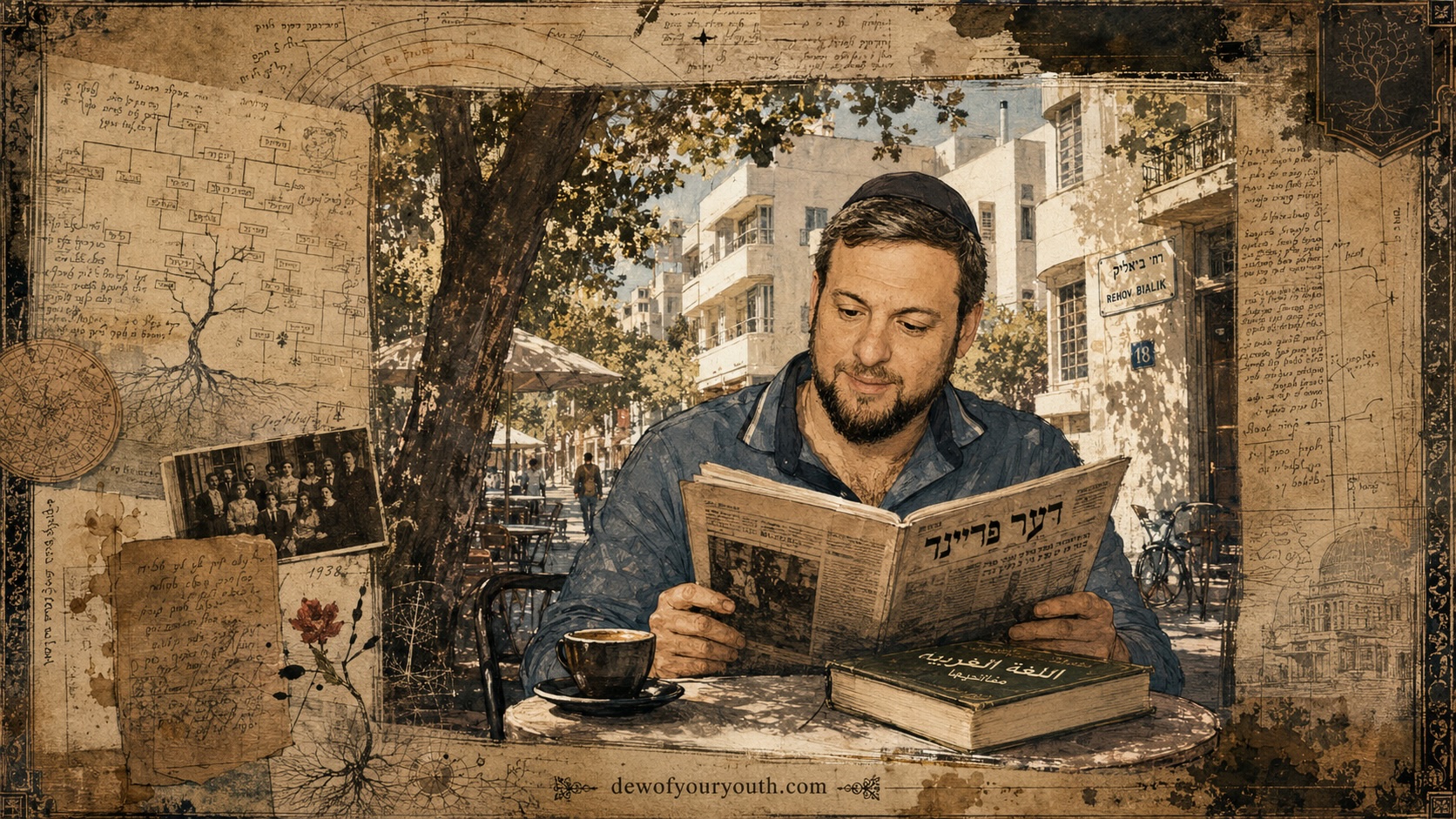
Modern Hebrew and Modern Standard Arabic
Hebrew and Arabic share deep linguistic roots, but their modern histories seem at first glance to have little in common. One was the sacred tongue of a scattered minority, preserved largely in prayer and scholarship. The other was the liturgical language of a global religion, spoken in dozens of dialects across a vast geography. Yet both underwent serious efforts at standardization within roughly the same historical window — and both largely succeeded. That parallel is worth examining.
The widespread adoption of Arabic occurred centuries after the first golden age of Hebrew. Islam spread after the Jews’ exile from their homeland, and even during the Second Temple period, Aramaic was already the lingua franca of the Levant and had replaced Hebrew in everyday life among upper-class Judeans. Hebrew was mostly relegated to religious study and prayers. By the 10th century, Arabic had fully replaced Aramaic as the dominant language of the MENA region. Pockets of Aramaic persist among Assyrian Christian communities in Syria, Iraq, and northwestern Iran — but the displacement was, for practical purposes, total.
So it’s rather surprising that both languages underwent parallel movements of standardization in the late 19th and early 20th centuries — and that both efforts were widely accepted in very different contexts. In this post, I’ll compare those efforts and examine the political and social forces that likely drove them. I’m neither a linguist nor a philologist, and I don’t play one on TV — so these observations should be taken for what they are: the impressions of a layman with a love of languages.
Matters of Scale
Whenever comparing Arabic to Hebrew, the first thing to establish is the difference in scale. There are an estimated 375 million native Arabic speakers — and that figure doesn’t account for the hundreds of millions more who use Modern Standard Arabic as a second register in formal, written, or broadcast contexts. By contrast, there are approximately 7 million native Hebrew speakers, with the total global population sitting around 10 million. We are not comparing like for like. We are comparing one of the world’s major languages to a small national language that, by any reasonable measure, should not exist in its current form.
The Golden Age of Language Standardization
Causes of the Standardization Trend
Hebrew and Arabic did not standardize in a vacuum. The 19th century was the golden age of philology — and more importantly, the golden age of nationalist movements that needed philology to do political work.
Across Europe, emerging nation-states were reaching for ancient languages to anchor new identities. Czech, Slovak, Finnish, Norwegian, Irish, Welsh — all underwent serious standardization or revival efforts during this period. The logic was consistent: a nation needed a language, and if that language had been suppressed or had atrophied, it needed to be recovered and formalized. Linguists and folklorists were doing the work of nation-building as much as politicians were.
Several forces converged to make this possible. Print culture created practical pressure toward standardization — you cannot publish a newspaper or a political pamphlet in seventeen regional dialects simultaneously. The collapse of old empires, particularly the Ottoman Empire, created political vacuums that nationalist movements rushed to fill. And academic philology had matured enough to provide the scholarly infrastructure: grammars, dictionaries, comparative linguistics, and the tools needed to codify a standard.
It is worth noting that many of these movements were also reactions against colonial or imperial cultural dominance. The message embedded in language revival was often: we have our own history, our own literature, our own tongue — we do not need yours.
Irish: Standardization at an Autopsy
Irish, honestly speaking, wasn’t even on my radar until recently. I grew up in Boston and always thought of Ireland as an English-speaking culture. But my recent acquaintance with Irish people from Ireland has opened my eyes to a much more nuanced and sobering story of a culture that was systematically marginalized by the English Empire.
Irish is a useful cautionary case. By the time serious standardization efforts began in the 1890s — driven largely by the Gaelic League — the language already had one foot in the grave. The Great Famine had devastated the Irish-speaking west. English was the language of economic survival, emigration, and aspiration. Native speakers were a dwindling rural minority.
The standardization effort was largely the project of urban intellectuals, many of whom had learned Irish as a second language and were driven as much by romantic nationalism as by any organic connection to living speech communities. The result was a language constitutionally enshrined as Ireland’s first official language, which most Irish people cannot speak. Road signs are bilingual. Schools teach it. The Gaeltacht regions where it is genuinely spoken continue to shrink.
This is not a failure of the standardization effort per se. The grammar was codified, the spelling regularized, a written standard exists. But standardization without a living speech community to carry it is preservation, not revival. Irish today is a beautiful language in a glass case.
The Hebrew Exception
Hebrew should not have worked. By the late 19th century, it had not been a spoken vernacular for roughly two millennia. On paper it looked a lot like Irish: an ancient language kept alive by religious practice and scholarly tradition, with no community raising children in it as a mother tongue.
But there was a crucial difference. Hebrew had never stopped functioning as a contact language between Jews. The linguist Shlomo Izre’el has written about the pre-state conditions of Palestine and the degree to which Hebrew already served as a practical pidgin — a bridge language between Jews who arrived speaking Yiddish, Arabic, Ladino, Persian, and a dozen other tongues and had no other common ground. This was not a new phenomenon. Benjamin of Tudela in the 12th century and Obadiah of Bartenura in the 15th century both traveled extensively through Jewish communities across the Mediterranean and Middle East, corresponding and communicating in Hebrew with communities that shared no other language. Hebrew was transactional and limited — but it was alive as a contact register in a way Irish never was.
What the revival did, then, was not resurrect a dead language. It took an existing contact register — functional but thin — and gave it the full formal apparatus of a modern vernacular. Grammar was codified, vocabulary was coined for concepts that didn’t exist in biblical or rabbinic Hebrew, and crucially, a generation of children grew up speaking it as a first language. Eliezer Ben-Yehuda, the figure most associated with the revival, raised the first modern native Hebrew-speaking child deliberately, as a kind of proof of concept. The concept worked.
Why did it work when Irish didn’t? Partly because every speaker already had prior knowledge of the language — the revival was asking people to expand and activate something they had already internalized, not learn something foreign. But the fuller answer requires acknowledging the catastrophic historical context. The generation that saw Hebrew become a living vernacular was also the generation of the Holocaust — the near-total destruction of the Yiddish-speaking world. The mass immigration to Israel that followed brought people who had lost everything and were, in many cases, actively choosing to build an identity outside a narrative of victimhood and exile. Hebrew wasn’t just a practical necessity — it was a statement. In that context, the sacrifices involved in abandoning a mother tongue felt less like loss and more like transformation.
A quick aside
Enjoying this post?
Come along on WhatsApp or Telegram — new posts, reflections, and the occasional spiral.
MSA: A Standard Without a Street
Modern Standard Arabic occupies a genuinely strange position. It is nobody’s mother tongue. No child grows up speaking it at home, no neighborhood conducts its arguments in it, no market vendor haggles in it. It exists as a written and formal register — the language of newspapers, official documents, political speeches, and broadcast media — sitting above a vast landscape of living dialects that are mutually intelligible to varying degrees and in some cases barely at all. An Egyptian and a Moroccan can communicate in MSA. In their respective dialects, they may struggle considerably.
In this sense, MSA is structurally more similar to pre-revival Hebrew than it might appear. Both were formalizations of an existing contact register — a shared linguistic roof above communities that spoke different things at home. The difference is that MSA will not replace the living Arabic dialects any time soon. There is no equivalent of the Zionist project forcing the issue — no mass ingathering of Arabic speakers who need a single vernacular to function together. The dialects are too deeply rooted, the communities too geographically stable, the pressure too diffuse. MSA does its job as a formal register, and then everyone goes home and speaks Levantine, or Egyptian, or Darija.
Whether this is a problem depends on what you think language standardization is for. As a tool for pan-Arab communication and shared cultural identity, MSA functions adequately. As a living vernacular — the kind of language you think and dream and argue in — it does not exist, and probably never will.
A Personal Postscript: The Pronunciation Problem and Yiddish
There is one dimension of the Hebrew revival that I find myself unable to resolve cleanly, and it concerns pronunciation.
Modern Israeli Hebrew uses a pronunciation that is, in most respects, closer to the historical reality of ancient Hebrew than the Ashkenazi pronunciation it largely displaced. The Sephardic-influenced vowel system, the distinction between aleph and ayin — these are not arbitrary choices. And yet something was lost when Ashkenazi pronunciation was pushed to the margins. Centuries of a specific community’s relationship with the language — the way a Lithuanian Jew said Shabbos, the particular music of Ashkenazi davening — these are not simply errors to be corrected. They are a living record of where the language went and what it became in exile.
It is worth noting, incidentally, that neither pronunciation tradition fully preserves the original. The daled without a dagesh, for example, was almost certainly pronounced as a dh sound — like the th in the — a distinction that both Modern Hebrew and Ashkenazi Hebrew have collapsed entirely. The claim that modernization was a return to authenticity is only partly true. It was also a set of choices, and some of what was chosen against was worth keeping. For more information on this from a Halachic perspective, Rav Kook has a responsum on the topic in his Responsas Orech Mishpat - The laws of reciting the Shema (16 - 17), arguing that each community should maintain its own pronunciation tradition. For the counter argument, which I have halfway embraced myself, see the Teshuva of Rabbi Ovadia Haddaya on the topic, which argues that pronunciations that are indefensible are just considered מנהג טעות — mistaken customs that can be corrected without halachic consequence. It’s in Shut Yaskil Avdi, Volume Two, Orech Chaim - Responsa 3. It also goes through all the various congregations and points out various mistakes they make in their pronunciation, which is interesting in its own right. He lists Ashkenazim, Sephardim, Tunisians, Persians, Georgians, Yeminites and Syrians, and finds mistakes in all of them — which is a reminder that no tradition is perfect, and that the idea of a single “authentic” pronunciation is always going to be an idealized fiction.
The Ashkenazi rabbinic establishment has largely responded by treating modern Hebrew as a separate language, which has real halachic implications, and which strikes me as simultaneously defensible and convenient. Defensible because the gap is genuine. Convenient because it neatly avoids having to engage with the new thing on its own terms.
One striking example of this is the disconnect in the spelling of names in Gittin (divorce documents). The correct spelling of names in Jewish divorce documents is generally determined by the most common form a name appears in the Bible — but this is only in the absence of a known way the individual signs their name. If the parties have a way in which they sign their name, it generally supersedes the Biblical spelling. The modern Israeli convention is to spell most names במלא, including all vowel letters. The name of Aaron, for example, is invariably spelled in the Torah as אהרן — without the ו — but is commonly spelled by Israelis as אהרון, with a ו. To my knowledge, this signature is generally dismissed in rabbinical courts on divorce documents — even though it is how the divorcing husband actually signs his name — on the grounds that it is considered as though the signature is in a different language.
I contain this contradiction personally. I daven in Ashkenazi pronunciation as a rule — it is the tradition I inherited and the one I feel at home in. But I say Kriyas Shema in modern Hebrew (with certain modifications - see note), and sometimes I find myself davening Shemoneh Esrei in it too, without quite deciding to.
Yiddish is a separate grief entirely — not about pronunciation or authenticity, but about what was thrown away. I came to Yiddish by choice, not inheritance — which means my grief isn’t quite personal. I wasn’t deprived of my own mother tongue. I was deprived of my ancestors’. The Jews who fled Europe ran as fast as they could and wanted nothing more than to belong to wherever they landed. They looked at Yiddish and saw only the memories of oppression and pain it carried with it. Very few stopped to consider the richness of culture, wisdom, and humor that had emerged from centuries of exile — the literature, the jokes, the philosophy, the music. They couldn’t see past the suffering to what the suffering had also produced. You can understand why. It is hard to find the beauty in something while you are still bleeding from it. The cooling of history takes time.
A handful of people saw it clearly at the time, and they came from opposite ends of the Jewish world. YIVO, founded in Vilna in 1925, was a secular academic project — an attempt to document and legitimize Yiddish as a civilization worth studying before it disappeared. The Hasidic rebbes, from the other end entirely, preserved Yiddish as a living vernacular almost by accident — not out of any program to save the language, but as a byproduct of refusing modernity wholesale. A Satmar child in Williamsburg today grows up speaking Yiddish as a genuine mother tongue, which is quietly remarkable. The irony is that the people most hostile to Yiddish as a serious cultural inheritance were the secular Jewish intellectuals and Zionists — the modernizers — while the people who actually kept it alive were either ultra-Orthodox communities who rejected the entire modernist project, or academics performing an autopsy with great affection. The mainstream just left, and didn’t look back.
I learned Yiddish because I looked back. What I found there was worth the looking.
With Arabic, I have none of this. No tradition to defend, no inherited pronunciation to feel ambivalent about, no identity wrapped up in which form of the language is correct. I came to Arabic as a guest — curious, unencumbered — and the result is that I gravitate instinctively toward the dialects. MSA is impressive and useful, but it is nobody’s mother tongue, and I find myself more interested in talking to people than in mastering a formal register. The Levantine and North African dialects I study feel alive in a way MSA doesn’t — warmer, more particular, more human. When you have no stake in the standard, the answer to “which form of the language should I learn” becomes obvious: learn how people actually speak.
The contrast is clarifying. With Hebrew, I carry the weight of inheritance — and that weight makes every question about pronunciation or usage into something larger than linguistics. With Arabic, I am free of that, and the freedom changes what I’m even looking for.
Maybe that’s what a living language does: it asks something of you. Hebrew asks me to figure out who I am in relation to my tradition. Arabic just invites me in. I’m grateful for both, and I’m not sure I’d trade either relationship for a simpler one.