If You Know Hebrew, Do You Know Moabite?
I recently wrote about Hebrew and Arabic, the words they share, and the ones that look familiar until you discover that you have confused bread with meat.
Learning Arabic has also made me think about what we mean when we call two ways of speaking different languages, rather than different dialects. Moroccan Arabic and Palestinian Arabic both get called Arabic, but that does not mean that speakers can necessarily understand each other without exposure or accommodation. The differences can be substantial.
Meanwhile, Hebrew and Moabite get different names.
How different are they, though? If you know Hebrew, how much Moabite do you already know?
There is a fairly straightforward way to try this. We have a long inscription left by a Moabite king. Put it into familiar letters and see how far you get.
That is the experiment here. I am a Hebrew speaker reading Moabite, not someone who has learned Moabite explaining it afterward. My first readings include guesses, things I get approximately right, and things I get wrong. Those are part of the result. I will keep them visible and distinguish them from the corrections. Otherwise, it would be rather easy to demonstrate how much Moabite I understand by first looking up all the Moabite.
A Moabite King Introduces Himself
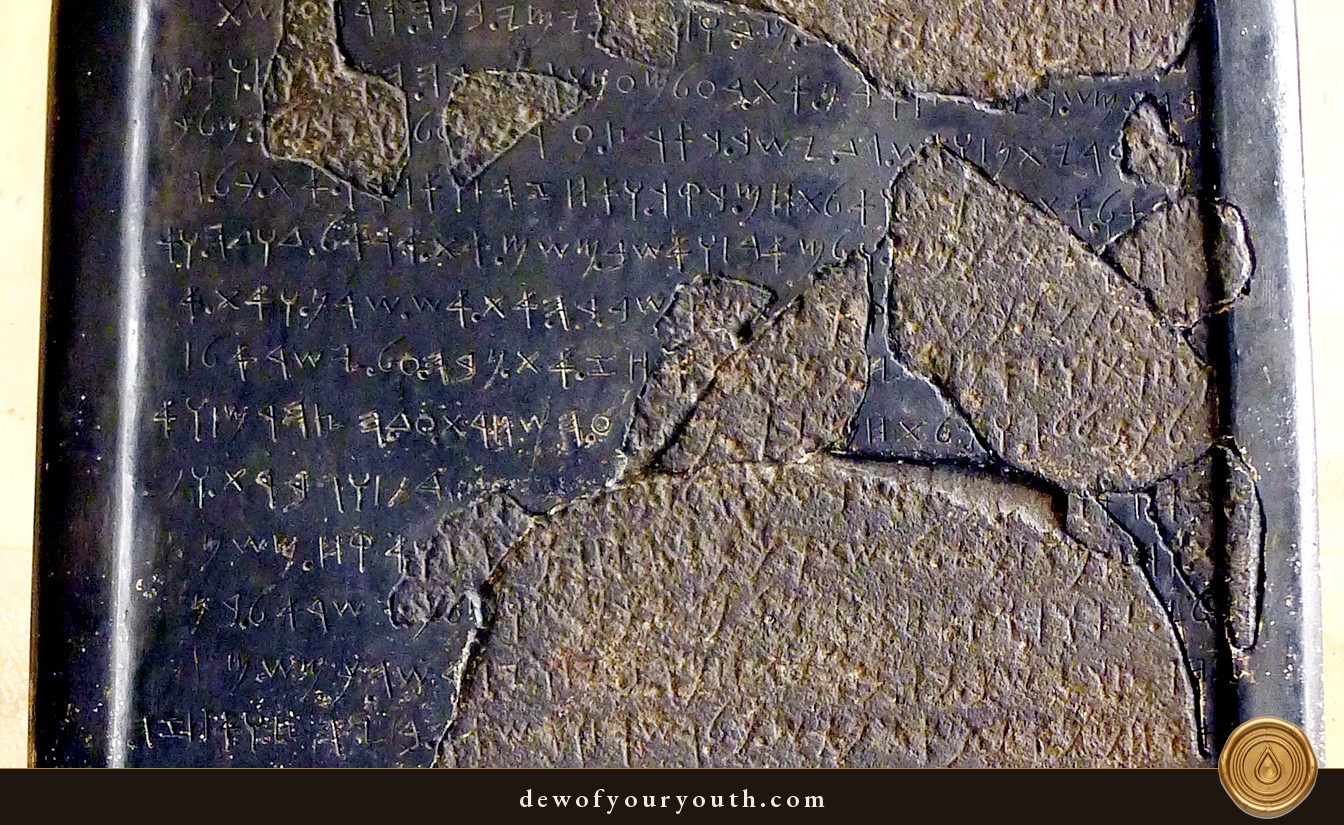
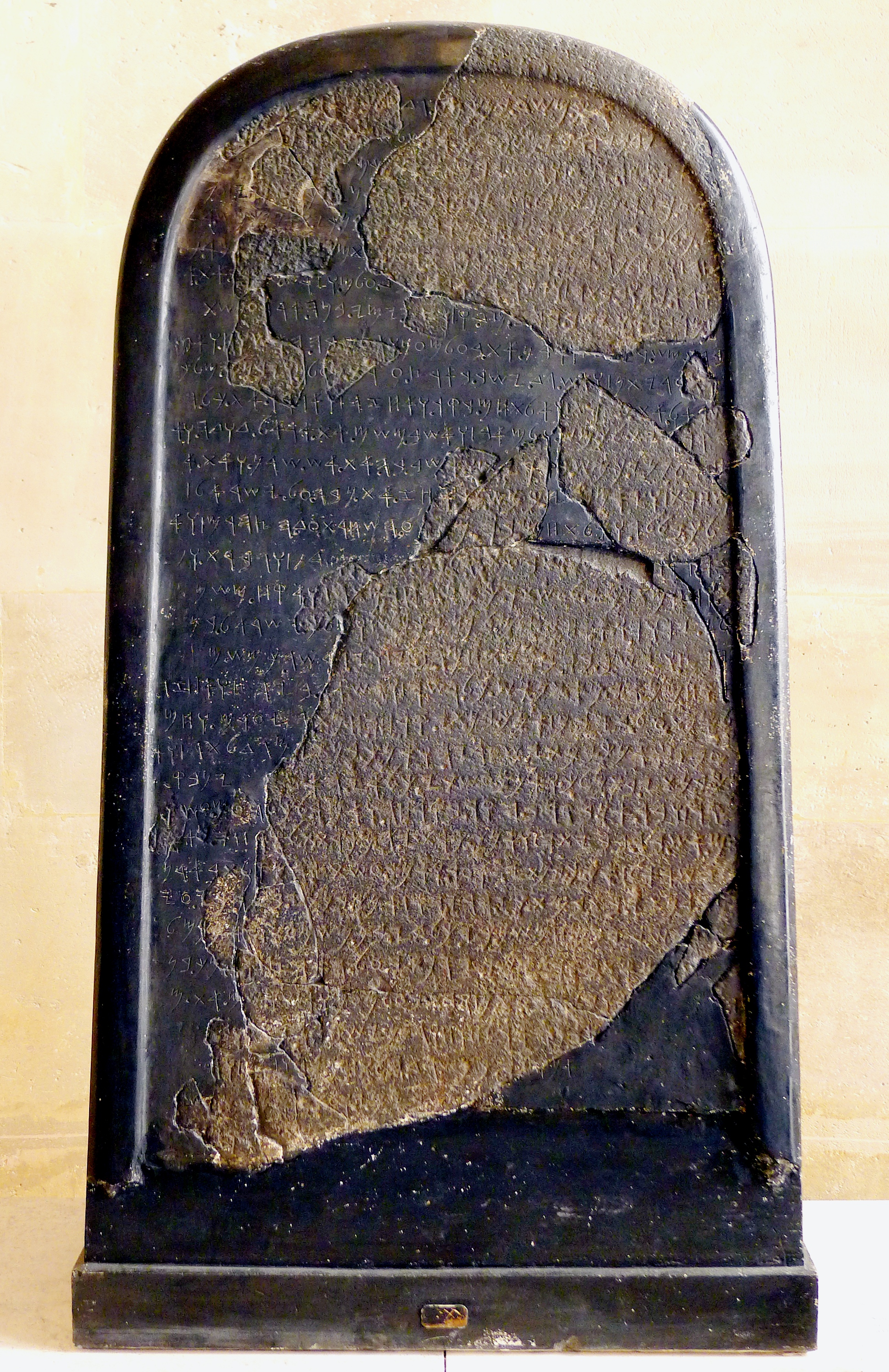
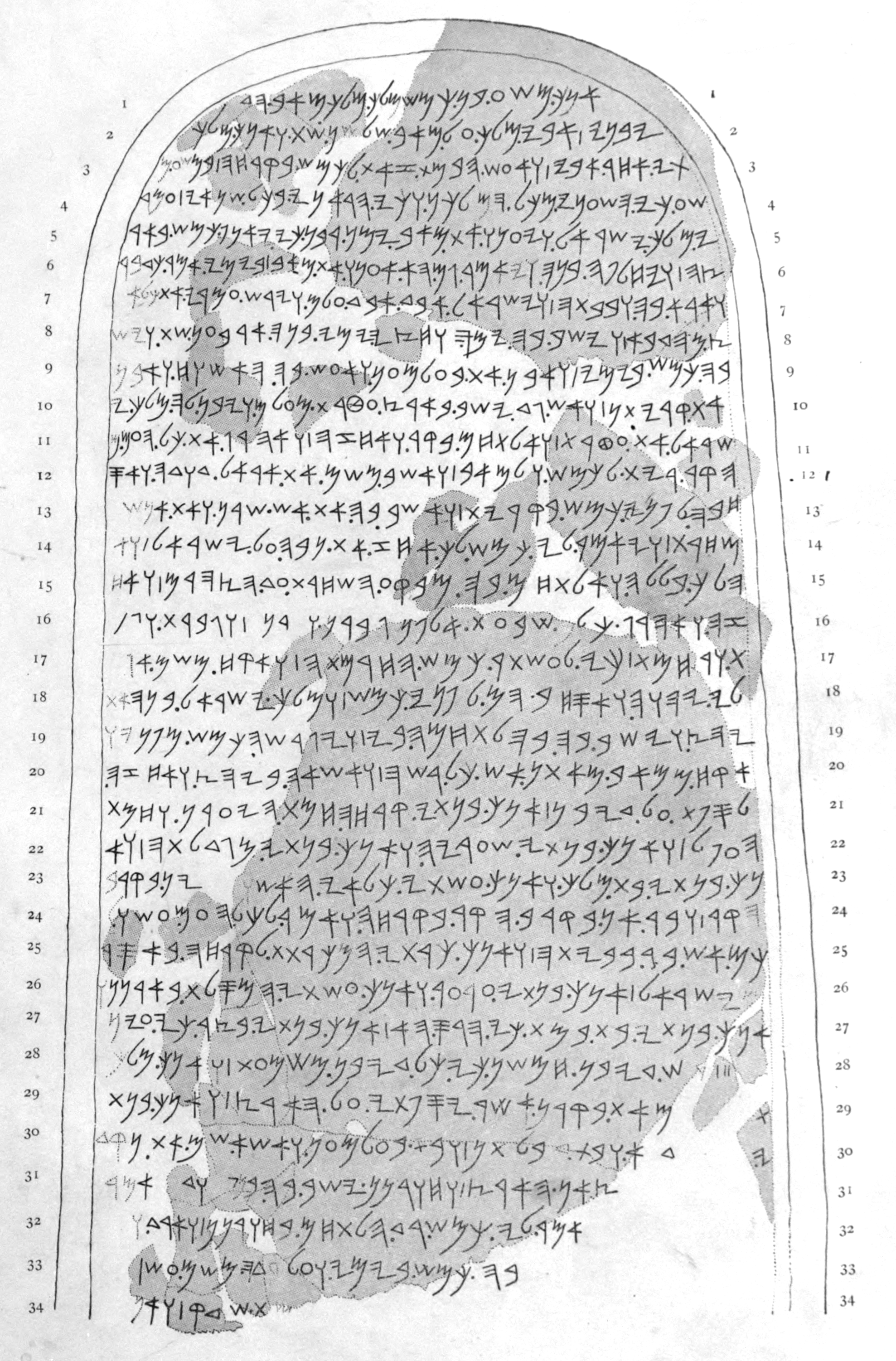
The Mesha Stele, also called the Moabite Stone, is a ninth-century BCE inscription commissioned by Mesha, king of Moab. It was found at Dhiban, the biblical Dibon, in what is now Jordan, and is now in the Louvre. It has thirty-four lines describing his victories and building projects.1
Mesha is also familiar from 2 Kings. In chapter 3, he is the king who had paid tribute to Israel and rebelled after Ahab’s death. Jehoram, Ahab’s son, then campaigns against him with Jehoshaphat and the king of Edom.
The stele traces Moab’s subjection to Israel back to Omri, Ahab’s father, and describes Mesha’s victories against Israel and Omri’s dynasty. That gives us the Moabite side of the broader conflict described in 2 Kings, though we should not assume that every episode on the stone corresponds to a particular scene in the biblical account.
It is also worth remembering who commissioned the inscription. Mesha is explaining his own accomplishments. His claim later in the text that Israel has perished forever would have come as news to the Israelites who continued living there.
This is not the only surviving Moabite writing. There is also the short Kerak inscription, and inscriptions on an altar from Ataruz, among other finds. But the Mesha Stele is by far the most substantial surviving text. It gives us enough connected language to do something more interesting than read a name on a seal.2
First, Get Past the Letters
The first obstacle is the alphabet:
𐤀𐤍𐤊 𐤟 𐤌𐤔𐤏 𐤟 𐤁𐤍 𐤟 𐤊𐤌𐤔[𐤉𐤕] 𐤟 𐤌𐤋𐤊 𐤟 𐤌𐤀𐤁 𐤟 𐤄𐤃𐤉𐤁𐤍𐤉
Those are The Canaanite language of Tyre, Sidon and Byblos; also the alphabet from which Hebrew, Aramaic and Greek scripts descend. Unicode characters representing the inscription’s closely related ancient letter forms. They are not a facsimile of the carving. The dots separate words, and the brackets indicate restored letters in the reading used here.
Ancient Hebrew was written in a related script too. The square Hebrew letters we use today developed from A Northwest Semitic language on a sister branch to Hebrew; long contact also shaped Mishnaic Hebrew. Parts of Daniel and most of the Talmud are Aramaic. writing; in Jewish terminology, this is The square Hebrew script, developed from the Aramaic alphabet; the script of Torah scrolls today.. Calling it Ashuri does not mean that our letters came directly from Assyrian cuneiform.
Put the same words into square Hebrew letters and suddenly things become considerably less foreign:
אנכ משע בן כמש[ית] מלך מאב הדיבני
I think a Hebrew reader with some familiarity with the Hebrew Bible can get quite a lot of that without having studied Moabite.
There is another qualification. Recognizing the words does not tell us exactly how Mesha pronounced them. This is primarily consonantal writing. Some letters can indicate vowels, but there is no system here that supplies the full pronunciation.
For instance, I initially read אנכ as something like anoki, using Hebrew אנכי to supply the vowels. Then I wondered whether it could have sounded more like anak. That uncertainty belongs in the experiment too: I could recognize “I” without knowing how to pronounce it. The spelling alone cannot settle those vowels. Nor should we automatically carry our modern Hebrew distinction between ב and בֿ, כ and כֿ, or פ and פֿ back into ninth-century Moabite. The history of those pronunciations is a separate question.
For the purposes of reading, I am going to lean on the Hebrew. It is useful scaffolding, provided I remember that it is scaffolding.
“I Am Mesha”
Here is the opening again:
אנכ משע בן כמש[ית] מלך מאב הדיבני
My first pass was essentially: “I am Mesha, son of The national god of Moab, named in Tanach and on the Mesha Stele.—or Kemosh-something—king of Moab, the Dibonite.”
אנכ is recognizable as אנכי, the first word of the Ten Commandments in Hebrew. בן and מלך need very little explanation. מאב is מואב without the ו, and הדיבני identifies him with Dibon.
I will keep pointing out letters that seem to be missing, so a word on what is actually absent. Hebrew, Aramaic, Arabic, Phoenician and Moabite are all written in A writing system whose letters record consonants, leaving most vowels for the reader to supply.: the letters record consonants, and the reader largely supplies the vowels. Some letters, particularly ו and י, can also do double duty as vowel markers, the “Mothers of reading” (imos hakriah): letters such as ו and י used to mark vowels. or אמות הקריאה, but whether a scribe writes them is a matter of spelling convention.
The Hebrew Bible: an acronym of Torah, Nevi’im (Prophets) and Ketuvim (Writings). itself spells some words both ways; David is usually דוד, but often דויד in Chronicles. Modern Hebrew without The system of dots and dashes written around Hebrew letters to mark vowels. adds extra ו and י to help the reader, and Arabic writes long vowels while leaving short ones unmarked. Ninth-century inscriptions use these vowel letters sparingly. So מאב for מואב, or השעני for הושיעני, is mostly a difference in how the words are spelled, not evidence that Moabite lacked the sounds.
The difficult bit is his father’s name. In the dictation, I tried a few readings and then slid into understanding it as “son of Kemosh,” as though the king were claiming divine parentage.
That was a reading mistake, and an interesting one for this experiment. I recognized בן and the name of a familiar Moabite god, and supplied an explanation that seemed to fit.
The correction is that this is his father’s personal name, containing the name Kemosh. The opening is damaged, and editions have offered different restorations; כמש[ית], Kemoshyat, is the reading used here. So the checked translation is: “I am Mesha, son of Kemoshyat, king of Moab, the Dibonite.”3
I understood the introduction and most of its words. I did not correctly identify the whole name.
Kemosh himself appears in Numbers, in the The weekly Torah portion read in synagogue; Parshas Eikev is the portion called Eikev. Chukat:
אוי לך מואב אבדת עם כמוש
Woe to you, Moab; you are undone, people of Kemosh.
— Numbers 21:29
The passage introduces this as something the מושלים, the poets or proverbial speakers, would say. It is part of the poem about Heshbon and Sihon, rather than a straightforward account of the Israelites singing a victory song about their own conquest of Moab.
But the expression עם כמוש is clear enough. Kemosh was associated with Moab, and here is a Moabite king whose father’s name contains his name and who credits him with his victories.
For someone who knows these names mainly from the Torah, seeing them in a text commissioned by a Moabite king is rather satisfying.
Thirty Years, With a Different Ending
The next sentence is almost as accessible:
𐤀𐤁𐤉 𐤟 𐤌𐤋𐤊 𐤟 𐤏𐤋 𐤟 𐤌𐤀𐤁 𐤟 𐤔𐤋𐤔𐤍 𐤟 𐤔𐤕 𐤟 𐤅𐤀𐤍𐤊 𐤟 𐤌𐤋𐤊𐤕𐤉 𐤟 𐤀𐤇𐤓 𐤟 𐤀𐤁𐤉
אבי מלך על מאב שלשן שת ואנכ מלכתי אחר אבי
My father reigned over Moab for thirty years, and I reigned after my father.
אבי מלך על מאב: my father ruled over Moab. Straightforward enough.
שלשן שת takes a little more work. שלשן is “thirty,” corresponding to Hebrew שלשים. The ending is different, but the שלש is right there. שת means “year,” where Hebrew gives us שנה.
My first reaction to שת was to connect it with שנה, helped by the context: a king describing how long his father ruled. It also reminded me of the Passover Haggadah, the text read at the seder:
השתא עבדי, לשנה הבאה בני חורין
This year we are slaves; next year, free people.
השתא is Aramaic, and I would not use it as a direct grammatical explanation of the Moabite form. It is simply another familiar expression that might help a reader make the connection.
Even without it, context helps. His father ruled over Moab for thirty something. Years would be a reasonable place to start.
Then:
ואנכ מלכתי אחר אבי
“And I reigned after my father.”
Replace אנכ with אני and put the vowels back in, and this is not a particularly difficult Hebrew sentence. The spelling אחר אב also appears in transcriptions of this passage; either way, the sense is “after my father.”
I have not learned a new language to get this far. I have recognized most of the words and made a couple of adjustments.
A Bamah of Salvation
The next sentence was where my reading became much more tentative. The version I was working from read:
ואעש הבמת זאת לכמש בקרחה במ[ת י]שע כי השעני מכל המלכן וכי הראני בכל שנאי
My first pass was roughly: “I made this altar to Kemosh in Qarhoh, Bamat Yesha, because he saved me from all the kings and let me see my enemies defeated.”
That gets the general purpose of the sentence. It also contains a few assumptions worth taking apart. Before doing that, there is a problem with the supplied text itself: editions differ. One traditional transcription gives:
ואעש הבמת זאת לכמש בקרחה במ[ת י]שע כי השעני מכל השלחן וכי הראני בכל שנאי
Roughly:
I made this high place for Kemosh in Qarhoh, a high place of salvation, because he saved me from all my attackers and let me triumph over all my enemies.
There are damaged letters and disputed readings here. In particular, translations differ over the word rendered “attackers”; some give “kings.” This is not a place where I want to pretend that every letter and every interpretation is settled.4
Still, look at how much is recognizable.
ואעש: I made. I got that directly from the Hebrew.
הבמת זאת: this In Tanach, a high place of worship; in rabbinic usage, an altar outside the Temple (pl. bamos).. The ה is the definite article, and the ת belongs to the noun. Hebrew gives us במה, and the ת is familiar from its construct form, במת. We should not read this as the plural במות just because the spelling looks a little unusual.
I initially called it an altar, which is how the word is used in rabbinic literature: the The first written code of the Oral Torah, edited around 200 CE by Rabbi Yehudah HaNasi.’s discussion of when bamos were permitted, in The Mishnah and Talmud tractate on animal offerings; its last chapter covers sacrifice outside the Temple. 14, is about altars outside the Temple. In Tanach, a bamah is more broadly a high place. That is a difference between Biblical and Rabbinic Hebrew, not between Hebrew and Moabite; Mesha’s usage simply matches the biblical one.
לכמש: for Kemosh.
בקרחה: in Qarhoh, generally understood as a part of Dibon.
במ[ת י]שע: this was another place where I supplied too much. I recognized ישע as salvation, but wondered whether he was naming the bamah “Yesha” or “Yeshua.” On the restoration used here, “a bamah of salvation” is enough; there is no need to make it a proper name.
Again, the Hebrew got me to the right idea. It did not stop me from adding an interpretation the words did not require.
כי השעני: because he saved me. Compare Hebrew הושיעני. Again, some of the letters we expect are absent, but the root and the suffix are recognizable.
And then:
וכי הראני בכל שנאי
My literal starting point was something like “he showed me … all my enemies.” In the dictation, I then understood it as being able to see myself victorious over my enemies. That was a way of getting at the sense, although “myself” is something I supplied, not a separate word in the inscription.
The checked sense is that Kemosh let Mesha see his enemies defeated, or triumph over them. So this is a case where recognizing the words and considering the context got me fairly close to the idiom.
Hebrew has a useful parallel in Psalms 59:11:
אלהים יראני בשררי
The idea is seeing the downfall of one’s foes. So the Moabite expression is unfamiliar at first glance, but even its idiom has a recognizable biblical counterpart.
Where the Hebrew Stops Being Enough
I do not want to give the impression that the whole inscription reads like a slightly misspelled page of Kings.
Later, Mesha describes taking Nebo and killing its population. The text includes:
שבעת אלפן גברן וגרן וגברת וגרת ורחמת
שבעת אלפן: seven thousand. גברן clearly has something to do with men. After that, I can make guesses, but guesses are not the same thing as a translation.
In my first reading, I wondered whether גרן and גרת were connected with גרים—converts, or perhaps people living among another population. I took גברת as something feminine related to גבר, perhaps women. רחמת made me think of רחם, a womb, but I did not know what to do with it.
Those associations are the point here. I recognized enough to see a list of people, with masculine and feminine categories, but could not confidently tell you what each category meant.
Checking translations does not produce complete agreement either. Some divide the population into native and resident men and women, followed by female servants or concubines; another gives men, boys, women, girls, and pregnant women. The גר connection helps with one interpretation, and the רחם association resembles another. Neither association, by itself, settles the text.5
My own conclusion at this point was essentially: he definitely says he killed a lot of people; I cannot tell you precisely how he classified them. That is a meaningful level of comprehension, but it has limits.
Another passage says:
ואהלך בללה ואלתחם בה מבקע השחרת עד הצהרם
I went by night and fought against it from the break of dawn until noon.
בללה is recognizable as בלילה.
מבקע השחרת suggests the breaking of dawn. עד הצהרם is close to עד הצהריים.
This sentence I understood fairly readily as going at night and fighting from dawn until noon. ואלתחם caught my attention because I would expect a Hebrew form such as ואלחם. I recognized לחם, noticed the unexpected ת, and understood the action without knowing the conjugation.
That is a useful result too: an unfamiliar grammatical form did not necessarily prevent me from following the sentence.
There are differences in vocabulary too. The inscription uses קר for a city, related to the family of words we recognize in קריה and קרית. Familiar material, but not always in the form or distribution I would expect from Hebrew.
These are real differences. The fact that I can follow the story does not mean I have accounted for its grammar.
So, Could I Talk to Mesha?
That is where I need to be a little more careful with my original question.
First, the result is mixed in a fairly specific way. I could follow much of the opening, sometimes almost word for word. I could infer some unfamiliar forms from context. I also misidentified part of a name and wondered whether a descriptive phrase was a place name. Further on, I could understand the general claim without understanding every category in a list.
Correcting those readings afterward should not erase them from the experiment. They show both how far the Hebrew got me and where it encouraged me to fill in gaps.
Reading a formal inscription with time to think, familiar letters, and help from the Hebrew Bible is also not the same as understanding someone speaking. I do not know exactly what Mesha sounded like, how quickly I would recognize his words aloud, or what his everyday conversation would have been like. Royal victory inscriptions also have a fairly predictable range of subjects. Once I know that the king is describing a battle, I have a useful head start.
Still, the amount I can recognize is striking. Hebrew and Moabite are very close members of the The Northwest Semitic branch that includes Hebrew, Phoenician, Moabite, Ammonite and Edomite. language group. The opening of this inscription makes that closeness tangible.
I would be comfortable saying that these Moabite sentences are easier for me to work through than plenty of things I encounter in Arabic, even though some very distant varieties of Arabic share a single language name. I would be less comfortable turning that experience into a precise ranking of mutual intelligibility. Written comprehension and spoken comprehension are different tests.
But the names alone certainly do not tell us how far apart the languages are.
I started with a text that looked completely foreign. Change the letters, recognize a few spellings, and suddenly I am reading about somebody’s father, how many years he ruled, and what his son did after him.
There are still words I cannot account for. There are vowels I cannot recover. But I can follow quite a lot of what a Moabite king wanted to tell me, nearly three thousand years later, using Hebrew I already know.
That seems worth getting past a different alphabet for.
Texts and Notes
The passages above are grouped into sentences for readability, rather than reproducing the stone’s physical line breaks. Square brackets mark restored letters. Transcriptions and translations differ, particularly in damaged passages. The English renderings here are adapted for the discussion, not presented as a new scholarly edition. Passages identified as my first readings preserve interpretations from the original dictation; subsequent explanations distinguish corrections from those initial impressions.
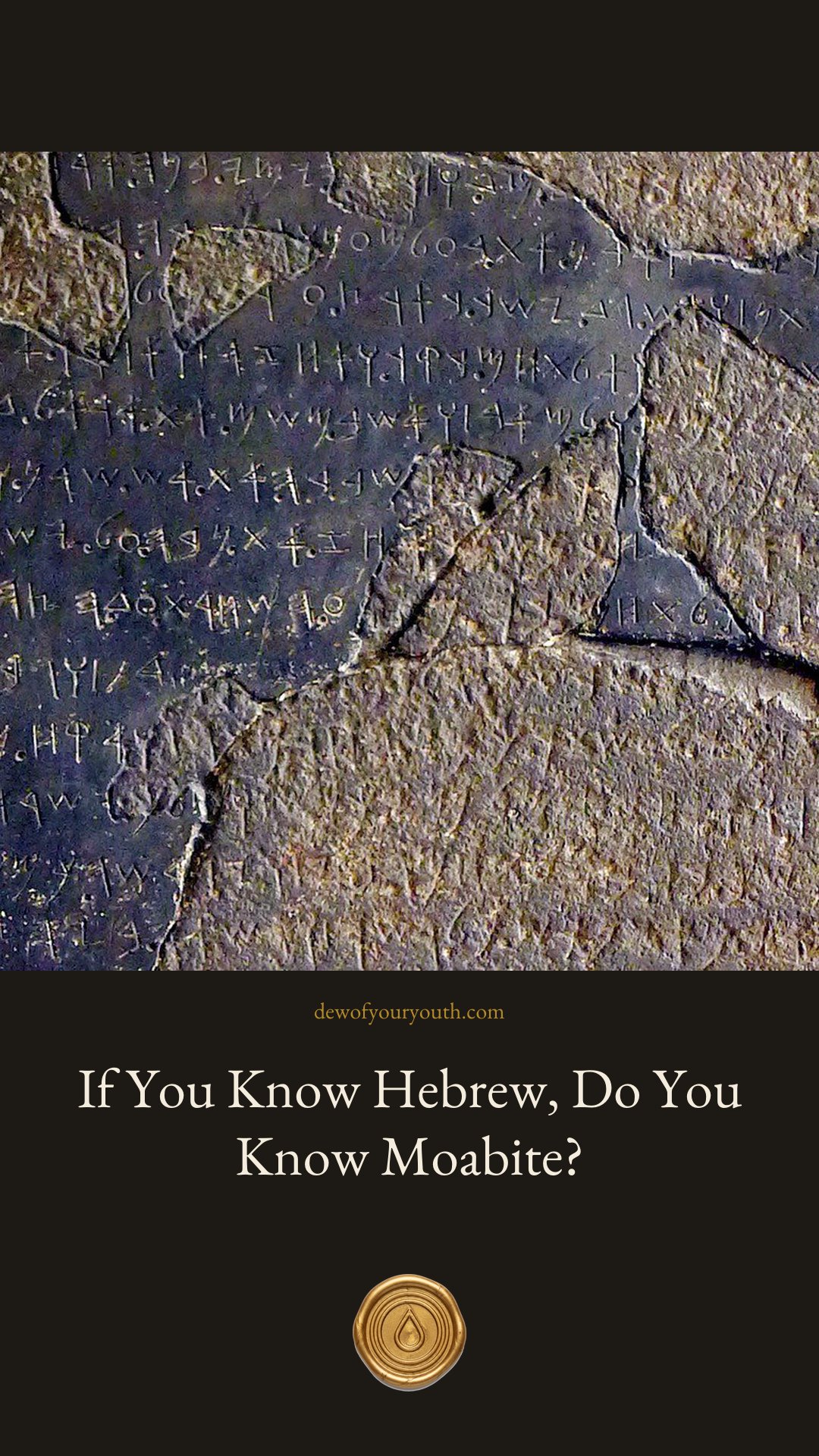
Featured image: detail of a photograph of the Mesha Stele by Mbzt, 2012, cropped, CC BY 3.0, via Wikimedia Commons.
Louvre collection entry: Stèle de Mesha. The entry identifies the material, thirty-four-line inscription, provenance, script, and ninth-century dating. The biblical passages are 2 Kings 1:1 and 3:4–27. ↩︎
K. C. Hanson, “The El Kerak Inscription”, with transcription and bibliography. For the Ataruz altar, see Adam Bean’s research abstract, “The Inscribed Incense Altar from Khirbet Ataruz: An Update,” in the 2016 ASOR meeting program. ↩︎
Compare the opening in the Jordan Museum’s translation and the damaged personal name in Hanson’s Kerak transcription. The latter is relevant to the restoration, although it is itself fragmentary. ↩︎
Compare the transcription and translation attributed to Alviero Niccacci, “The Stele of Mesha and the Bible: Verbal System and Narrativity,” Orientalia 63 (1994), pp. 226–248, reproduced in the Mesha Stele text section, with André Lemaire’s translation. They illustrate the differences behind “attackers,” “kings,” and the restoration involving ישע. The Hebrew parallel is Psalms 59:11. ↩︎
Compare Lemaire’s translation of lines 16–17 with the Jordan Museum’s translation and the translation adapted from Klaas Smelik at Livius. Their differing lists are a reason to avoid deriving a confident translation from the apparent Hebrew cognates alone. ↩︎