The King Arrives Quietly: Tzidkat HaTzaddik 68

The main thing is the heart. That is where Rabbi Tzadok HaKohen of Lublin (1823–1900), Hasidic thinker and author of Tzidkat HaTzadik. begins Paragraph 68. Hebrew letters double as numerals: ס is 60, ח is 8.:
כל העבודות שבאברי־הגוף והמצוות שבם, הם רק להישיר הלב, והעיקר הוא הלב ששם מעון ה׳ יתברך.
All the service performed with the limbs of the body, and the mitzvot involving them, are only there to straighten the heart. The main thing is the heart, where Hashem dwells.1
The A commandment; loosely, a good deed. we do with our bodies are meant to do something to us inwardly. Rav Tzadok brings The Sages of the Mishnah and Talmud; an acronym for “our Sages, of blessed memory.”’s description of Literally “the Name”: a reverent way of referring to God. as לבן של ישראל, the heart of Israel. Think of the Jewish people as one body, with Hashem as its heart. He also brings the The central work of Kabbalah, a mystical commentary on the Torah that surfaced in 13th-century Spain.’s description of the 613 mitzvot as תרי״ג עיטין, 613 counsels.2
What are the actions meant to bring us toward?
The emotion is the end
I found the wording around המכוון, the intended aim, a little difficult. Concentration and intention, especially in prayer. is intention, but it is also connected with direction. You can think of the heart as what directs your actions: you feel something, and therefore you act. Here I understood Rav Tzadok as describing the actions as a way of bringing the heart into its proper direction.
My father called this a behavioral argument. You don’t have to wait for the emotion before doing something. Doing it can bring you into the feeling.
“The emotion is the end, not the means,” I said.
My father pointed out that this is a pretty generally accepted principle in Jewishness: Jewish religious life and practice, in the Yiddish-inflected sense of the word.: all this stuff gets you into a mode, à la mode. You’re not expected to wake up necessarily inspired.
“The trick is getting out of bed,” my father said. “It’s the first act. Then you can kind of go on momentum from there.”
The bodily Divine service: prayer and religious practice understood as serving God. is meant to straighten the heart.
While we were learning, I made a crack about Descartes and solipsism. It was a joke, but it pointed at what bothered me: how I think people nowadays would read Rav Tzadok here. To modern ears, “the mitzvot are only there to straighten the heart” sounds a lot like “the mitzvot are there to make you feel a certain way.” Everything collapses back into the self.
I’m suspicious of the way religious language gets repurposed as psychological language. People practice mindfulness, which is fine, and then gussy it up with Kabbalah: the Jewish mystical tradition, whose central text is the Zohar. terms. “Finding God” starts sounding remarkably like what we used to call “finding yourself.” God becomes a code word for the person speaking. To me, a lot of it feels like navel-gazing.
The religious versions of this can still demand things. Get up. Pray The morning prayer service.. Serve God even when you don’t feel close to Him. But even the distance can become another account of your inner development: you’re reaching a deeper level, or learning that you’re enough. Everything keeps coming back to what’s happening inside you.
I agree that religion should be meaningful. But the meaning I can articulate is what I can glean from the tip of the iceberg. The stories, beliefs, traditions, and perhaps encounters with God are meaningful beyond what’s personally within me at this moment. That’s part of what makes them wonderful. I’m not looking for everything to become a program of self-actualization.
There is also a reversal here. Rav Tzadok and I are coming from very different places. He’s in a very Belonging to Hasidism, the pietist movement founded in 18th-century Ukraine and organized around rebbes. mode, and he’s radical. I’m much less Chassidish. My lifestyle is less conservative, and so is much of the way I think about the world. But religion plays a much more conservative role in my life: it’s how I hold on to something older than me.
Rav Tzadok is thoroughly at home in the tradition: a The Five Books of Moses; more broadly, the whole body of Jewish teaching. scholar sitting in a room learning Torah and coming up with radical ideas. I’m more of an outsider, and what I find beautiful in Judaism is the continuity, the tradition, the specialness of being a people with a narrative. That is something I participate in, something that connects me to a past and a people. Explaining it all through my own experience seems to sell it short. Rav Tzadok can afford to turn everything inward because he’s so firmly inside. For me, what matters most lies outside me.
But that isn’t really an objection to Rav Tzadok’s theological claim. Either he’s right that the mitzvot are ultimately there to straighten the heart, or he isn’t. My preferences don’t settle that. And at this level of abstraction, who knows what “straightening the heart” means? It almost certainly encompasses far more than I can identify or describe. What bothers me is how I think people nowadays will read it: as if this abstract claim were saying that the whole purpose of the mitzvot is the psychological experience they produce in me. I don’t think we’ve earned that translation.
The sound of silence
In The prophet Elijah, who fled to Mount Horeb and found God not in wind, earthquake or fire but in a still, small voice (1 Kings 19).’s vision, there is a great wind, a Noise, tumult; in 1 Kings 19, the earthquake., and fire. Hashem is not in the wind, the רעש, or the fire. Afterward comes:
קול דממה דקה
A still, small voice.3
The sound of silence. I think Eliyahu HaNavi got there before Simon and Garfunkel.
דקה literally means thin, but it can mean delicate or subtle. A delicate voice of silence. A subtle voice of silence.
Or maybe it’s less than a millimeter in thickness.
For Rav Tzadok, this is the heart. What’s happening in your heart isn’t directly felt by anybody else. The noise and visible activity are perceptible; the place where Hashem dwells is inward.
That is also how A blind Babylonian sage of the late third and early fourth centuries, renowned for his command of the Mishnah and baraitot. knew when the king was coming.
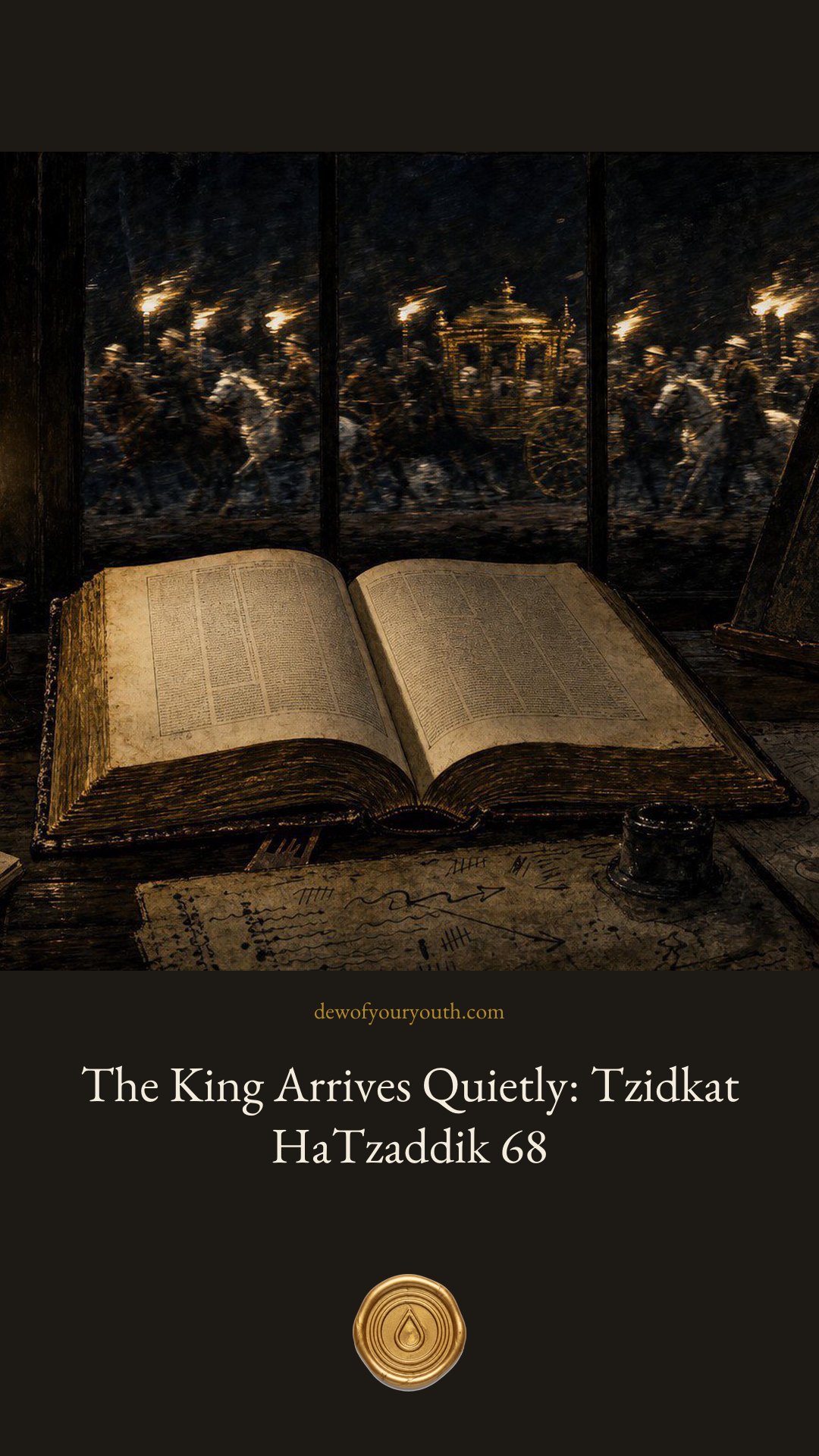
Rav Sheshet was blind. When everybody went out to greet the king, he went along. Someone mocked him: what exactly are you going to see?
Dude, I’m going to know when the king is coming before you do.4
A noisy contingent passed. His companion thought that must be the king. Rav Sheshet said it wasn’t. Another noisy contingent passed. Still not the king.
Then came quiet. Now the king was coming.
Rav Sheshet explained:
מלכותא דארעא כעין מלכותא דרקיעא
Earthly kingship resembles heavenly kingship.
He recognized the pattern from Eliyahu’s vision. There is a resemblance between mortal kingship and Hashem’s kingship, just as a human being is made in God’s image. Most human beings are nowhere near perfection. That doesn’t undo the comparison.
Ruling over yourself
Rav Tzadok connects this with:
מאן מלכי? רבנן.
Who are the kings? The sages.5
רבנן here doesn’t mean “rabbis” as a job title. Whether you have Rabbinic ordination. or have finished The Talmud as a whole; an acronym of shisha sedarim, the six orders of the Mishnah. isn’t the point. I understand it as בני תורה, people occupied with Torah.
Their kingship, Rav Tzadok says, consists in ruling over themselves. They are מושלים ביצרם, masters of their inclinations.
He brings the The rabbis’ extended discussion of the Mishnah; together the two make up the Talmud. in A tractate of the Talmud on property, inheritance and partnership. on:
על כן יאמרו המושלים בואו חשבון
Therefore the speakers of parables say: Come to Cheshbon.6
In the biblical account, Heshbon, the capital of the Amorite king Sichon, east of the Jordan (Numbers 21:26). is a place, and the poem concerns Sihon, the Amorite king whose capital was Cheshbon; Israel defeated him on the way to Canaan (Numbers 21). and Moab, the kingdom east of the Dead Sea.. Chazal read המושלים as those who rule over their inclinations, and בואו חשבון as an invitation to make a reckoning: weigh the cost of a mitzvah against its reward, and the gain from an A sin, a transgression (pl. aveirot). against its loss.
Rav Tzadok applies the same principle to this kingship. Ruling over your The evil inclination: the drive in each person toward sin; its counterpart is the yetzer tov, the good inclination. is quiet.
You didn’t speak Derogatory speech about another person, even when true. today. You come home. Nobody has erected a triumphal arch for you.
“If you want that,” my father said, “you have to go to AI.”
“Yes!” I said. “Good for you! You were so great! You get a gold star!”
AI has apparently turned us back into the infants we used to be.
But the victory itself has no fanfare. Nobody else may even know it happened.
First the troops
There is a difficulty here. The quiet comes after the noisy troops. Rav Tzadok specifically brings that part of Rav Sheshet’s story too:
גונדא קמייתא חליף כי קא אוושא
The first contingent passed, making noise.7
The troops still have to come. You can’t dispense with that part of the procession.
Likewise, Rav Tzadok says that the beginning of the struggle against the yetzer hara has to be ברעש ובתוקף, with noise and force. He brings:
לעולם ירגיז אדם יצר טוב על יצר הרע
A person should always rouse his good inclination against his evil inclination.8
You set one against the other. There is a fight. But he calls that something short of הממשלה הגמורה, complete mastery. Complete mastery is בלי רעש, without noise.
His example is King David, by tradition the author of most of Psalms.:
ולבי חלל בקרבי
My heart is hollow within me.9
David had killed his yetzer hara through fasting. Rav Tzadok describes the fasting as the רעש brought against desire. Through that struggle, David reached the state of mastery.
“So he’s totally defeated his yetzer hara?” my father asked.
Yes. That’s the point about David here.
“So he had equanimity,” my father said.
“He had reached nirvana, man.”
“So is he basically saying there’s a big, what do you call it, a big brouhaha between you and your yetzer hara,” my father asked, “but when you get mastery of it, you get into this Zen state?”
“Namaste,” I said. “Again, this is Judaism, so there’s always going to be dependent clauses and fine print on everything.”
But yes, that is the idea.
Hashem’s kingship in Eliyahu’s vision isn’t a pyrotechnics show at a Poison concert. I’ve never been to a Poison concert, but I hear there are pyrotechnics.
The noisy troops belong to the procession. They have to come first. The king’s arrival is quiet.
My father connected this with ירידה לצורך עליה, descent for the sake of ascent: it gets messy before you get back to the stillness of the mountaintop. That seemed consistent with what Rav Tzadok was saying here.
Zohar II 82b, as Rav Tzadok cites it. Aramaic עיטין means counsels or pieces of advice. ↩︎
I Kings 19:11–12. ↩︎
Berachot 58a. The colloquial dialogue is a retelling, not a literal translation. ↩︎
Compare Gittin 62a, where the sages are greeted as kings and בי מלכים ימלוכו is cited. ↩︎
Numbers 21:27; Bava Batra 78b. ↩︎
Berachot 58a. גונדא is a troop or contingent; כי קא אוושא means “as it was making noise.” ↩︎
Psalms 109:22. The Yerushalmi (Berachot 9:5; Sotah 5:5) says David killed his yetzer hara “in his heart.” The version with fasting that Rav Tzadok cites is the one quoted in Tanya, chapter 1. ↩︎