A Hundred Deaths and Not One Jealousy: Tzidkat HaTzaddik 81–82
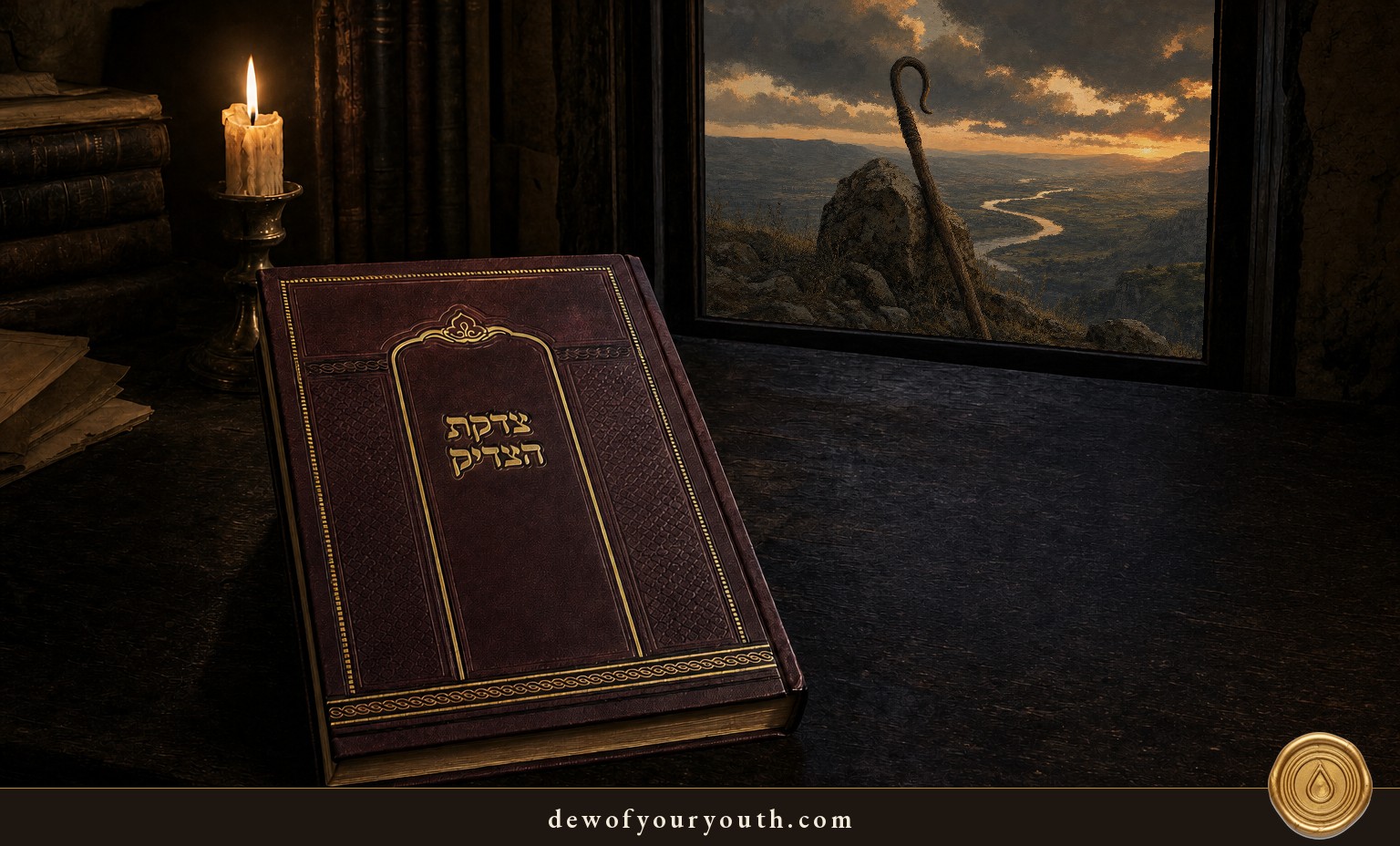
My father and I learned paragraphs 81 and 82 of Tzidkat HaTzaddik (“The Righteousness of the Righteous”): Rav Tzadok’s book of short numbered teachings on spiritual life.. Before we opened the book, he had a question about the evil eye. I’ve put that conversation at the end.
Two ways out
Last time, Rabbi Tzadok HaKohen of Lublin (1823–1900), Hasidic thinker and author of Tzidkat HaTzadik. said that one kingship doesn’t touch another, not even by a hair’s breadth. King David couldn’t live one more day once Shlomo’s reign was due.1 Paragraph 81 picks that up:
פעמים נגזר על אדם למות ח״ו משום אין מלכות כו׳… והעצה לזה העדר הקנאה ושיסכים שיאפיל הש״י אורו בחיו ויזרח אור אחר.
Sometimes it’s decreed that a person die, God forbid, because one kingship doesn’t touch another… And the advice for this is the absence of jealousy: that he agree that God darken his light in his lifetime, and another light shine.2
This is a very hard thing for people to do. You were the master, the authority on something, and now you’re going to let somebody else become the authority while you’re still alive.
But that’s the only way out. Or rather, it’s one of two. The other way out is in a box.
There’s a known story about Rabbi Akiva Eiger (1761–1837), rabbi of Posen, famous for his penetrating questions on the Talmud and the Shulchan Aruch.. A man was refusing to give his wife a A Jewish bill of divorce. The husband has to give it of his own free will., and they made him go speak with Rabbi Akiva Eiger. Rabbi Akiva Eiger quoted him the first Mishnah in Kiddushin: a woman acquires herself in two ways, by a get or by the death of her husband (וקונה את עצמה בגט ובמיתת הבעל). “Are you willing to give a get?” That’s all he said.
The man said no. He turned around, started down the stairs, fell, and died.
Whenever you tell this story to someone who doesn’t know who Rabbi Akiva Eiger was, you have to explain. He wasn’t a wonder-worker like the Rabbi Yisrael Abuhatzeira (1889–1984), Moroccan-born kabbalist in Netivot, famous for his blessings.. In the yeshiva world he’s known for his questions, more than for his answers: questions on all of the Talmud and all of the Shulchan Aruch that confound you and open the whole topic up. He was a genius of pure analysis. He just told the man how it was, and God sort of did the rest.
And he’s closer to this book than you’d think. His grandson, Rabbi Yehuda Leib Eiger, Rabbi Leibele Eiger of Lublin, shocked the family by becoming a Hasid, a student of the Rabbi Mordechai Yosef Leiner of Izbica (1801–1854), author of Mei HaShiloach, student of the Kotzker Rebbe and teacher of Rav Tzadok.. After the Izhbitzer died, Rabbi Leibele Eiger was Rav Tzadok’s rebbe.
So you have two ways out of this predicament. Either you overcome your jealousy and accept that other people will outshine you, or the box.
A hundred deaths
Rav Tzadok’s example is Moshe. The Midrash says that at the end of his life the wellsprings of wisdom were closed off to him, and he stood before Joshua, Moshe’s student and successor, who led Israel into the Land. as a student. He was able to overlap with Yehoshua that way, briefly, for a few hours. But then Moshe said:
מוטב מאה מיתות ולא קנאה אחת.
Better a hundred deaths and not one jealousy.3
So he accepted death. Jealousy is a natural human reaction, and Moshe said, I’d rather be dead.
But why would Moshe be jealous of Yehoshua? The Gemara says a person is jealous of everyone except his son and his student.4 Rav Tzadok answers in brackets that this is after death, as the proofs there show. In this world, even your own student can get to you.
And then:
משום דאכתי לא עבר ירדנא.
Because he hadn’t yet crossed the Jordan.
That’s the Gemara in Nedarim, with Ulla on the road. Last time, I was the one who brought it in. I made a whole big deal of it, how it fit Gilead so perfectly, how it tied everything together. Really, I could have just waited a paragraph for Rav Tzadok to bring it himself ;).
Quick refresher: Ulla was traveling up to the Land of Israel when one of his companions slaughtered the other on the road. When Rabbi Yochanan heard, he was surprised. The verse promises an angry heart there, in exile. How could someone be that angry in the Land of Israel? Ulla answered that they hadn’t crossed the Jordan yet.
Outside the Land you get the לב רגז, the trembling, angry heart of exile, and jealousy, Rav Tzadok says, flows from that same angry heart. Moshe was in the plains of Moab, on the wrong side of the river.
When a person attaches himself to the holiness of the Land of Israel, he can do it. Rav Tzadok says that nowadays everyone has four cubits there, his own share of the Land, and the place of his feet in the Temple. That’s why, when Shlomo dedicated the Temple, he asked that Jews exiled in the land of their captors be heard when they pray to God “by way of their land,” the Land He gave their fathers.5 Even from exile, you have a piece of it to pray through.
I’m not sure I understand this. My father wasn’t either. There are loose ends. He says the solution is not to be jealous. Then he basically says, well, you’re going to be jealous. Then the way not to be jealous is to hold onto the Land of Israel, whatever that means. And Moshe was stuck in a catch-22: the only cure for his jealousy was to go into the Land, and God had told him he couldn’t go into the Land.
The sky on a cloudy day
Then he says, in brackets again, that this was shown to him in a dream, the night going into Monday of the week of Re’eh, the 25th of Menachem Av:
למען ירבו ימיכם וימי בניכם על האדמה… כימי השמים על הארץ.
So that your days and your children’s days may be many on the land… like the days of the heavens over the earth.6
So naturally I wanted to know what year that was. You can narrow it down, but not by much. He gives the 25th of Av, a Monday, in the week of Re’eh. The week of Re’eh doesn’t really tell you much once you know that it’s the 25 of Av, as that always comes out during Parshat Re’eh. In his lifetime (1823–1900) there were 24 of those. That seemed like a lot to me, but turns out the 25th of Av is always exactly five weeks before Rosh Hashanah, so it’s the same day of the week. And Rosh Hashanah can’t fall on Sunday, Wednesday or Friday. So the 25th of Av only has four days to pick from: Monday, Tuesday, Thursday or Shabbos.
Then the book helps a little. Right under the title, first line:
קונטרס קראתיו צדקת הצדיק בשנת צדקו״ת אה״ב
I called this pamphlet Tzidkat HaTzaddik in the year tzedakot ahev.
That’s the year, written as a verse, “He loves righteousness,” Psalms 11:7. Both words have the little quote marks that mean that it’s a gematria (add the values of the letters): 608, so 5608, which is 1847. Rav Tzadok was born in 1823, so he was about twenty-four, already a student of the Rabbi Mordechai Yosef Leiner of Izbica (1801–1854), author of Mei HaShiloach, student of the Kotzker Rebbe and teacher of Rav Tzadok..
But that’s when he started it, not when he finished it, and nobody knows how long it took him. It wasn’t even published in his lifetime; it came out of his manuscripts in Lublin in 1913. And I’ve always had the impression that the brackets were put in later, when he went back over it, and the dream is in brackets.
So the earliest it can be is Monday, August 13, 1849. If the brackets are later, it could be any of these sixteen Mondays:
| Hebrew year | Date | His age |
|---|---|---|
| תר״ט (5609) | August 13, 1849 | 26 |
| תרי״ג (5613) | August 29, 1853 | 30 |
| תר״ך (5620) | August 13, 1860 | 37 |
| תרכ״ג (5623) | August 10, 1863 | 40 |
| תרכ״ו (5626) | August 6, 1866 | 43 |
| תרכ״ז (5627) | August 26, 1867 | 44 |
| תרכ״ט (5629) | August 2, 1869 | 46 |
| תר״ל (5630) | August 22, 1870 | 47 |
| תרל״ג (5633) | August 18, 1873 | 50 |
| תר״ם (5640) | August 2, 1880 | 57 |
| תרמ״ז (5647) | August 15, 1887 | 64 |
| תר״ן (5650) | August 11, 1890 | 67 |
| תרנ״ג (5653) | August 7, 1893 | 70 |
| תרנ״ד (5654) | August 27, 1894 | 71 |
| תרנ״ז (5657) | August 23, 1897 | 74 |
| תר״ס (5660) | August 20, 1900 | 77 |
That last one would be cutting it close. He died on 9 Elul that year, September 3, 1900, two weeks later, also a Monday.
I can’t pin it down more than that.
He reads it with two Gemaras. The first is in Megillah. Rabbi Yehoshua ben Korcha lived a very long time, and when Rabbi Yehudah HaNasi, editor of the Mishnah, referred to in the Talmud simply as “Rebbe.” asked him for a blessing, he said: may it be God’s will that you reach half my years. Why not all of them? Because then the ones who come after you would be left herding cattle.7
You don’t want to live that long. You’ll live to see yourself become—
“Yesterday’s news,” my father said.
Well put. Yesterday’s news. Nowadays, with technology, that takes about five minutes. Back then you had to live a long time to see yourself obsolete.
The second is Reish Lakish in Avodah Zarah: let us be grateful to our ancestors who sinned with the golden calf, because if they hadn’t, they’d have lived forever, and we’d be as if we’d never come into the world.8 It’s human nature to want to be something, and it’s a normal, healthy drive. If Moshe and Yehoshua and everybody were still around, where would we fit?
So God promised long life to both of them together, you and your children. How is that possible? That’s robbing the children. Unless it’s like the days of the heavens over the earth. The sky lasts forever. But sometimes it’s covered in clouds, and you can’t see it clearly. It’s still there. You just can’t see it. Another theme of his, from the eclipse. Like the Lubavitcher Rebbe, still around. You just can’t see him.
So you have a long life, and at some point you’re squared away, sometimes invisible, and your children have room. Otherwise, he says, it’s no blessing at all, because a hundred deaths and not one jealousy.
For the record, I’d be happy if my father stayed around. I’m not sitting here waiting. I don’t feel like his light is eclipsing mine.
“I’m not missing it,” he said.
Rav Tzadok is apparently talking about other people’s parents. But I get it. It’d be hard to have the great leaders of later generations if Moshe were still there. At some point you want someone leading you who isn’t from the Iron Age.
“Couldn’t even have two popes,” my father said. “Well, you did, but it was a weird thing.”
That’s the idea. Two kings can’t wear one crown.
I feel like he’s making a deeper point than the one we caught. “At this point it seems like a life observation,” my father said, “but I’m not sure what to make of it theologically.” As an observation, it’s definitely true, and it’s the normal way to read that Gemara: Rabbi Yehoshua ben Korcha told Rebbe, you don’t want to live to see yourself obsolete.
Wandering
Paragraph 82:
כשאדם נע ונד אע״פ שמדמה שהוא צריך לכך לטובתו מ״מ ודאי חטא ברציחה [דוגמת קין].
When a person is a wanderer, even though he imagines he needs to for his own good, he certainly sinned in murder [like Cain].9
Even if he thinks he has good reasons to move around. In paragraph 80, the repair for anger was a change of place. Now he goes the other direction: if you keep changing places, look for the murder.
I had to move a lot. I guess I murdered somebody. I’m just being informed.
“Could be,” my father said.
Not necessarily literal murder. I feel like I’d remember that. Things like it: embarrassing someone in public, which the Sages compare to shedding blood because the color drains out of his face.10 Causing someone severe distress. And wasting seed, which the Sages also count as a kind of killing.11
וכשנשקט ונקבע במקום ידע כי תיקן זה.
And when he becomes quiet and settled in a place, he should know that he has repaired it.
So when your life calms down and you have a place, that’s a sign you fixed it. I guess with the price of real estate, murder is rampant.
Sometimes, he says, prayer atones for half. Cain’s sentence was to be a wanderer, and after he prayed, the verse says he “settled in the land of Nod,” the land of wandering.12 Settled, but in wandering. Half.
The rest depends on the grace of a place on those who live there. The Sages say every place has a charm in the eyes of its inhabitants.13 If you’re settled somewhere but the place has no charm for you, if you feel like a stranger there, you haven’t been fully forgiven. You’re still wandering in your mind. That’s a sign you repaired the deed but not yet the thought.
So there are two things: the act of murder, or the murder-like act, and the murderous intention behind it. You can be settled and still not at one with your surroundings, and then only the first one is fixed. Full repair is finding a place you love, where you feel you’ve found your place in life.
Then you’re not a murderer.
“Good to know,” my father said.
How seriously to take it
My father asked whether jealousy could also be a kind of killing. Maybe. Rav Tzadok gives a list, and it isn’t meant to be complete. I’d add stealing: money and blood are the same word in Hebrew, damim. Jealousy makes the bones rot.14 And maybe Cain’s sin was partly jealousy and partly anger, before it was murder.
But whenever you read Jewish ethical literature, and the practice of deliberately working on one’s character. like this, the idea is very interesting, and how you could apply it to your own life is very hard to know. How far can I stoop into what he’s saying? I don’t think I’m perfect.
I do know I haven’t killed anyone literally.
Before we opened the book: the evil eye
My father had a question from his A Torah lecture or class., which was learning Taanit 8b, about rain, and about blessing resting only on what’s hidden from the eye, “on something the eye has no power over.” Someone there brought up that there’s no Ayin hara: harm believed to come from an envious or begrudging look at someone’s good fortune. on Yosef and his descendants.15
“I would think just the opposite,” my father said. Most of his life, when they asked him about the dream, he said, well, it wasn’t me, it was God, the whole bit, to keep the evil eye off him. His whole problems were because of the evil eye. His father preferred him, so everyone else got jealous. There was the coat. He was attractive to, what’s-her-face, Potiphar’s wife.
First of all, maybe he earned not having the evil eye once he succeeded. When he went with his brothers, it was still possible for the evil eye to get him. Afterwards, when he beat his desire with Potiphar’s wife, then it doesn’t have any hold. Which is literally the reason the Gemara gives: the eye that didn’t want to feed on what wasn’t his, the evil eye can’t rule over it.
Second of all, you’re asking the type of question Rav Tzadok would ask.
Also, I don’t want to make too much of it, but the evil eye isn’t just a superstition. We believe there’s a divine calculus behind it, and a lot of that calculus is jealousy. You look at something and you’re like, why does he deserve it and I don’t? Now you’re stirring up judgment on this person. He has what you want.
But you have to separate that from “I have the evil eye.” In every Middle Eastern religion, alive and dead, the evil eye plays a big role. Everyone believed in it.
Where each one says it:
- Judaism: eina bisha in Aramaic, same words as the Yosef Gemara. Rav went to a cemetery, did what he did, and said ninety-nine out of a hundred die of the evil eye and one by natural causes (Bava Metzia 107b).
- Islam: al-ʿayn ḥaqq, “the evil eye is real.” Sahih al-Bukhari 5740, Sahih Muslim 2188. Muslim adds that if anything could outrun fate, it’d be the evil eye.
- Christianity: Mark 7:22, ophthalmos ponēros, an evil eye, which English Bibles turn into “envy.” The Greek Orthodox have a priest’s prayer against vaskania.
- The Druze: Hitti, The Origins of the Druze People and Religion (1928), in the folklore chapter: “potent and widespread.”
- The Mandaeans: a lead amulet from Khuzestan, four incantations, evil eye and envious gaze included (Greenfield and Naveh, Eretz-Israel 18, 1985).
- Zoroastrianism: Vendidad 22, the Evil Spirit makes the world sick with his evil eye. Forrest, Witches, Whores, and Sorcerers (2011), chapter seven.
- The Sumerians: igi-hul, eye-evil (Thomsen, JNES 51, 1992).
- Everyone: the hamsa. Nobody agrees where it came from.
We’re not really used to thinking about the evil eye, except in a sort of cultural way. We say things bli ayin hara (or the Yiddishified kinayne hora) and poo poo poo. But it doesn’t seem to stop people from buying Jaguars and fancy houses and custom-made suits. How serious is it? In the past I think it was a serious consideration. Not a cute little folk superstition.
Why Ashkenazim are named after animals
I’ve seen it said that this is why Ashkenazim have a custom of naming children after animals. You name your son Shmuel after Shmuel the Prophet, and people think, what, you think he’s Shmuel the Prophet? Name him Aryeh, lion, and okay. Nobody’s going to get jealous of a lion.
Rabbi Chaim Kanievsky (1928–2022) of Bnei Brak, a leading Torah scholar and halachic authority of the Haredi world., as it was told over by someone who asked him, said that it’s known to the kabbalists of Ashkenaz: if you name a child after an animal, he’ll be protected from serious illness. No written source is quoted. Someone asked him a question and he gave an answer. The chain of custody on this transmission is really iffy, to be honest.
So take it as a notion. Nobody really knows why we name the way we do. Yehuda Aryeh makes sense; Yaakov blessed Yehuda as a lion. But Dov Ber, bear and bear, in Hebrew and Yiddish? There’s nothing especially good about bears. Nobody knows why anybody names a kid Dov Ber.
Paragraph 80, in The Sun in Eclipse. The Gemara is Shabbat 30a. ↩︎
Devarim Rabbah 9:9; Midrash Tanchuma, Va’etchanan. ↩︎
Sanhedrin 105b: בכל אדם מתקנא חוץ מבנו ותלמידו. ↩︎
I Kings 8:48. The four cubits are from Ketubot 111a. ↩︎
Deuteronomy 11:21. ↩︎
Megillah 28a: הבאים אחריך בהמה ירעו? ↩︎
Avodah Zarah 5a. ↩︎
Bava Metzia 58b. ↩︎
Niddah 13a. ↩︎
Genesis 4:16; Vayikra Rabbah 10:5. ↩︎
Sotah 47a: חן מקום על יושביו. ↩︎
Proverbs 14:30: ורקב עצמות קנאה. ↩︎
Berakhot 20a: עין שלא רצתה לזון ממה שאינו שלו, אין עין הרע שולטת בה. ↩︎