I Read Aramaic for Years. Then I Heard It Spoken.
Before I get into the A Northwest Semitic language on a sister branch to Hebrew; long contact also shaped Mishnaic Hebrew. Parts of Daniel and most of the Talmud are Aramaic. experiments, I want to explain what I thought I knew of the language. With the other languages in this series, I’ve mostly been approaching unfamiliar texts and seeing how far Hebrew gets me. Aramaic is different for me. I’ve spent years reading it, and I expected that experience to count for quite a lot.
Then I heard people speaking it.
There’s also enough variety within Aramaic that this is going to take more than one post. We’ll start with some ancient texts, as we’ve been doing, and then try listening to some of the languages people still speak today. But first, a little about why I went into this with more confidence than was probably justified.
The Aramaic I grew up reading
Like many, many people with a An academy for advanced Torah and Talmud study. background, I grew up reading things in what we call Aramaic. I figured there were probably some questions about pronunciation, but I expected Aramaic to be a language where I would have a major leg up.
Among the Jewish communities I knew, we could generally understand one another when reading a piece of Aramaic. I’ve been to various Of the Jews of Spanish and Portuguese descent; loosely, of Middle Eastern and North African Jewry as well. communities and other communities, and the differences in pronunciation never seemed to prevent that. For reading Aramaic, I think my expectation more or less holds true. There are plenty of things I don’t understand, but I can usually get somewhere. Seeing the words in Hebrew letters often makes it easier.
Talmudic Aramaic is no longer a language with a community of native speakers. But in that version of Aramaic, I am pretty competent. I can read even words that someone with a basic Jewish background might not know, from my experience reading An Aramaic translation of the Bible, such as Targum Onkelos on the Torah (pl. targumim)., not just the The Babylonian Talmud, compiled in the academies of Babylonia (c. 500 CE): the Talmud usually studied. but also parts of The Jerusalem Talmud, compiled in the Land of Israel (c. 400 CE) in a western Aramaic dialect., and various Targumim. I think I have an above-average Aramaic vocabulary even for someone with a yeshiva background.
Then I heard spoken Aramaic
So when I discovered that there are modern-day The Aramaic languages still spoken today by Jewish, Christian and Mandaean communities, mostly from Iraq, Iran, Turkey and Syria., I went in with maybe some misplaced optimism. Some of these languages are recently extinct; others have small communities of speakers. There are even Jewish communities with their own Aramaic languages, although it seems that those are going out of existence very quickly.
At some point, over a decade ago, I first came across what I knew as The Aramaic dialect of Edessa, and the literary and liturgical language of Syriac Christianity., or What many speakers call their Northeastern Neo-Aramaic, spoken by Assyrian and Chaldean Christians., as I think the speakers call it. I associated it mostly with Chaldean Catholics: an Eastern Christian community from northern Iraq, many of whom speak Neo-Aramaic.. I knew it was a form of Aramaic, but I could not understand a word they were saying.
I realized that the difference between reading Aramaic and understanding spoken Aramaic was vast—much greater than I had expected from my experience with Hebrew or even Arabic.
Even though my vocabulary is much smaller in Arabic, I can understand more spoken Arabic than I can spoken Aramaic. Now, it could just be a question of dialect: my Aramaic vocabulary is good in an extinct form of the language. I’ve also spent much more time consciously trying to learn Arabic. Aramaic was something I mostly picked up from books, rather than through disciplined learning and practice with the spoken language.
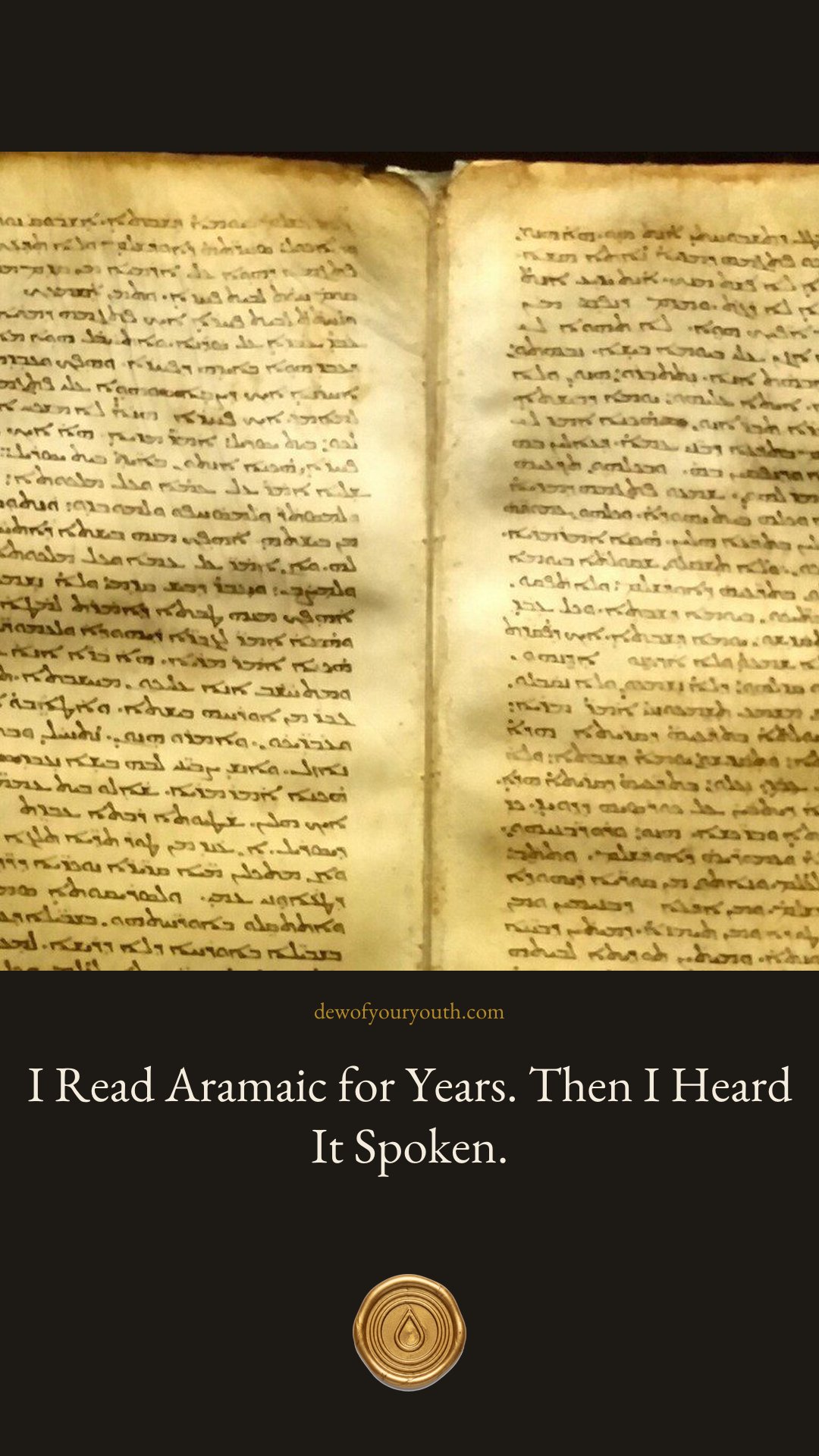
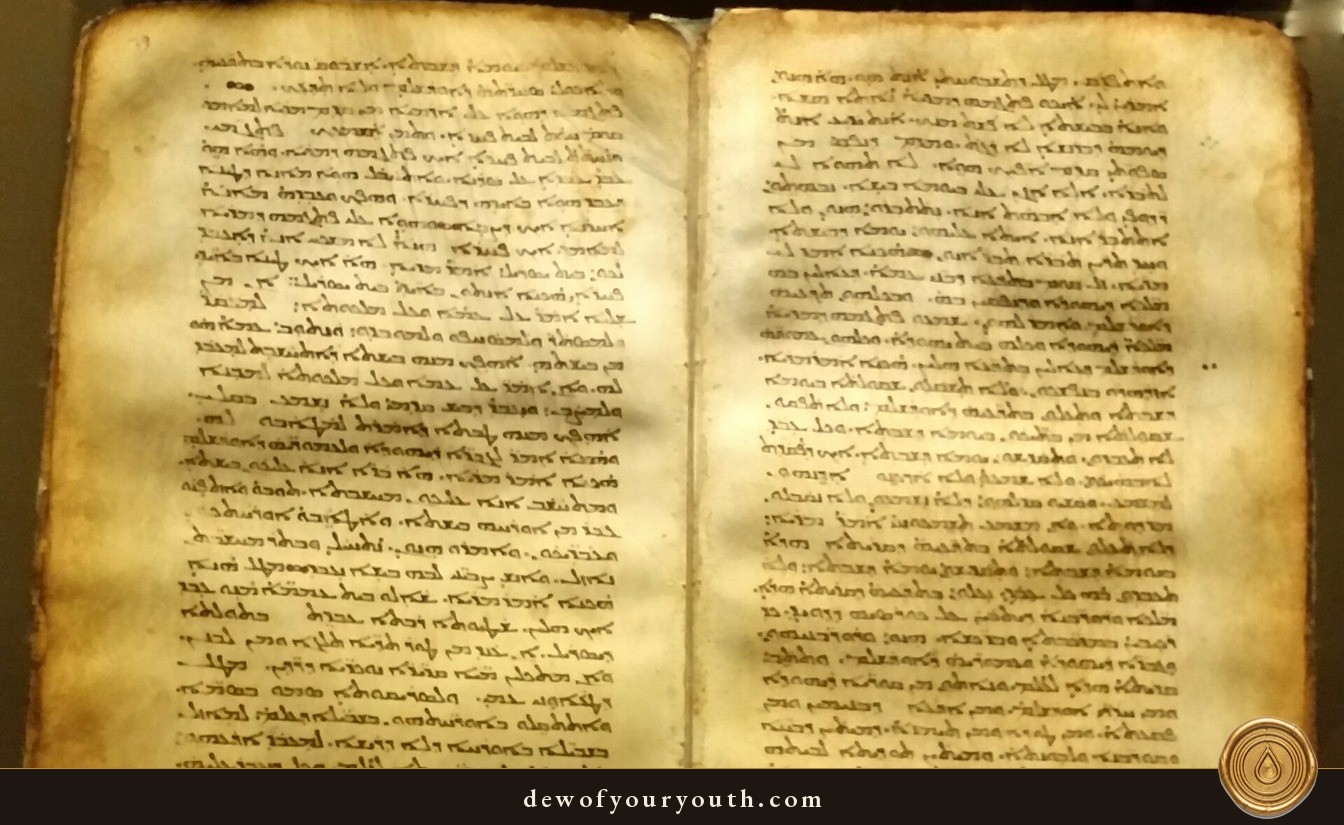
Thinking back, I first came across Syriac around when my first child was born. I had discovered the The standard Syriac translation of the Bible, made in the early centuries CE., a Syriac translation of the Bible, and taught myself the letters so I could read it in my spare time.
I had studied to be a scribe, and I’ve always had a love of letters. I also taught myself to write the old The Paleo-Hebrew script: the older Hebrew alphabet, close to Phoenician, used before the square script.. One year, as a sort of gag, I handwrote all my Gifts of food sent to friends on Purim. cards in it.
At the time, I didn’t know there were Chaldeans speaking a modern form of Aramaic. I think I eventually searched for Syriac on YouTube, and that’s when I discovered that, despite being able to read quite a lot, I couldn’t understand a word of what people were saying.
I don’t know how much I processed that then. I probably also imagined that their modern Aramaic was closer to the Syriac of the Peshitta than it actually is.
Listening to different dialects
At some point, I discovered a Cambridge University project called the Northeastern Neo-Aramaic Database Project. It’s a very, very cool site with many audio recordings of people speaking different Aramaic dialects.
A couple of things jumped out at me when I started listening. I had already had the shell shock of being unable to understand even basic things. But some dialects were much easier than others for me to guess at words and phrases. I couldn’t fully understand any of them. I couldn’t follow normal speech.
In the recordings I listened to, people were usually telling a fairy tale or another story. They weren’t just having an everyday conversation. With stories, the vocabulary isn’t necessarily obscure, but it isn’t always the most basic vocabulary either. They’re talking about a princess and a palace, somebody traveling, various kinds of animals, and things like that.
Reading a story is another matter
Now, there are plenty of tales and stories in Jewish literature written in Aramaic, and I’ve generally gotten through those pretty easily. But first of all, you read them at your own leisurely pace. You’re not trying to follow somebody telling the story aloud. You also don’t have to deal with an unfamiliar accent. You’re using whatever pronunciation you normally use when reading Hebrew and Aramaic.
I suspect the vowels we supply are often wrong—almost always wrong, I would have said on first hearing these recordings. There are words like Aramaic בַּרְתָּא, “daughter.” that sound familiar, and some words we probably pronounce relatively correctly. But with many others, I suspect we’re mangling them enough that a native speaker would have trouble understanding us.
You could say we have our own sort of Talmudic dialect, the way yeshiva students read and discuss these texts. It’s somewhat of an international language. I can go and understand a A Torah lecture or class. in The Mishnah with the Gemara’s discussion of it: the central text of rabbinic law and thought, mostly in Aramaic. whether the speaker is Persian, Of the Jews of Central and Eastern European descent., Moroccan, or Yemenite. Yemenite pronunciation is probably the hardest for me, and sometimes takes a little more effort, but I can still understand what’s being said.
That familiarity clearly doesn’t carry straight over into understanding Neo-Aramaic. And we should note that many of these dialects aren’t mutually intelligible either. It isn’t just that I can’t understand them; their speakers may have difficulty understanding one another.
How we’ll approach the experiments
So I’m going to do an extended series on Aramaic.
First, we’ll do some of what we’ve been doing up until now with the ancient languages. I’ll treat The Aramaic dialect and script of the Nabataean kingdom of Petra; the script developed into the Arabic alphabet., The Aramaic dialect of the Mandaeans, a small Gnostic religious community from southern Iraq and Iran., Old Syriac, and some of the others separately. They’ll all come under Aramaic, but each will get its own experiment.
Throughout this series, I’ve been asking how much I can understand as a Hebrew speaker. With Aramaic, we have a better way to answer that question, because there are still people speaking it today. We don’t have to stop at what I can figure out from a written passage. We can listen to actual speakers and see how much I understand.
I do want to do the ancient varieties first, because that’s more apples to apples with the experiments we’ve done so far. Then we’ll move on to the Neo-Aramaic recordings. From what I’ve heard so far, I expect what I can understand will be very limited.
Cover: a 9th-century Peshitta manuscript at the National Library of Israel. Photo by JHistory, CC BY-SA 4.0, cropped.