Fredrick Philip Green (1865–1939)

Intro
I want to dedicate some time to writing about my paternal grandmother’s grandfather, part of Roberta (Green) Shore’s family line. My grandmother recently turned 100 years old, though her condition is not good. While reviewing family records, I noticed that his yahrzeit falls on the third night of Hanukkah. This past Hanukkah marked his 86th yahrzeit. Despite several surname changes over the generations, my grandmother’s family early history is documented in a genealogical work titled The Propp Family History, by David-Hillel Ruben and Henry W. Propp. I do not own the book myself, but I have been able to consult portions of it thanks to the generosity of a distant relative (name withheld).
Based on what I have seen in The Propp Family History, Myer Propp fled Shkudvil, Lithuania sometime in the nineteenth century, eventually settling in Sweden. Upon leaving Lithuania, he changed his name to Myer Greenberg. He is associated in later records with a wife, Rachel (Pikin). It is unclear whether they fled together as a married couple or whether Myer emigrated as a bachelor and married Rachel after settling in Sweden.
Early Life
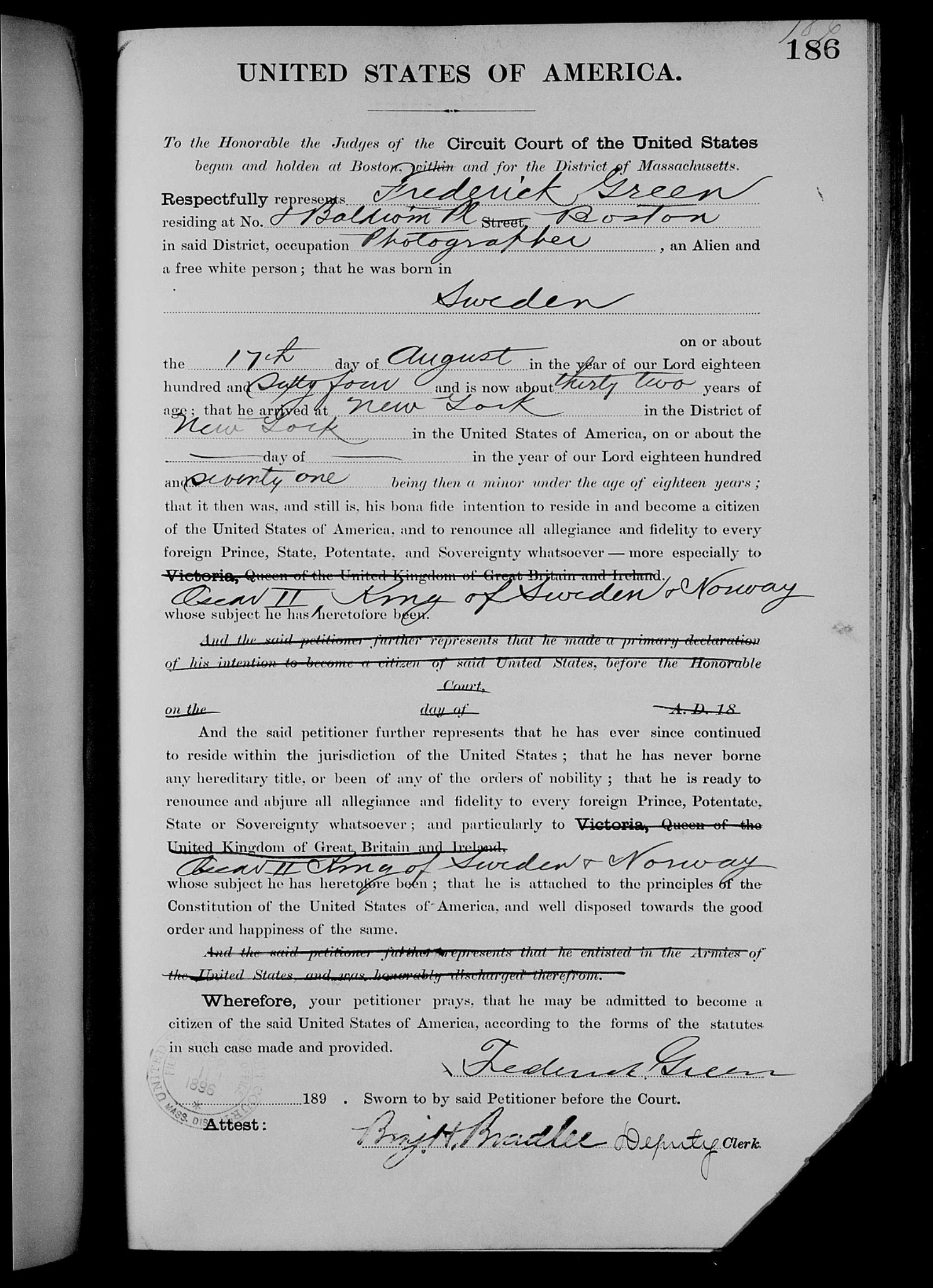
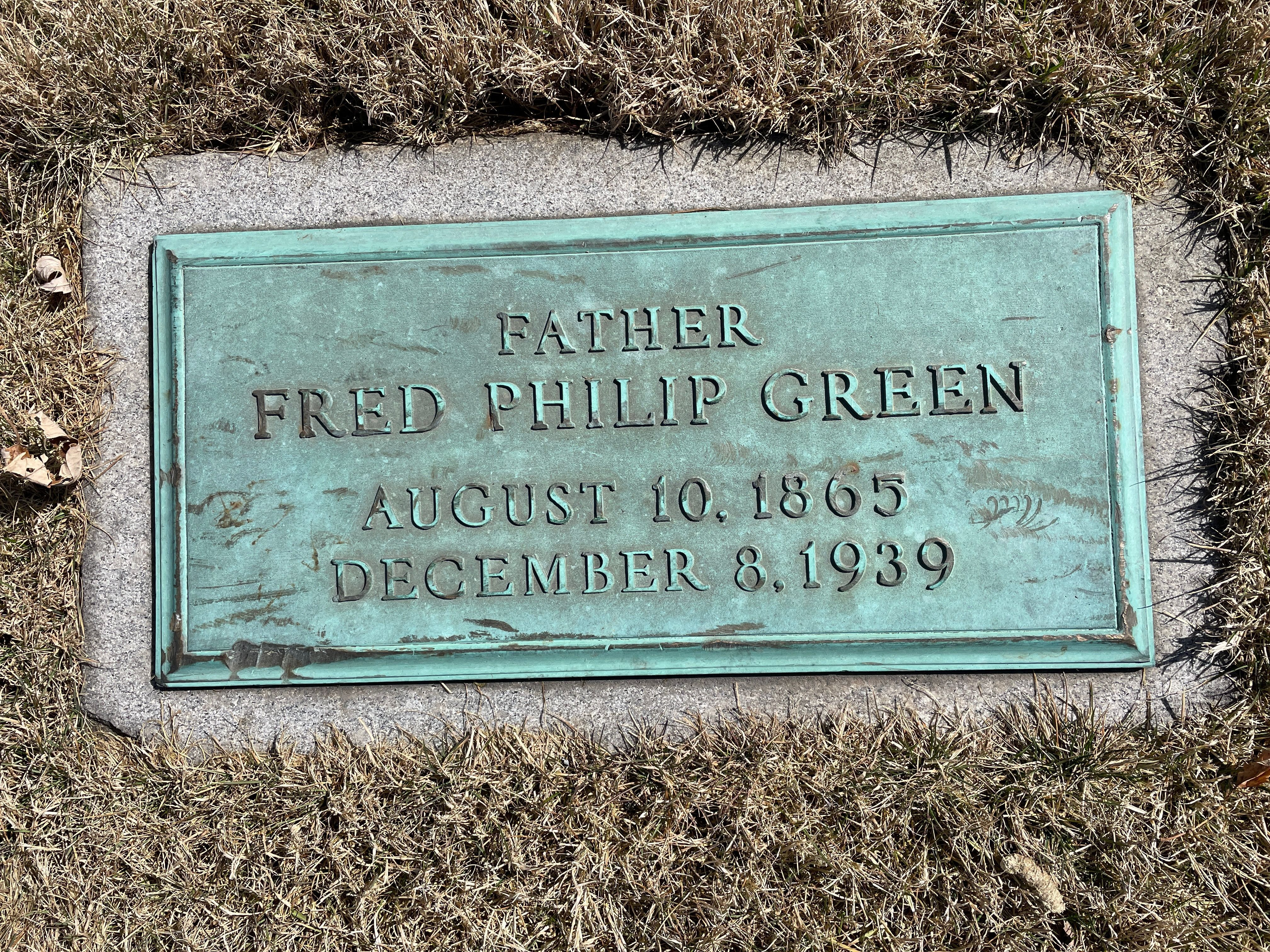
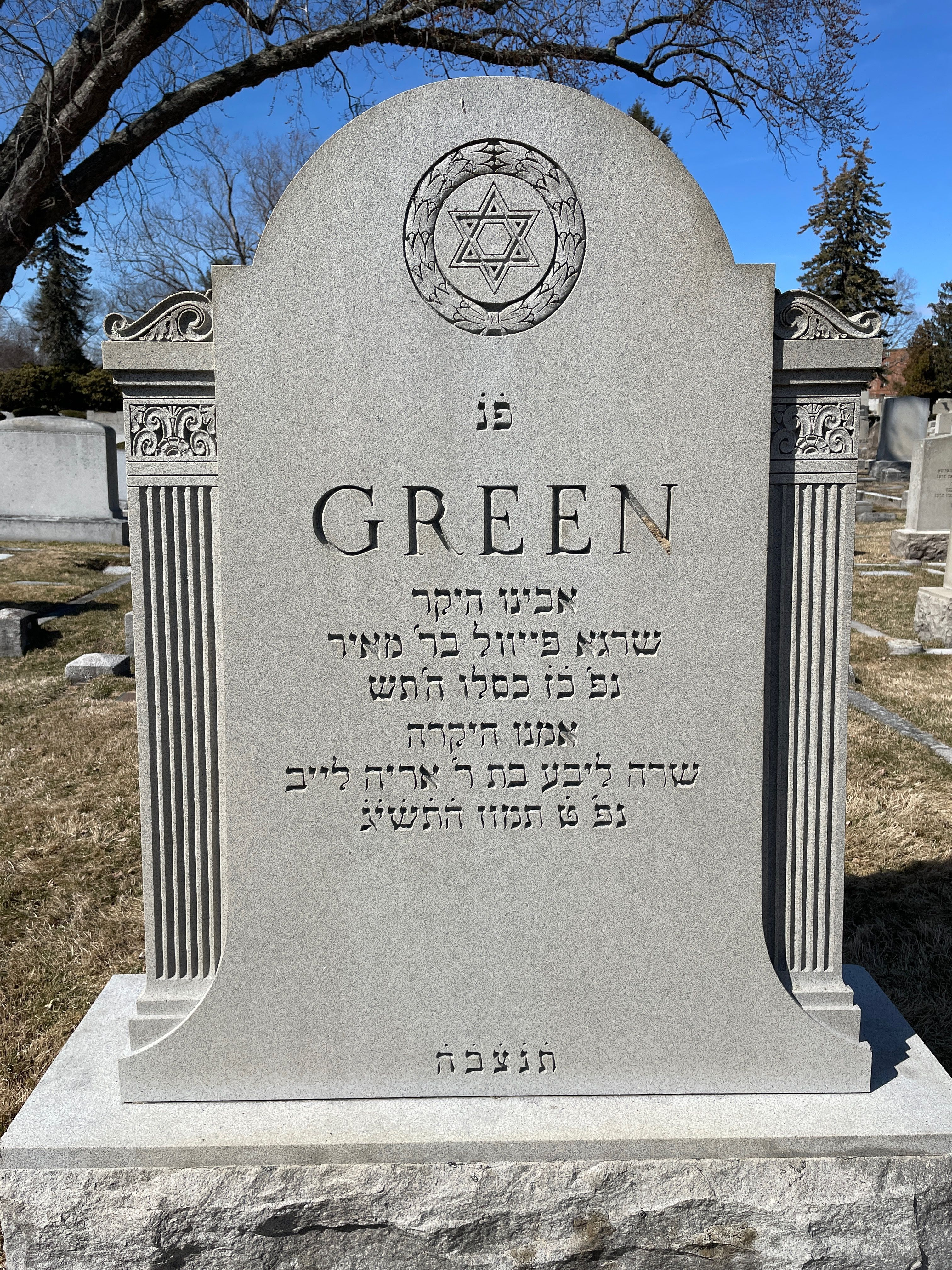
It was there, in Sweden, that their son Fredrick Philip (Fred) Greenberg was born in August 1865. His exact birthdate is not consistent across sources. In sworn testimony given during his naturalization process, Fred stated that he was born on 17 August 1865, while his tombstone records his birthdate as 10 August 1865. His Hebrew name, Shraga Feivel, is preserved on the tombstone.
In 1871, Fred emigrated to the United States with his family, a date likewise supported by his sworn naturalization testimony. Depending on the exact date of arrival (only the year of arrival is recorded), he would have been five or six years old at the time. According to family memory, he retained the ability to speak Swedish later in life. His surname was shortened to Green at some point before his Naturalization Testimony, taken in September of 1895.

Marriage, Career and Children
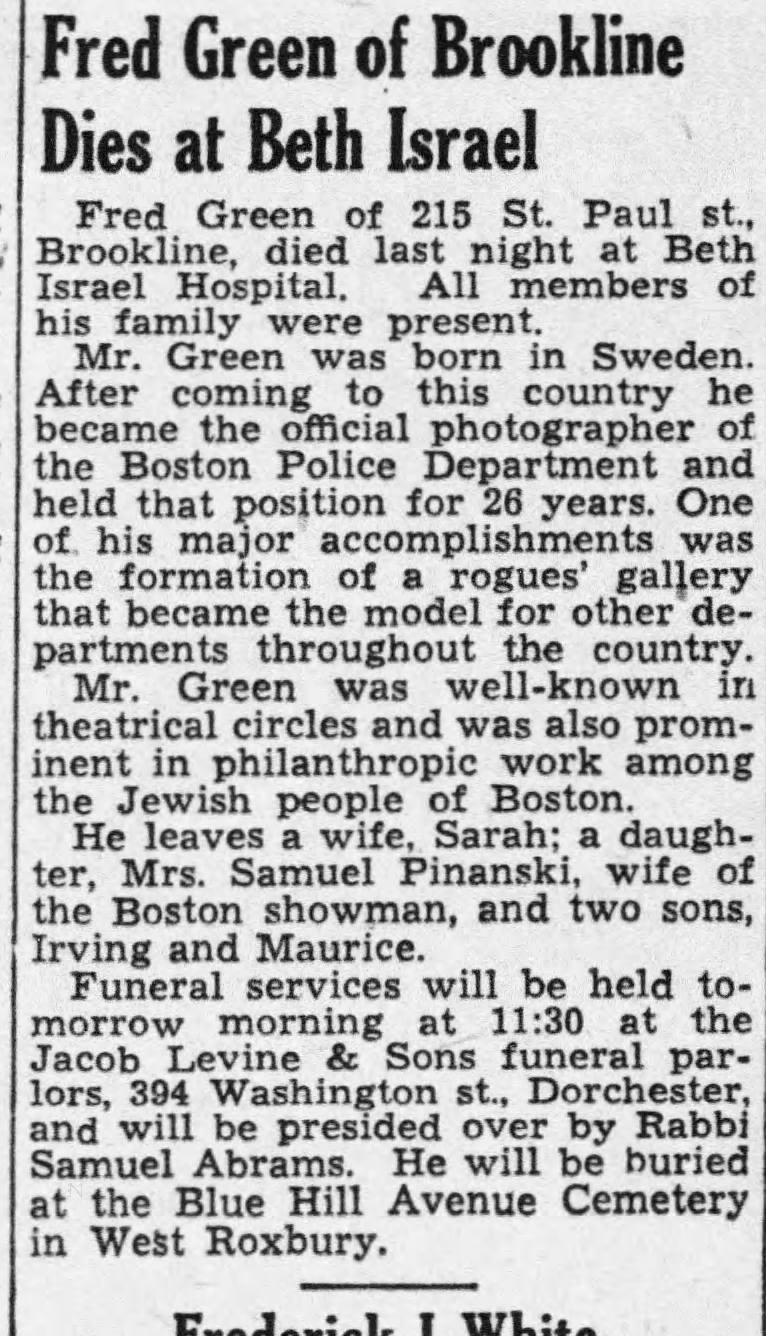
He married Sarah Libby Cohen, a New York native, in 1890 and worked as a photographer. Family recollections add further, though sometimes imprecise, details. At one point I believed that Fred Green had been involved in lobbying the Commonwealth of Massachusetts to require photographs on driver’s licenses, but I now think this was a mistaken inference, likely arising from his long association with police identification photography.
Other family memories, however, remain unresolved. According to my father, Fred owned early cinemas in Boston, though I have not yet been able to locate documentary evidence to confirm this claim. It is nonetheless notable that Fred’s oldest daughter, Anne Green, married Samuel Pianski, a recognized pioneer in early New England movie theaters. While this connection does not establish ownership, it situates the family within circles closely tied to the early cinema industry.
While best documented for his twenty-six years as the official photographer of the Boston Police Department, Fred Green also maintained a civilian photography practice. Contemporary accounts describe him as well known in theatrical circles, and archival photographs attributed to him include documentation of Jewish lifecycle events such as bar mitzvahs. Taken together, these sources suggest a professional life that extended beyond police identification photography into private, communal, and cultural settings.
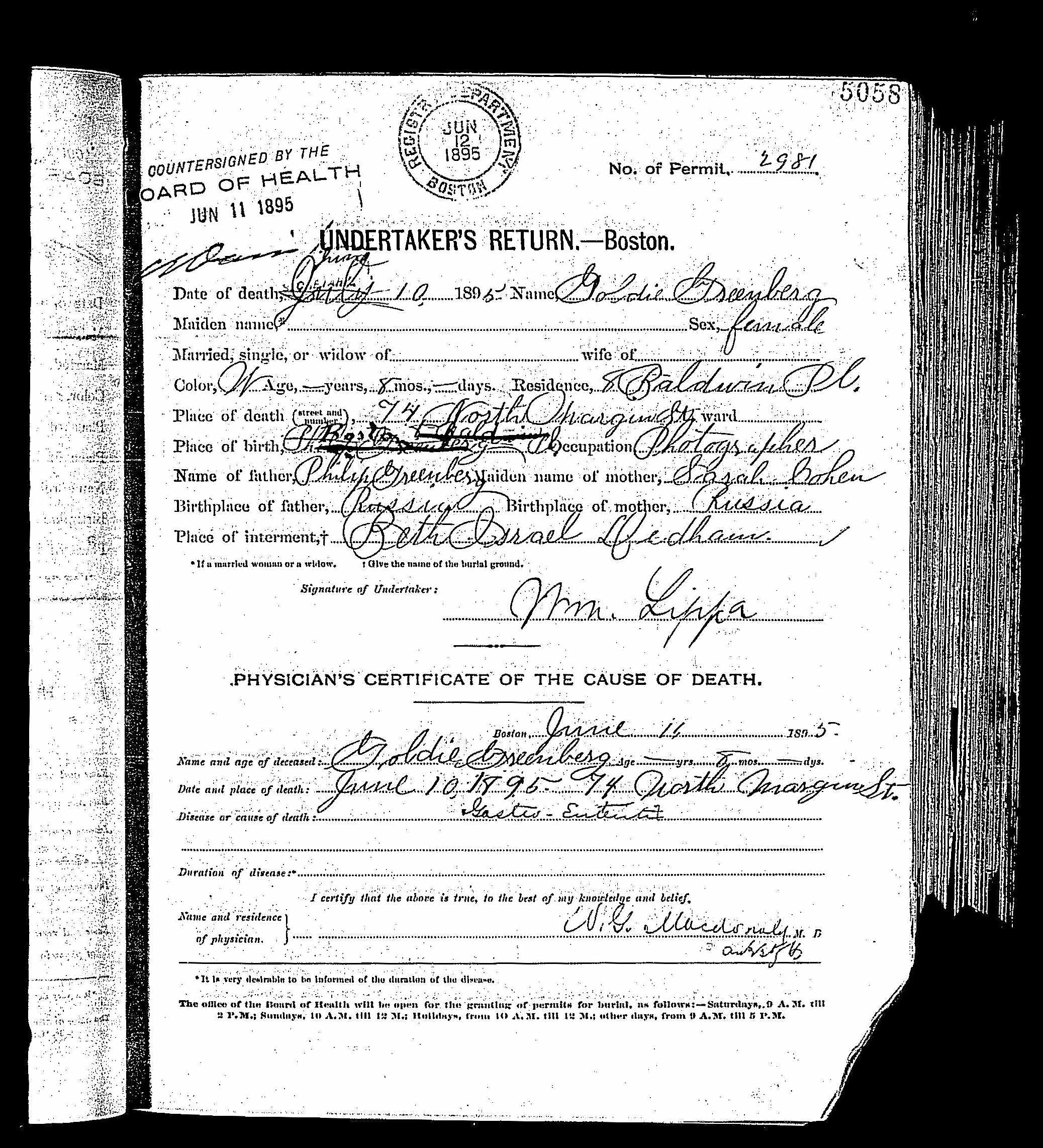
His obituary records that he was survived by one daughter, Anne, and two sons, Irving and Maurice. Civil records, however, show that Irving was a twin, and that his twin sister, Goldie, died in infancy in 1895 and is therefore not mentioned in the obituary.
It is noteworthy that Boston civil records are inconsistent in their recording of the parents’ origins. In one record, Fred and Sarah are listed as having come from Poland, while a death certificate records their origins as Russia. Neither designation aligns with other documentation, which shows that Fred was born in Sweden and Sarah was American-born. These discrepancies likely reflect the broad and imprecise manner in which Jewish origins were recorded in late nineteenth-century Boston, rather than the actual biographical facts of the family.
His Yahrzeit is Kislev 27, 5700.
flowchart TB
  %% Fredrick Philip "Fred" Greenberg / Green family tree (with parents)

  Myer["Myer Propp
(later: Myer Greenberg)
from Shkudvil, Lithuania → Sweden"]
  Rachel["Rachel (Pikin)
(wife; marriage timing uncertain)"]

  Fred["Fredrick Philip (Fred) Greenberg / Green
b. Aug 1865 (10th or 17th)
d. Dec 1939
Hebrew: Shraga Feivel"]
  Sarah["Sarah Libby Cohen
b. New York"]

  Anne["Anne Green"]
  SamP["Samuel Pianski
(early New England cinema pioneer)"]

  Irving["Irving Green
(twin)"]
  Goldie["Goldie Green
twin
d. Jun 10, 1895 (infancy)"]
  Maurice["Maurice Green"]

  %% Parent relationships
  Myer -.-> Rachel
  Myer --> Fred
  Rachel --> Fred

  %% Fred's family
  Fred --- Sarah

  Fred --> Anne
  Fred --> Irving
  Fred --> Maurice
  Fred --> Goldie

  Sarah --> Anne
  Sarah --> Irving
  Sarah --> Maurice
  Sarah --> Goldie

  %% Marriage
  Anne --- SamP

  %% Visual grouping
  subgraph "Founding Generation"
    Myer
    Rachel
  end

  subgraph "Fred Greenberg / Green Family"
    Fred
    Sarah
    Anne
    SamP
    Irving
    Maurice
    Goldie
  end

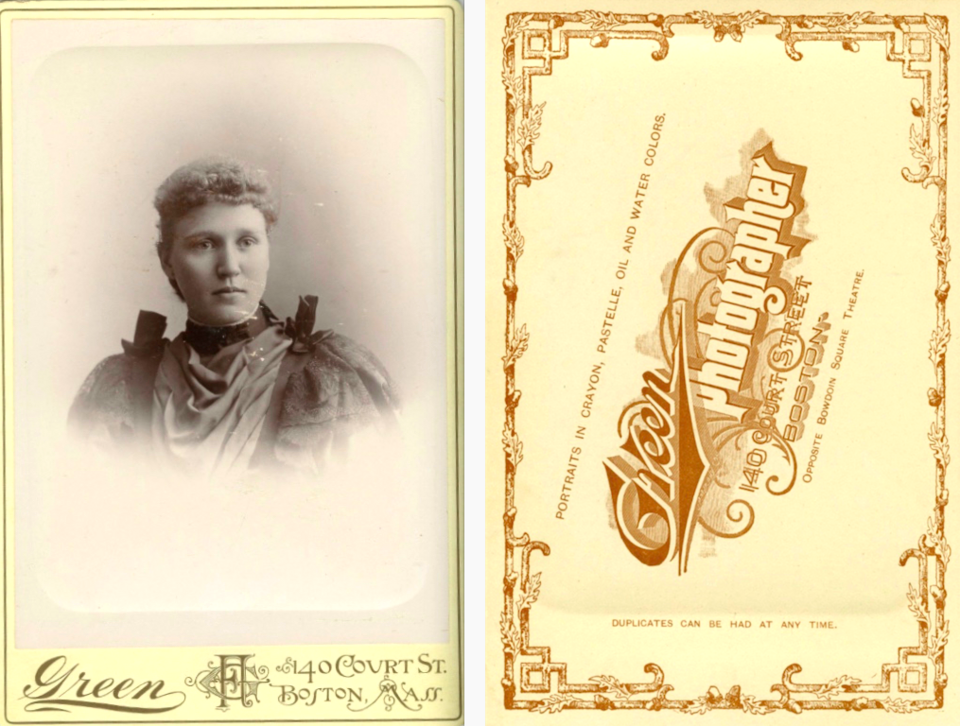
An example of Fred Green’s civilian portrait photography.