Categorically Wrong
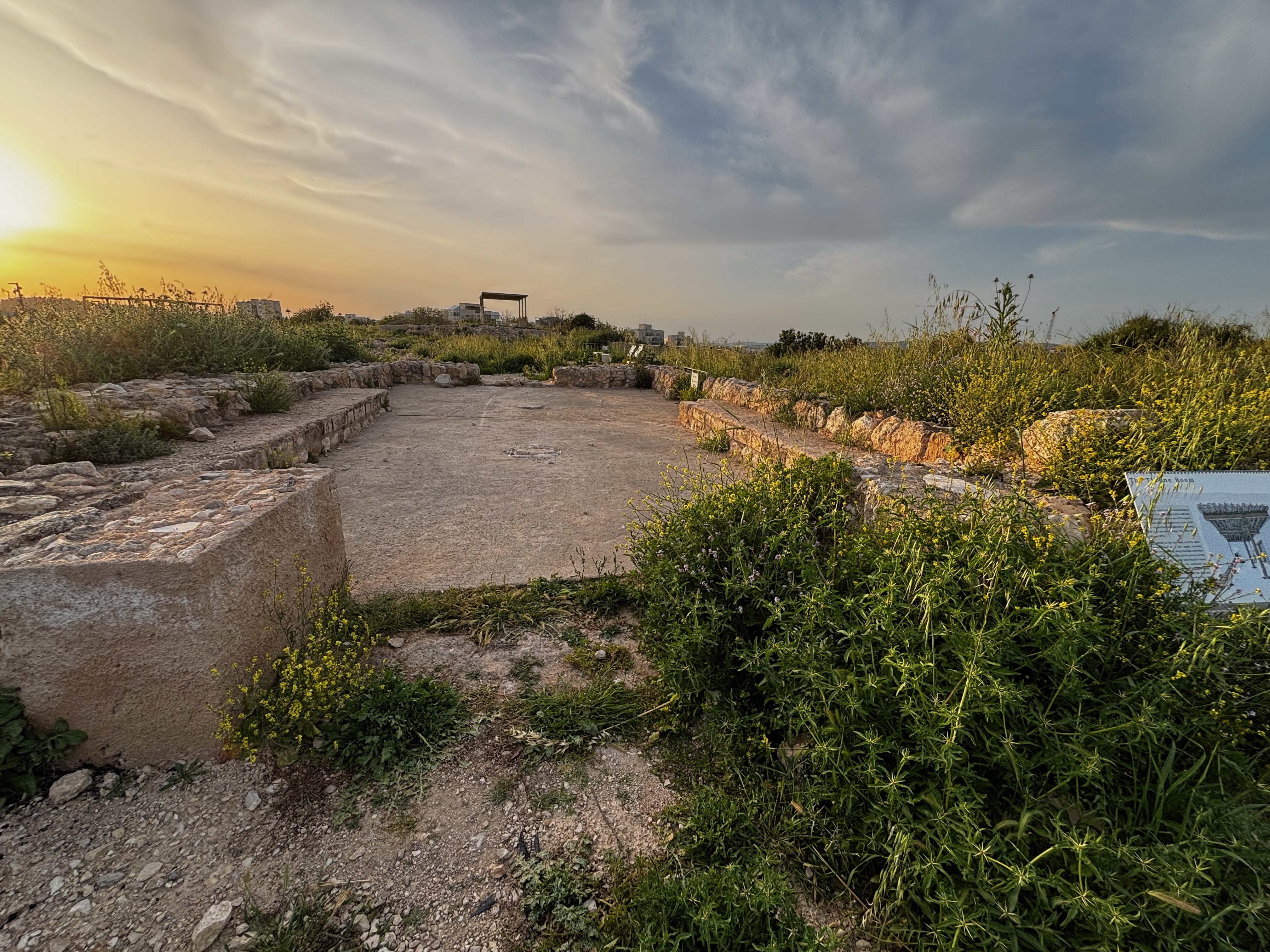
Yesterday was Yom HaShoah. To clear my head, I went for a jog up Tel Yarmut—an archaeologically significant hill about five minutes from my home. It contains the ruins of a Bronze Age Canaanite city and even gets a passing mention in Joshua 10 as an Amorite city.
The hill is quiet, almost pristine, a stark contrast to the urban sprawl of Greater Beit Shemesh. I didn’t go there for any particular reason, but while jogging, a thought popped into my head:
To be a Jew is to be hopeful.
That’s it. That was the thought. Not much of a thought, really. What — you were expecting a pithy, Nietzschean aphorism?
For context, earlier that day I had watched an interview between Jonathan Sacerdoti and Martin Stern, a Holocaust survivor originally from the Netherlands.
Martin’s story is both harrowing and profound. But as the interview progressed, two things became clear. First, Martin identifies deeply as Jewish and with the plight of the Jewish people. Second, Martin is not (or at least, by all appearances at the time, was not) what we would call “halachically Jewish.”
That combination should feel strange. For some, it’s immediately disqualifying. If “Jewish” is a strictly defined category, and Martin doesn’t fall into it, then whatever else he may be—sympathetic, admirable, even heroic—he is not “one of us.”
And yet, watching him speak, that conclusion felt… off.
Martin was persecuted as a Jew. He suffered as a Jew. He identifies as a Jew. At some level, he lived the Jewish story at its darkest point. To say that this has no bearing on the question of belonging—that it is entirely irrelevant because of a technical definition—requires a kind of flattening that I find difficult to accept.
I’m not trying to rewrite definitions or blur lines that exist for a reason. But the technical definition felt incomplete. As if something real was being left out of the picture in order to preserve clarity.
The Tax of Ketia bar Shalom
I am reminded of the tale of Ketia bar Shalom in Tractate Avoda Zara 10b.
Ketia was a Roman official under a King who sought to destroy the Jews. Ketia stood against the decree, outmaneuvering the King’s logic. For this “victory,” he was sentenced to death.
As they were seizing him, a certain matron said to him: “Woe is the ship that goes without having paid the tax.”
With that, Ketia bent down, severed his foreskin, and said: “I have paid my tax; I will pass and enter!”
A Divine voice emerged and declared that Ketia bar Shalom was destined for the World-to-Come. When Rebbe (Yehuda the Prince) heard this, he wept, saying: “There is one who acquires his world in a single moment.”
Rashi’s commentary makes the point sharper:
Without the toll: Meaning, woe is you—since you are being killed because of them [Israel], and yet you have not circumcised yourself to receive your reward with them.
Ketia bar Shalom was not born a Jew. He was not, by any procedural standard, what we would call halachically Jewish. And yet, in the moment of his death, he identified himself completely with the Jewish people.
The Gemara does not treat this as mere sympathy. It treats it as something far more consequential. The matron’s critique wasn’t that he was an outsider looking in; it was that, having already cast his lot with the Jewish people through his suffering and his stance, he had not yet physically acknowledged the “tax” of a reality he already inhabited.
A quick aside
Enjoying this post?
Come along on WhatsApp or Telegram — new posts, reflections, and the occasional spiral.
The Map and the Terrain
One can attempt to force this story back into a comfortable framework—to suggest there must have been a beit din present, or that this constitutes a post-facto halachic conversion.
But that reading feels less like an explanation and more like a defense mechanism. It assumes the categories must be complete, and that any deviation must be reconciled at all costs.
The alternative is to take the story at face value: as a glimpse into a reality where belonging to Am Yisrael is not fully exhausted by the formal structures that govern it.
- Halacha is the map. It requires borders to function. It provides the clarity we need to act.
- Existence is the terrain. It is often wider and more complex than the map allows for.
To insist that Martin Stern’s experience has no bearing on the question of “belonging” is not an act of fidelity to Halacha. It is an act of conceptual flattening. We risk confusing the map with the totality of reality. When we do that, we blind ourselves—not only to people, but to the nature of life itself.
The View from the Hill
Standing on Tel Yarmut, none of this was structured in my mind. I was just running.
Parts of the hill are marked. There are signs—fragments of walls identified, rooms labeled, a rough sense of what once stood there. Enough to orient you. Enough to say: this was something.
But most of it isn’t like that. Most of the hill is covered in grass and lilac and weeds. The outlines blur. You know you’re standing on top of something ancient and significant, but it doesn’t fully present itself to the “labels.”
It’s beautiful precisely because it isn’t curated. A few minutes away, the city of Beit Shemesh feels defined. Built for use. Everything in its place. On the hill, you are aware of more than you can account for.
I think that contrast was why the thought stayed with me. To be a Jew is to be hopeful—perhaps because we believe that even the parts of our story that don’t fit into the “city limits” of our definitions are still part of the hill. They still belong to the land.