The Space Between the Claps
“The time in between my clapping is ma.”
— Hayao Miyazaki, speaking with Roger Ebert
I’ve gotten interested in Studio Ghibli films over the last few weeks. Recently I watched Spirited Away, and last night I watched The Boy and the Heron. Both left me with a lingering sense of calm. Their worlds are strange and sometimes frightening, but after the screen went dark, something in me had settled.
I found myself wondering where that feeling came from.
The animation is beautiful, of course. But I kept returning to the stretches where very little happens. Chihiro sits on a train traveling across an enormous expanse of shallow water. We sit with her. There is time to look out the window, to notice the other passengers, to feel the distance she is traveling.
The film lets the experience unfold without immediately explaining it or moving us along.
Miyazaki calls this interval ma (間). In his conversation with Roger Ebert, he illustrated it by clapping his hands. The space between the claps gives the action its rhythm. Without breathing room, action becomes busyness.
Those pauses gave everything else room to register. The quiet stayed with me, and it brought me back to things I had learned long before I encountered Miyazaki.
A field where something can appear
I’ve been reading Keiji Nishitani and the Kyoto School philosophers. Nishitani writes about the “field of emptiness,” kū no ba (空の場). The word ba (場) means a place or field.
The field is important. It is the place where something can appear, where something can grow, where a building can stand. Its openness allows something to take form.
Nishitani’s account of emptiness challenges the standpoint from which we experience ourselves as subjects confronting a world of objects. One aspect of that challenge has stayed with me: we can become so occupied with what everything means for us that we leave very little room for anything to reveal itself.
We enter a room and begin arranging it around ourselves. We enter a conversation and start preparing our reply. We encounter an unfamiliar idea and immediately decide where it belongs.
Sometimes we need to wait.
That is what I experienced watching Chihiro’s train cross the water. The film gave me time to encounter something before deciding what to do with it.
The interval, ma (間), gives an experience room to develop. The field, ba (場), gives something a place to take form. Both matter to what becomes possible.
What Rav Schechter taught me
I learned several passages in Rav Hutner’s Pachad Yitzchak with our Rosh Yeshiva, Rav Aharon Schechter. What I remember clearly is the understanding he impressed upon me: the letters are the building blocks of existence.
We ordinarily think of letters as marks we combine into words, and words as tools for describing a world that already exists. The Torah’s account of creation through divine speech, and the treatment of letters in Sefer Yetzirah, ask us to think more deeply. Creation was given expression through utterance. Language belongs to the constitution of the world.
That changed how one thinks about letters. Their shapes and relationships were worth attending to because they expressed something underlying existence itself.
The letters’ grammatical functions offered another way to notice these relationships: where something comes from, what receives an action, and what exists within something else.
I also remember learning to notice how a letter’s significance can find expression in its grammatical function.
A prefixed mem (מ), meaning “from,” points toward an origin: the place from which something emerges. In “Min ha-mayim meshitihu” (מן המים משיתיהו)—“I drew him from the water”—the water is the source from which Moshe is drawn. In “Mekimi me’afar dal” (מקימי מעפר דל)—“Who raises the poor from the dust”—it is the mem (מ) of me’afar (מעפר) that marks the point of departure. I associate this with the maternal image: a child comes forth from a mother.
The nun (נ) in forms such as nistar (נסתר), “hidden,” and nivra (נברא), “created,” directs my attention toward what receives an action. There is the borei (בורא), the creator, and the nivra (נברא), that which is created.
The letter bet (ב) expresses containment in grammar too. As a prefix, be- (בְּ־) means “in”: something exists within something else. In babayit (בבית), “in the house,” the grammatical function and the image come together—a place with an interior, and something dwelling within it.
As I remember the teaching, these grammatical relationships helped disclose something of the letters themselves: origin and emergence, acting and receiving an action, a place and what it contains. Grammar became another place to look for the patterns through which existence takes form.
This understanding remained with me even when I wasn’t consciously thinking about it. Years later, a Japanese film sent me back to it.
Seeing and hearing
We often describe truth in the language of sight. We “see the point.” An explanation becomes “clear.” We want to stand somewhere from which the whole thing can be surveyed.
There is real power in that. There is also a temptation to believe that once we have seen something, the work of understanding it is finished.
The Gemara gives a striking example (Rosh Hashanah 26a). In explaining Rabbi Akiva’s rule that a witness cannot become a judge, it says that in capital cases the court is commanded to search for grounds to acquit (“v’shaftu ha-edah… v’hitzilu ha-edah,” ושפטו העדה והצילו העדה), but judges who have themselves seen the killing are unable to find them: “v’cheivan d’chazyuhu d’katal nafsha lo matzu chazu leih zechusa” (וכיון דחזיוהו דקטל נפשא לא מצו חזו ליה זכותא). The impression of what they saw can become so forceful that it crowds out the deliberation still required of them.
“I saw it myself” can close a conversation.
Hearing has a different character. A sentence takes time. Someone else has to finish speaking. Their next words may change your understanding of the first ones. You may need to ask a question, reconsider, or listen again.
To hear someone, you have to be quiet enough to hold their voice.
That helps me understand why shemi’ah (שמיעה) occupies such an important place in Torah. Shema (שמע) asks something of the person being addressed. We have to receive what comes to us before we can respond.
Seeing the sounds
At Sinai, the Torah brings these two senses together in an extraordinary phrase:
“V’chol ha’am ro’im et ha-kolot.” (וכל העם רואים את הקולות)
All the people saw the sounds.
Chazal describe the people’s souls departing with each divine utterance. The encounter was more than they could bear.
I find myself thinking about this through the distinction between seeing and hearing. What happens when speech reaches someone with the immediacy and force we associate with sight? When there is no distance in which to consider it, no interval in which to gather oneself?
The Torah elsewhere emphasizes that at Sinai the people heard a voice and saw no form. I understand the language of sight here as expressing the overwhelming certainty of the encounter.
Their request to Moshe moves me:
“Daber atah imanu v’nishma.” (דבר אתה עמנו ונשמעה)
You speak to us, and we will hear.
They needed mediation. They needed the revelation to reach them through a human voice, in a way they could receive and survive.
This is how I find myself reading their request. Truth can exceed our capacity to bear it. Receiving it requires something of the recipient, and sometimes it requires someone who can help make reception possible.
Moshe could stand where they could not.
And Moshe said:
“V’anachnu mah?” (ונחנו מה)
What are we?
Man and Mah
The manna belongs to this discussion too. When the Jewish people first encountered it, the Torah says:
“Vayomru ish el achiv man hu, ki lo yad’u mah hu.” (ויאמרו איש אל אחיו מן הוא כי לא ידעו מה הוא)
They said to one another, man hu (מן הוא), because they did not know mah hu (מה הוא)—what it was.
In my memory of the discussion, the difference between man (מן) and mah (מה)—the nun (נ) and the heh (ה)—was important. As I understood the teaching, man (מן) expresses the attempt to identify something, to give it a determinate place among the things we know. Mah (מה) opens onto what has not yet been fixed within those categories.
This is a reading of the letters, reaching beyond the ordinary translation of the verse.
The manna came from beyond the familiar order of their lives. They encountered it before they knew how to name it. Receiving it meant living with a gift whose nature they had not already mastered.
This gives another dimension to the teaching that Torah was given to those who ate the manna. Receiving Torah requires a capacity to encounter something before we have fitted it into what we already know.
Chazal distinguish Moshe and Aharon’s “What are we?” from Avraham’s “I am dust and ashes.” Even dust and ashes name something. Mah (מה) goes further.
The teaching I carried away from learning with Rav Schechter was that Moshe’s humility belonged to his capacity to receive Torah. It concerned his fundamental stance toward what came from beyond himself.
Moshe had convictions. He argued, acted, led, and carried responsibility. His humility did not prevent any of that. But his own importance did not have to occupy the whole field.
There is also the Torah’s explanation of his name: “Min ha-mayim meshitihu” (מן המים משיתיהו)—I drew him from the water. Water takes the shape of what holds it. For me, that becomes another image of receptivity: the ability to encounter something without immediately forcing it into the shape of one’s own expectations.
Then there is Miyazaki’s ma (間): the interval that gives an action room to register.
The interval between the claps and Moshe’s mah (מה) began to illuminate one another for me. Both brought me back to the space in which something can be received.
The same pattern brings imma (אמא), mother, and abba (אבא), father, to mind. This too comes from Rav Hutner, as I remember it.
The womb offers an interior in which life can grow. Its openness is a capacity: it can receive, hold, nourish, and allow something to develop. The seed introduces the beginning of a life that can take form there.
In this image, the feminine and masculine belong to one generative relationship. There is a place that receives and a contribution that enters it. Life develops through their encounter.
The maternal image brings together two things I have been considering: an interior that holds life, and an origin from which life emerges. The paternal image brings the seed from which something can be built. I hear the sounds of imma (אמא) and abba (אבא) alongside mah (מה) and bah (בָּהּ), and find myself returning to the relationship between receptivity and formation.
This is how the sounds and images speak to me, rather than a claim about the historical derivation of the words.
An empty womb can become a place of life. An open field can support a building. A pause can allow a feeling to develop. The space inside a letter helps give the letter its form.
Once I begin looking with the understanding Rav Schechter taught me, these cease to feel like unrelated examples.
The house inside the mouth
In the familiar Ashkenazi scribal form of peh (פ), the white space inside the letter takes the shape of a bet (ב).
Peh (פה) means mouth. Bet (ב) brings to mind bayit (בית): a house, a place with an interior.
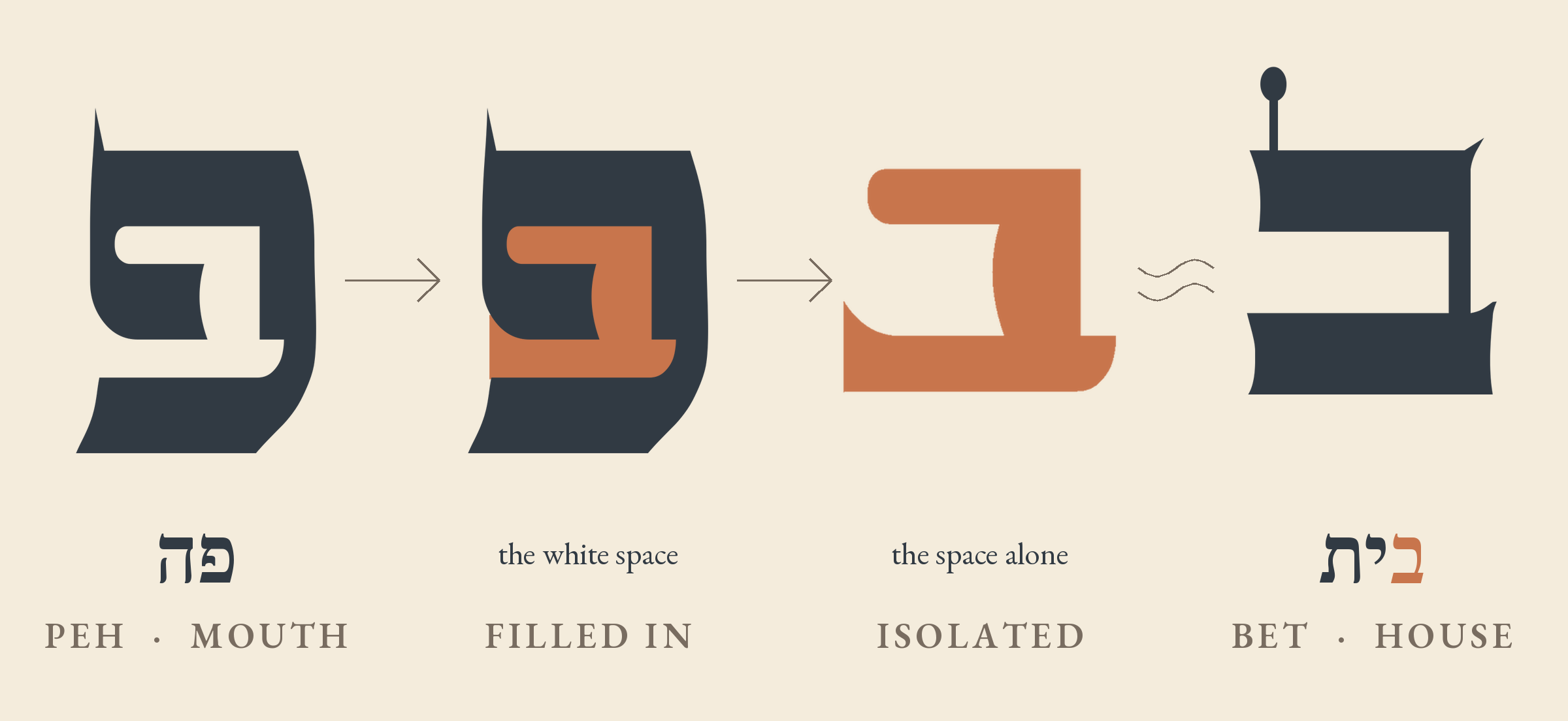
The mouth contains a house.
And bet (ב) is also the opening letter of Bereshit (בראשית). The Midrash asks why the world was created with this letter. Creation begins with a bet (ב); the letter of speech contains a bet (ב) within it.
Through what Rav Schechter taught me, the space within the letter deserves attention too. The white parchment and the black ink together make it readable.
This brings me back to Nishitani’s ba (場), the field, and to the Hebrew bah (בָּהּ): “in her” or “in it,” when the thing referred to is feminine.
The Japanese word names a place. The Hebrew expression places something within another. A bayit (בית) gives that “within” a dwelling, while binyan (בניין), building, brings in the act of giving something form.
The field is the place on which something can be built. A house holds life within it. The mouth gives speech somewhere to form.
The openness matters because of what it makes possible.
Chazal describe three ways the Avot spoke of the place of the future Temple. Avraham called it a har (הר), a mountain. Yitzchak called it a sadeh (שדה), a field. Yaakov called it a bayit (בית), a house.
I associate the following reading with my memories of learning, though I cannot confidently place its source.
A mountain suggests a place beyond settled life. You leave familiar ground to encounter it. That fits something of Avraham, who left his home and stood apart from the world around him.
A field has already entered into a relationship with human life. It can be cultivated. Things can grow there. It holds the possibility of what may develop.
A house takes that relationship further. It is a place you inhabit, where you dwell and belong. What began as an encounter beyond familiar ground becomes somewhere life can be lived.
This helps me understand the connection I am drawing to Nishitani’s ba (場). His field and Yaakov’s house are different images, but both give us a way to think about the place in which something can become present.
The Hebrew bet (ב) expresses this relationship grammatically too. The prefix be- (בְּ־) means “in.” A bayit (בית) gives that “within” a dwelling.
And in the scribal form of peh (פ) we have been considering, that same bet (ב) appears in the interior white space. The letter of the mouth contains a place within it.
The field allows growth. The house allows dwelling. The space within the mouth allows speech to take form.
Hearing across traditions
People sometimes describe different religious traditions as paths up the same mountain, each offering a different view of the summit.
Here, I find myself thinking about listening.
I don’t need Nishitani, Miyazaki, Rav Hutner, and Rav Schechter to become interchangeable. Their differences give me something to think about. A film can help me hear a teaching again. A teaching can help me notice something in a film that I might otherwise have passed over.
I began with a train moving across water. I ended up thinking about Moshe, the manna, the letters of creation, and something Rav Schechter impressed upon me years ago. An encounter with another world brought me closer to something I had carried from my own.
The world was created through utterance. From within the understanding I received from Rav Schechter, I find it meaningful to wonder whether people in very different traditions can hear something of the order underlying creation.
The resemblance between ma (間) and mah (מה), or between ba (場) and bah (בָּהּ), does not prove that. But it gives me something to listen to.